Funds for full-day kindergarten rely partly on performance. Why some question the change
School districts across Idaho may soon have additional funds to offer optional full-day kindergarten.
A bill to use state literacy funds to give districts a full-day option now heads to the House floor for approval after a panel of lawmakers cleared it Monday.
The bill received widespread support from senators last week, but some legislators and education groups question how the funding for the program was set up in the bill, and whether it would punish schools whose students don’t perform as well.
The state now funds optional half-day kindergarten, and many Idaho school districts use a mix of resources to offer a full-day option. Some school districts charge families an additional cost each month to enroll in the full-day option. Others use funds from supplemental levies or other local or state funds.
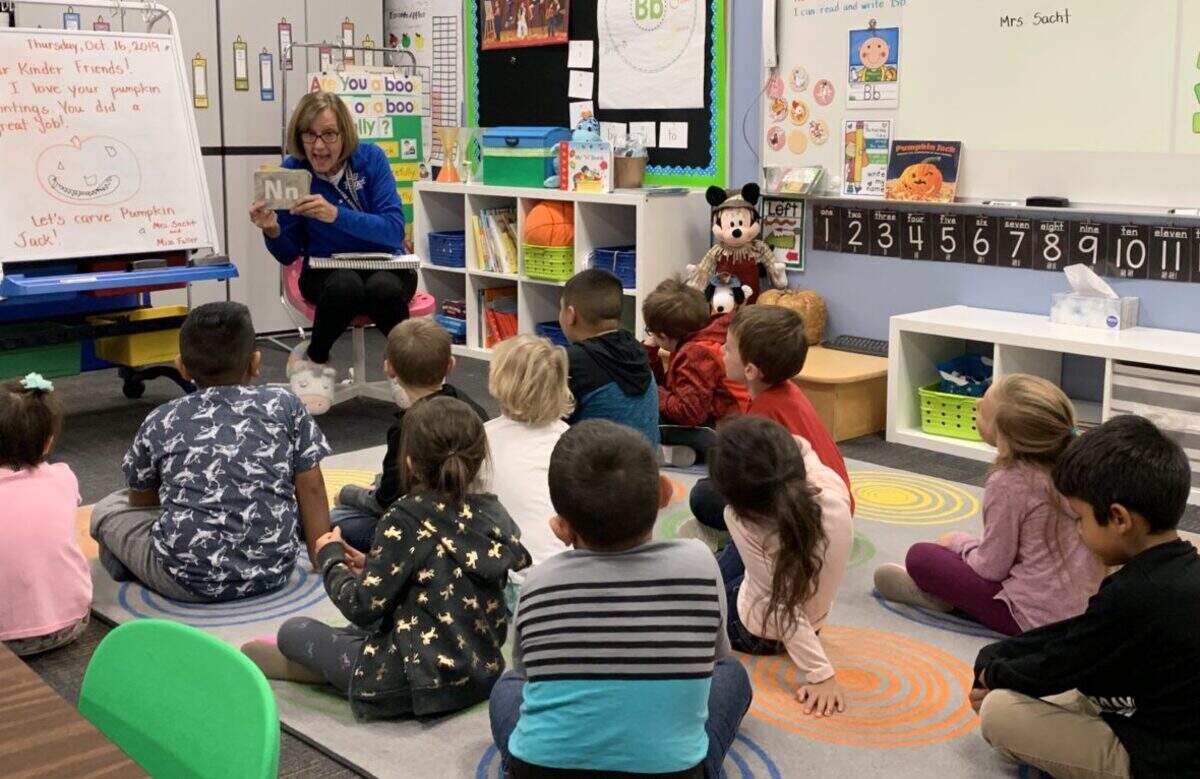
Teachers, administrators and literacy experts say full-day kindergarten improves students’ proficiency in reading and writing and helps ensure kids are ready for first grade. It also gives teachers more time to build on kids’ social emotional skills.
Funding based on enrollment, performance
The bill deals with the distribution of the state’s literacy intervention funds, and removes any ambiguity about whether they can be used for optional full-day kindergarten. Under the bill, half of the funds would be distributed to districts and public charter schools based on enrollment of students in kindergarten through third grade.
The other half would be based on performance. The state would look at the number of students in kindergarten through third grade who either improve or score as proficient on the Idaho Reading Indicator (IRI), Idaho’s statewide reading assessment. The funding formula allots additional funds for economically disadvantaged students who improve or score as proficient.
Previously, schools received more literacy funds if they had more struggling readers.
The state now has about $26 million for early literacy spending. Gov. Brad Little proposed increasing that amount by $46.6 million, for a total of about $72 million.
Sen. Steven Thayn, R-Emmett, who sponsored the bill, did not respond to request for comment Friday. But during a committee meeting, he said the funding formula provides accountability with educational investments.
“This bill strikes a good balance between different views,” Thayn said. “Everybody knows I’m not a real fan of all-day kindergarten, but I know a lot of people are, so who am I to get in the way of anything?”
An earlier version of the full-day kindergarten bill had kept the funding based on enrollment alone, not performance. It would have adjusted the calculations for support units so that students could be funded for whatever their parents choose — a full day or half day of kindergarten.
Senators question performance-based funding
During debate on the Senate floor, some senators raised concerns about the way schools would receive the funding. Although most lawmakers supported the bill, they said they could see legislators having to revisit the issue.
Sen. Janie Ward-Engelking, D-Boise, said she believes the funding formula is somewhat “counterintuitive.” It rewards the school districts whose students make a year’s growth or are proficient, but it doesn’t provide additional resources for those students with a greater need, Ward-Engelking said.
Each student faces unique challenges, she said. For example, some districts could have a higher number of students who are refugees and may speak a different language.
“I want to make sure that we don’t leave those students who need additional resources behind,” she told the Idaho Statesman.
Ward-Engelking also said she’s concerned not all school districts will receive enough money to offer optional full-day kindergarten because of the way the funding is set up. Districts will likely be set for the next few years due to the federal COVID-19 relief funds, but it could become an issue in the future, she said.
She also said that using one reading test to measure growth doesn’t take into account the other benefits students could gain from full-day kindergarten. That can include improving their math skills, or making progress with their social skills.
“We’re just using one test, one measure to decide whether they made the appropriate growth,” she said. “And kindergarten is about so much more than that.”
Still, she said she’s spoken with other senators who agreed to revisit the plan if it wasn’t working. Other senators also said it was difficult to draw conclusions based on one assessment.
“In education, we never use one measurement or one moment in time to tell the story about a child,” said Sen. Carrie Semmelroth, D-Boise, on the Senate floor. “I will be voting yes for this bill. But my concern is that the emphasis on one test for such high-stakes resources for schools could be damaging for kids.”
Sen. Lori Den Hartog, R-Meridian, raised concerns about the previous funding formula, which gave more money to schools when students didn’t score as proficient in reading.
Under that formula, she said, schools that were doing a good job educating their early learners were losing funding.
“I think this particular piece of legislation strikes a good balance between what we intend to invest in as a state and allowing our local school districts to decide what works for their communities and for their kids,” she said.
Bill gets support from education groups, with some hesitance
Several education groups testified in support of the bill, but some also raised similar concerns about allotting funding based on performance.
Quinn Perry, deputy director of the Idaho School Boards Association, said the group appreciated the work that went into the full-day kindergarten bill, but heard concerns from school business managers, administrators and board members about the “predictability and stability in the new formula.”
“Our concern is that if this passes and it creates instability, that it could create issues with current programs that our communities expect and want,” she told lawmakers. “So my request to this committee in this legislature is that we want to be partners with you.”
Others said although the bill was a step in the right direction, it wasn’t exactly what they were hoping for.
“We are hoping, expecting to have a universal voluntary full-day kindergarten bill that would give our youngest students a sound foundation for the rest of their educational journey,” said Rod Gramer, from Idaho Business for Education. “What we have instead is a compromise bill that is not perfect.”
The troublesome part of the bill, he said, is that it takes funding from districts for students who don’t progress.
“To take money away from serving the most challenged of our students is counterproductive to helping all of our students eventually get to proficiency,” he said.
Sherri Ybarra, state superintendent of public instruction, said funding optional full-day kindergarten had been a priority of hers, and the bill will accomplish that.
“I particularly appreciate that the bill prioritizes services for economically disadvantaged students and that it provides individual districts with the flexibility to develop literacy intervention programs that will best support their students and meet local needs,” she said in a statement.
Editor’s note: This story was updated at 12:22 p.m. on March 15 to mention approval from a House panel.
This story was originally published March 12, 2022 at 4:00 AM.