‘We didn’t bend or crumble’: Boise State president touts resiliency during pandemic
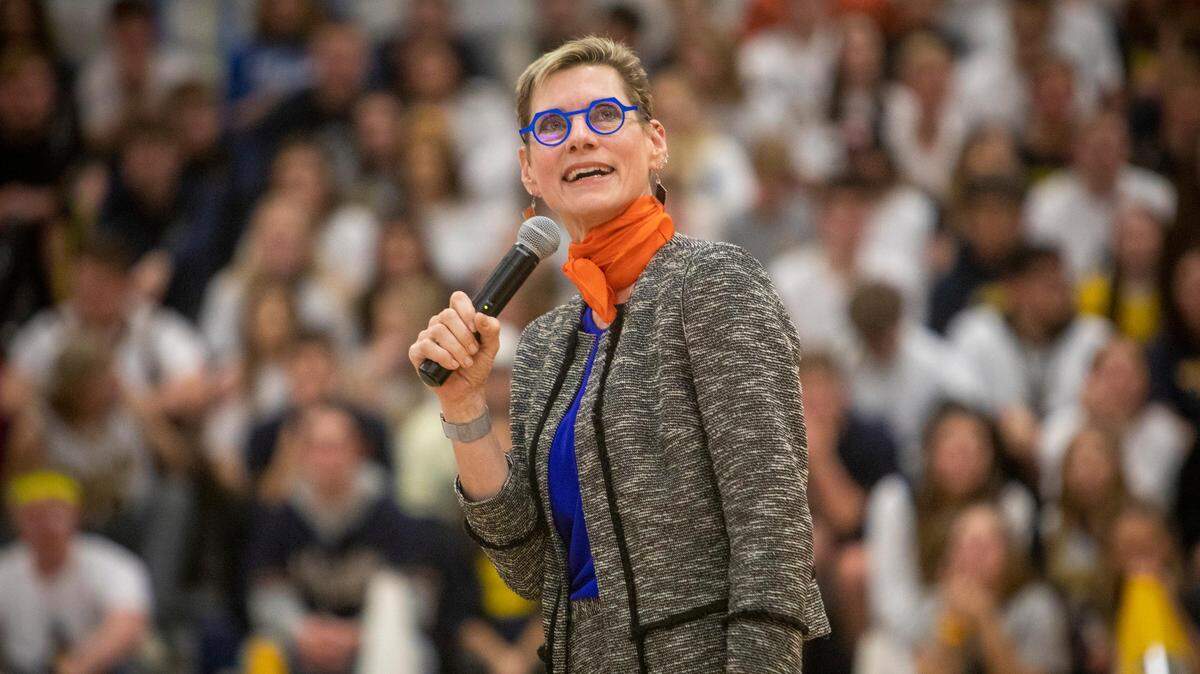
Boise State President Marlene Tromp on Wednesday highlighted the resiliency of the university after a difficult year marked by the coronavirus pandemic and celebrated the school’s accomplishments.
During her annual State of the University address held at Albertsons Stadium, Tromp talked about how Boise State had innovated throughout the pandemic and emerged stronger.
“What we did is we developed new ways to connect with our students. We faced the challenges of this year and we actually built new ways of teaching, new ways of giving service, new ways of supporting our community,” she said, speaking to masked attendees.
“In the face of those challenges, we didn’t bend or crumble. We did more. And we learned things that we’ll take with us into future years that have made us a better university.”
Over the past year, Tromp said, Boise State educated health care workers and gave additional support to teachers as they adapted to a remote learning model. The university also opened a public health office, and held COVID-19 testing and vaccination clinics.
This year, students are back on campus, but masks will be required for everyone indoors as the school year begins.
“We are so happy to be together again,” Tromp said. “And to be able to have our students in the classroom and to give them the experiences that make a college experience really extraordinary.”
This school year is once again likely to be marked by the pandemic in a major way. COVID-19 cases have been surging in Idaho and across the country, and public health officials have been warning about the spread of the more transmissible delta variant.
Boise State — along with the other public universities in the state — is not requiring vaccines for students and staff, but it has been encouraging everyone to get vaccinated to slow the spread of the virus. Along with many states in the South, Idaho has a dismal vaccination rate.
Tromp on Wednesday also talked about the launch of the Institute for Advancing American Values, which she announced earlier this year. The institute will focus on concepts including free expression, free speech and the free exploration of ideas, she said.
“We’re going to focus on dialogue. Haven’t we seen too little dialogue in the last couple of years, where people who disagree cannot talk to each other?” she said. “We’re going to be a model for what it looks like for people to actually be in dialogue, even when they disagree.”
Universities and K-12 schools in Idaho have faced criticism in recent months from Republican lawmakers and others who say they are teaching critical race theory and indoctrinating students. Boise State earlier this year experienced budget cuts after the GOP-dominated Legislature moved to cut funds to universities in an attempt to target social justice programs.
Earlier this year, Lt. Gov. Janice McGeachin announced the creation of a task force to look into indoctrination in Idaho schools and to root out “the scourge of critical race theory, socialism, communism, and Marxism.” The task force will hold its fourth and final meeting next week, at which it is expected to give recommendations and hear from the public. Teachers and students have said they are scared about how the task force could have a negative impact on education in the state.
During her address, Tromp did not touch on critical race theory or the task force, but she said universities are places where difficult conversations can take place.
“It is critical that they do so,” she said. “Because as a country, we are so polarized that we have almost forgotten that it’s possible for us to find our shared humanity, and to solve our common problems together, and Boise State will be a national leader on this front.”
She also highlighted the university’s efforts to be a leader in the area of cybersecurity, its work to reach rural areas of the state and its focus on scholarships.
This year, the university redirected funds and put more than $1 million in new money into scholarships for Idaho students, she said.
“We don’t want finances to be a barrier for students,” she said. “We want every talented student in this state to go on and get their higher education.“
At the end of the speech, in the team’s football stadium, she led the crowd in a Boise State chant, and the BSU marching band came out for a performance.
“Our impact as a university, our special location, our special character, who we are as an institution will not just make an impact on Idaho,” she said. “It will make an impact on the world.”