West Ada School District heads back to school with masks optional. Could that change?
.png "At an anti-mask protest outside Central District Health last December, one person made their feelings known about schools in the West Ada district.")
Amy Johnson, the chair of the West Ada School District’s board, started off its meeting this week with a hopeful sentiment.
“We are not going to talk about COVID in all of our agendas this year,” she said to an audience full of people dressed in yellow to show support for the district’s mask-optional policy.
In June, the school board voted unanimously to remove a mask requirement from its student handbook for the 2021-22 school year. But under the updated pandemic operating plan, Superintendent Derek Bub was given the “authority to make operational decisions,” which could include putting into place a mask mandate, “if necessary, to mitigate the spread of COVID-19.”
And it could be necessary — at least on a school level, Bub said Tuesday.
In his superintendent update during the board meeting, he presented some grim numbers on the spread of the virus. The number of coronavirus cases and positivity rate have jumped among those 18 and younger, he said, citing data from Primary Health and Central District Health. That means when school starts, the district could quickly be dealing with a situation in which hundreds of students will have to quarantine.
Children do still have a very low risk of being hospitalized or dying from the virus, but they can get sick and spread it.
“Our No. 1 goal … is for our students to be in school five days a week,” Bub said. “We support our parents’ right to choose the protections that they want. When these two items conflict, though, we need support. And these two items may conflict.”
The school district is the largest in Idaho and spans a large geographic area, Bub pointed out, so something that happens in one school may not be happening across the district. West Ada is looking to address the situation on a school-by-school basis, he said. That could mean a classroom or a school could have to wear masks, while others don’t.
“At this time, we highly recommend our kids to have masks,” he said. “Our families need to review the data with their kids and make a decision based on their comfort level. This may change. This is where we stand today … We may have to change course.”
Other options for West Ada parents
During the board meeting, Bub listed a number of other options the school district is exploring to accommodate the parents who want a mask mandate.
One option is creating a classroom where masks are required and students can use the Virtual School House platform with supervision. This would mean children would have somewhere to go during the day — helping to ease that burden on parents — but would also be in a classroom where all of their peers were masked.
The district is sending out a survey to see whether there is interest in a model like that, Bub said.
The district’s principals are also being asked to send out another survey to parents asking whether they would like extra mitigating measures for their child. Those could include asking teachers to help make sure kids wear a mask in the classroom or podding students basked on whether they are wearing masks.
Virtual School House remains an option for all, Bub said.
“If we sit and we think to ourselves, as a family, I never want my kid to wear a mask, I never want my kid to see that again, Virtual School House might be a great option,” Bub said. “If we sit and we say, as a family, I want my kid to be in a mask at all times, Virtual School House might be a great option.”
What the experts say on masks and COVID-19
Experts in Idaho and across the country have warned about the potential for outbreaks in schools given how transmissible the delta variant is and how a small percentage of school-age children are vaccinated.
A few weeks ago, the Centers for Disease Control and Prevention updated its guidance to recommend “universal indoor masking for all teachers, staff, students and visitors to schools, regardless of vaccination status” and masking for fully vaccinated people indoors in “areas of substantial or high transmission.”
The American Academy of Pediatrics similarly recommended that everyone older than 2 should be wearing masks.
The Boise School District changed its policy to mandate masks for students and staff indoors, but so far, other school districts in Idaho have not followed.
Dr. David Pate, former CEO of St. Luke’s Health System, said his advice to school boards and districts is to figure out their objective.
“Is the objective to have all kids in school for full school days every day?” he told the Idaho Statesman in a phone interview. “Or is the objective to have kids not wear masks?”
If children go back to school without masks or social distancing, then it might be short term, Pate said. According to the most recent data from the state, only about 24% of those 12-15 in age and 32% of those 16-17 have received at least one dose of the vaccine — the lowest shares among all age groups in the state. A vaccine has not yet been approved for those younger than 12.
The delta variant is “very, very different” than what schools dealt with last year, Pate said.
“We know what delta does,” he said. “All we have to do is look around to the other states in the country that have opened schools and haven’t had mask requirements, and what we’ve seen is those outbreaks occur in the first week, often in the first few days.”
Pate pointed to a school district in Arkansas that opened without a mask mandate and had more than 800 people in quarantine within days of opening.
Given the rise in cases and hospitalizations, he asked: “How do you put this all together and think it’s going to be anything other than a disaster?”
Confusing ‘personal freedom with public health’
Few youngsters who get the virus are hospitalized, said Dr. Kenny Bramwell, St. Luke’s Children’s System medical director, during a media briefing Wednesday.
“If all of us are focused just on the patients in the hospital, we may miss the boat just a bit, as far as how many patients get this illness, and unfortunately, how many patients spread this illness,” he said.
If children get the virus in school, they will bring it home and pass it on to friends or family who may be more vulnerable or unvaccinated, Pate said, and that could overwhelm hospitals.
“I think we’re making this a lot harder than it is. I get it, that people don’t like wearing masks. I don’t like wearing a mask,” he said. “But it sure beats having COVID or being in the hospital, and we’re just not past it.”
Bramwell said people are confusing “personal freedom with public health.”
“They feel that wearing a mask is an infringement on their rights, and they are going to make a statement and show that they’re just not going to comply with that,” he said. “That is, unfortunately, great news for the virus and bad news for our collective health.”
Masks aren’t a perfect solution and won’t prevent all outbreaks, Pate said, and there could still be problems even if school districts follow all of the available mitigation strategies. But he believes masks are the state’s “best shot.”
“We can talk all day about how psychologically traumatizing it is for a child to wear a mask,” he said. “But no one talks about how psychologically traumatizing it is for a child to know that they infected a parent, and their parent is now in the hospital or a parent has now died.”
Mask pushback on both sides
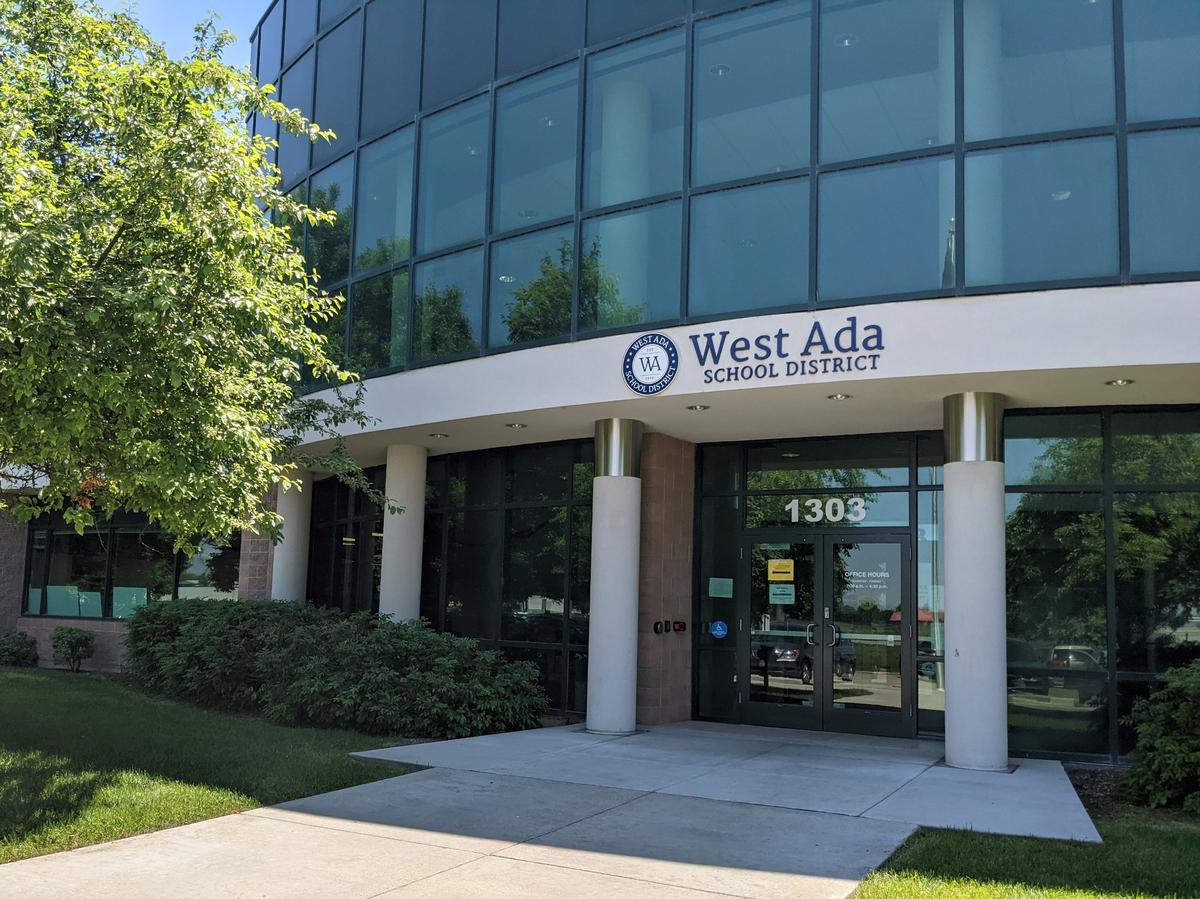
The school district is facing pushback on both sides of the issue. At the meeting Tuesday, people dressed in yellow filled the seats in the room and lined the walls. They held signs reading “Keep masks optional” and “We support Dr. Bub.”
Toward the end of the meeting, David Binetti, who earlier this year started the Smile West Ada group, handed Bub a large stack of nearly 500 letters representing parents who wanted to be able to choose whether their kids wore masks in schools.
“They’re remarkably positive and forward looking and supportive of the superintendent,” Binetti said.
Binetti, who has since started the West Ada Parents Association, said they are still advocating for “full time, in person, all smiles.” The organization includes more than 900 parents, Binetti said. On its website are hundreds of messages from parents thanking the superintendent for allowing them to have a choice.
Binetti pointed to the low death and hospitalization rates for children who get the virus. Vaccines have also been largely found to prevent more severe symptoms and hospitalizations from the virus.
“It’s really unfair for children to suffer because some adults don’t want to get vaccinated,” Binetti told the Idaho Statesman.
Instead of looking at spread within the community, he said the focus should be on issues such as morbidity. If another variant develops that has a different impact on children, he said parents would “support any and all actions required in favor of safety.”
For parents who aren’t comfortable sending their children to school, he suggested the Virtual School House.
But on the other side, some parents are pushing for a mandate.
A Facebook page — the West Ada Community for Health and Safety — for parents, residents and staff “looking for safety protocols to be followed at West Ada” has about 250 members, and a petition supporting masks was signed by more than 450 people.
Jennifer Wamsley, who has a son in the district, said she is immunosupressed and her husband is immunocompromised. They are vaccinated, but they still worry about how the virus could impact them, their son — who’s too young to get vaccinated — and the community.
Her son is planning to do the Virtual School House option for the upcoming year so he doesn’t have to be in a classroom without masks. When they were making the decision, she and her husband sat down with their son, and showed him information on the infection rates and vaccine rates in the state. His best friend, though, is going back to school in person.
“He’s not going to get to see his best friend for a year because West Ada can’t get their act together and do what is best for the children,” she said. “Schools will become super-spreader places if they do not put in a mask mandate.”
Tough decisions on school for parents
Wamsley also worries that kids who go to school with a mask will get bullied. She is urging the district to mandate masks.
“It’s not hard to put a mask on your face,” she said.
Amanda Allard-Korell, who has a daughter entering first grade, is also scared to send her child back to school without masks. Her father has cancer. A few years ago, he had a stem-cell transplant, which she said “erases your immune system.” He is currently in treatment. He was vaccinated against COVID-19, but he “likely has little to no protection” because of his condition, she said.
She and her daughter live in the same neighborhood as him, and her daughter sees her grandparents daily. Last year, her daughter did the Virtual School House option, but it was difficult.
Now, Allard-Korell said she is making the decision of whether her daughter should go to school, and potentially get sick and infect her grandpa, or attend the Virtual School House again, which can be hard on her social and emotional health.
“I am just incredibly, incredibly concerned that she is going to catch COVID at school and give it to my dad,” she said, choking up. “I could never live with myself if she gave my dad COVID and he died, because he’s been fighting so hard for the past three years to stay alive for us.”
She said she and her family have been very careful. They don’t eat inside restaurants, they still wear masks and they haven’t done many of the typical summer activities that bring crowds of people.
“I can’t believe that anybody would take a chance on their child’s health,” she said. “Because I don’t think anybody really knows or understands this disease yet.”