Kohberger defense expert says police mishandled key evidence in Idaho murder case
AI-generated summary reviewed by our newsroom.
- A forensic expert for the defense alleges an evidence chain of custody log was fabricated.
- The Idaho state crime lab found DNA on the knife sheath later confirmed as Kohberger's.
- Kohberger pleaded guilty in 2025 to four counts of first-degree murder and received life.
The pivotal piece of evidence that tied Bryan Kohberger to the Moscow crime scene changed hands several times among law enforcement before it arrived for lab testing, and may have been challenged at his murder trial over its documentation.
Forensic scientist Brent Turvey, who worked as a crime scene analysis expert for Kohberger’s defense team, alleges that police mishandled the knife sheath found inside the King Road house where four University of Idaho students were fatally stabbed in November 2022. A week after the killings, the Idaho State Police crime lab in Meridian located on the leather sheath a single source of male DNA later confirmed to be from Kohberger.
But prosecutors are tasked with proving the authenticity of evidence in court, including through its chain of custody with police, for an item to be admitted at trial and considered by a jury. That chain for the knife sheath in the Kohberger case appeared to Turvey to be legally insufficient, he told the Idaho Statesman.
His conclusion created a possible opening for Kohberger’s defense to prevent the sheath — and the DNA found on it — from being introduced at trial, Turvey said. If proved in court, it could have been monumental for upending the prosecution’s case against Kohberger.
“The chain of custody with it on the outside is supposed to have one signature for every person that’s handled it,” Turvey said in a phone interview. “With each trade-off, from this person to this person, there should be two sets of writing for each.”
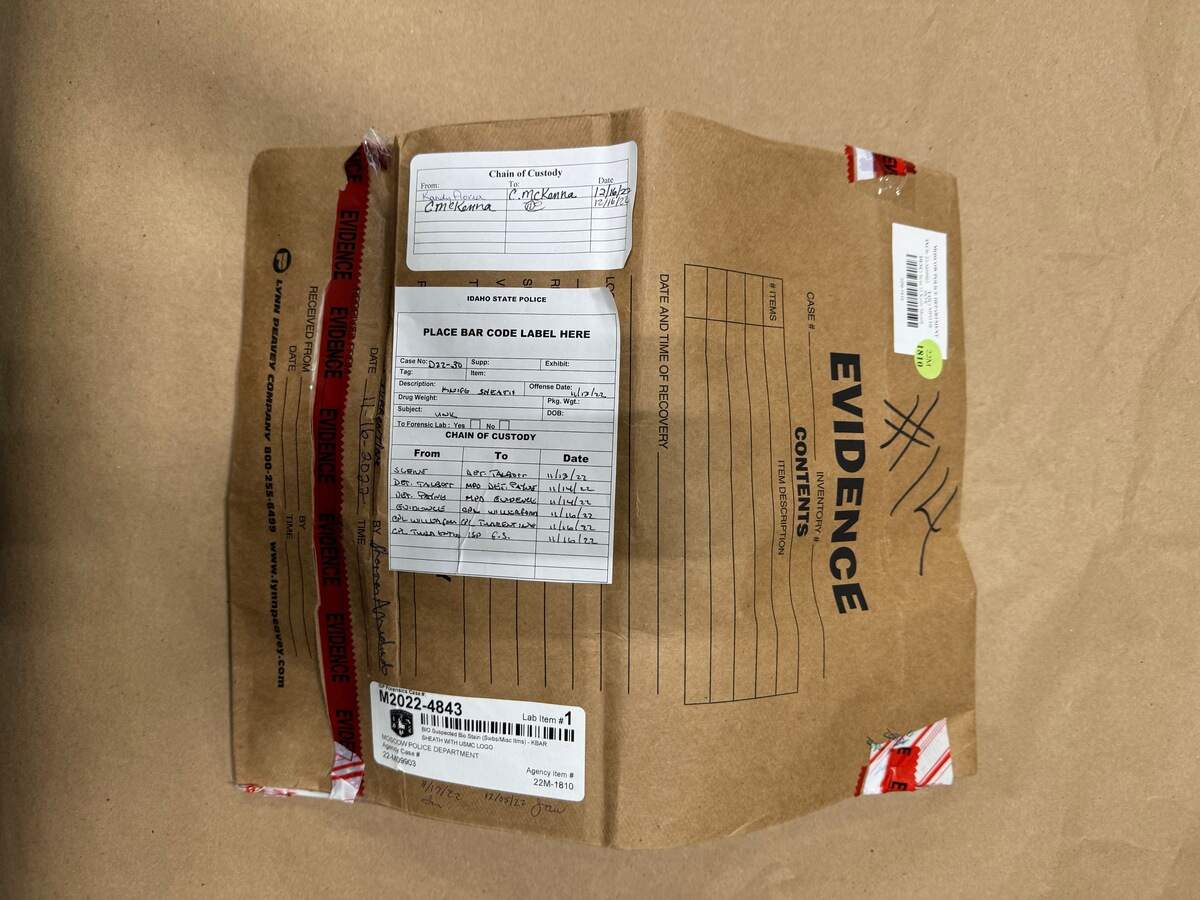
But the evidence bag for the knife sheath lacked those required signatures, he said. The chain of custody was documented by a single person after the fact when the knife sheath came through the state crime lab, which he called “manufactured.”
“Somebody sat down and fabricated and falsified evidence for the chain of custody,” Turvey said.
Veteran criminal attorneys in Idaho who spoke to the Statesman rejected the premise of Turvey’s assumptions — both generally, and specific to the knife sheath evidence in the Kohberger case. And police involved in the case did as well.
Regardless, Kohberger’s murder case never went to trial.
Last July, Kohberger, 31, pleaded guilty to four counts of first-degree murder in a plea agreement that allowed him to avoid the death penalty. The former graduate student of criminology at Washington State University in nearby Pullman, Washington, was handed four consecutive life sentences in prison with no chance of parole, and he also waived all rights to appeal.
The four victims were U of I undergraduates Kaylee Goncalves and Madison Mogen, both 21, and Xana Kernodle and Ethan Chapin, both 20. Detectives never established a direct link between Kohberger and the four victims.
Idaho attorneys weigh in
Following the conclusion of the closely tracked criminal case, ISP released a photo of the evidence bag that contained the knife sheath when it arrived to the lab on Nov. 16, 2022. It includes redactions over the names of the ISP trooper who hand-delivered it and the evidence specialist who checked it into the lab, and an ISP scannable bar code. The red-and-white evidence seal is unbroken and signed “BP 11/14/22,” which stands for Moscow Police Cpl. Brett Payne, who led the homicide investigation.
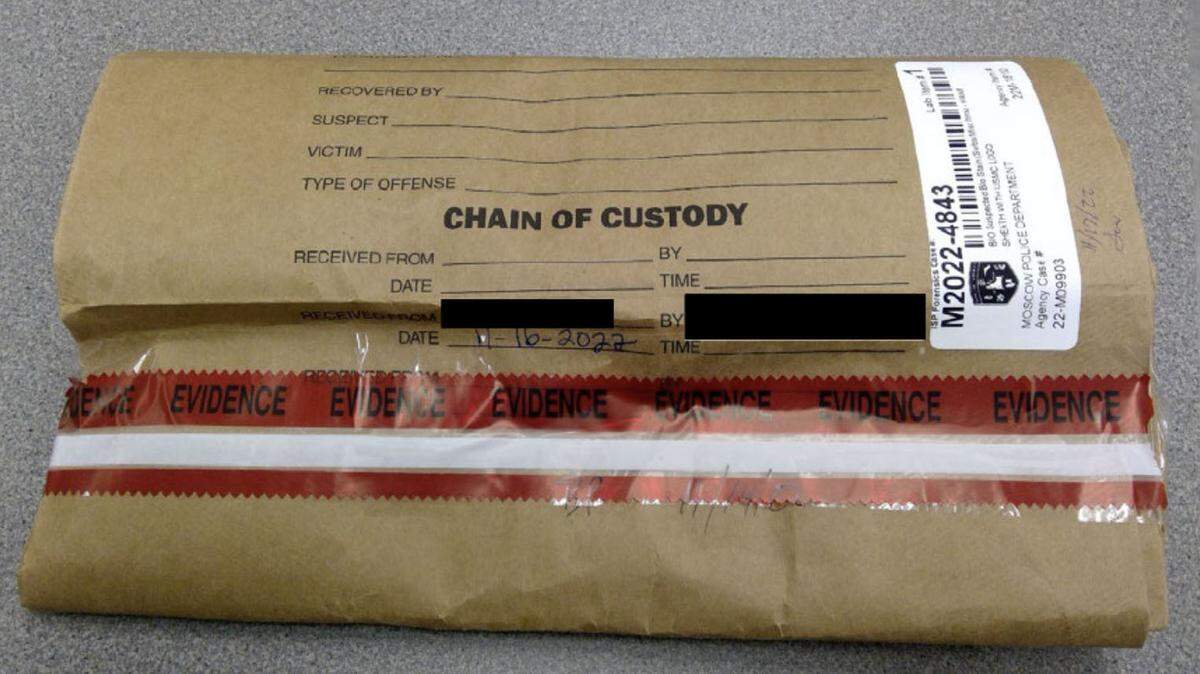
But a different photo of the evidence bag that Turvey said was a state record released to the defense ahead of trial — a copy of which he provided to the Statesman — includes a police chain of custody sticker documenting its path to the lab. It details the knife sheath’s recovery from the crime scene on Nov. 13, 2022, its handoff from an ISP detective to Payne the next day, into Moscow police evidence and then on to two ISP troopers who drove it to the lab on Nov. 16. The photo also shows a Moscow police bar code and green sticker with an evidence number on the bag’s opposite flap.
The second image was “deliberately withheld” from the public despite resolution of the case, Turvey said. It reveals that the sticker to document the police chain of custody was added later, he said.
Regardless of the type of item discovered at a crime scene or its importance to a case, prosecutors must establish the chain of custody for evidence at trial, acknowledged Twin Falls County Prosecutor Grant Loebs, who sits in a leadership role with the Idaho Prosecuting Attorneys Association.
“It doesn’t matter if you found it if you can’t prove what you did with it afterward,” he said in a phone interview. “It has to be secured and handled properly, documented who had it and what they did with it, and who they gave it to.”
It’s not uncommon for defense attorneys to simply sign off that the chain of custody is in order to save time and move proceedings along, Loebs said. That’s because, if necessary, a chain of custody can be affirmed in court through the testimony of each person who handled the evidence while in police possession in the absence of a specific log with individual signatures, he said.
In his more than 30 years of experience as an attorney in the state, Loebs has seen what he called a legitimate challenge in court to the chain of custody for a piece of evidence “almost never.”
“Police know this is a big issue, and are generally very careful about it,” he said. “They never know if a piece of evidence is key. Sometimes it’s obvious, but not always, so they have to treat everything like a key piece of evidence.”
Edwina Elcox, a longtime criminal defense attorney in Boise, agreed that chain of custody objections rarely succeed. Much of police evidence gathering and preservation is “absolutely standard” protocol, and members of law enforcement can be called to the stand to testify about their individual role possessing an item from a crime scene, she said.
“As long as chain of custody can be established, the court is going to allow evidence to come in,” Elcox said in a phone interview. “The reality is when there is a procedural flaw — that there’s something police are supposed to do and policies dictate best practices or it is required — does that necessarily exclude evidence when those things don’t happen? No, it doesn’t.”
The Latah County Prosecutor’s Office, which led the criminal case against Kohberger, declined to comment.
‘Not a game-ender’
Turvey said he raised his concerns about the retroactive police chain of custody for the knife sheath to Kohberger’s defense team, led by public defender Anne Taylor. The backdated evidence bag sticker represented criminal evidence tampering, false reporting and professional misconduct, he alleged to the Statesman.
Moscow Police Chief Anthony Dahlinger — a captain in charge of the city department’s detectives at the time — said his agency, in collaboration with state police, met the legal requirements for processing the King Road crime scene. That included the needed documentation for individual pieces of evidence such as the knife sheath, he told the Statesman in a phone interview.
The local department hasn’t documented evidence chain of custody with handwritten notes in a log for at least a decade, Dahlinger said. Instead, Moscow police rely on electronic bar codes and green stickers with evidence numbers, and that system worked in this case, he said.
The Idaho State Police did not respond to the Statesman over several days to meet a requested deadline.
“The main thing is the integrity of the packaging to show clearly that the seal and signature has no cuts, scrapes or tears,” Dahlinger said. “From my knowledge and experience, this is not a game-ender for that piece of evidence.”
Dahlinger was unmoved by Turvey’s assertions that the knife sheath could have been withheld as evidence if Kohberger’s case had gone to trial, or that it would have changed the end result of a successful prosecution.
“We followed the facts and the evidence showed that one person did this,” he said. “One person did it, and he admitted to it. To me, it’s pretty cut and dry. We saw zero evidence of anybody else being involved.”
In the days after Kohberger pleaded guilty just weeks ahead of trial, Taylor held a meeting with a group of defense experts helping on the case, including Turvey, to explain why Kohberger took a plea deal with the prosecution, Turvey said. He’s still never received a “straight answer” from Taylor and her defense team about that decision, he said, nor about the evidence chain of custody issues he said he presented.
Taylor did not respond to an email request for comment Thursday from the Statesman.
Taylor and fellow case public defender Elisa Massoth are scheduled to give a two-and-a-half-hour presentation at the Idaho Association of Criminal Defense Lawyers annual event on Saturday in Sun Valley titled, “Lessons learned from Kohberger.” The paid event requires attendees to pledge to keep all information confidential and agree not to share anything except with those involved in legal defense.
Even if the defense in the case sought to challenge the knife sheath over a perceived chain of custody procedural issue, it would not have impacted whether it was admitted at trial, Elcox said. Instead, it would have been left to jurors to decide how much weight to place on the piece of evidence as they deliberated over Kohberger’s guilt beyond a reasonable doubt, she said.
“The defense could theoretically make something of that and say that they’re supposed to document it this way,” Elcox said. “You can argue all of these things, maybe, but it doesn’t preclude admissibility.”
But she expressed doubts such an objection would have gotten Kohberger’s defense team very far at trial.
“Absent something more explosive or concerning, I don’t think this blows up the Kohberger case,” Elcox said. “I just don’t.”
Reporter Sally Krutzig contributed.
This story was originally published April 23, 2026 at 4:28 PM.
CORRECTION: This story has been updated to correct the timeline in which Kohberger’s defense explained the plea deal to a group of its experts retained for his scheduled trial. That meeting was held after Kohberger pleaded guilty.