Sentencing sheds new light on murders that shook rural Idaho last year
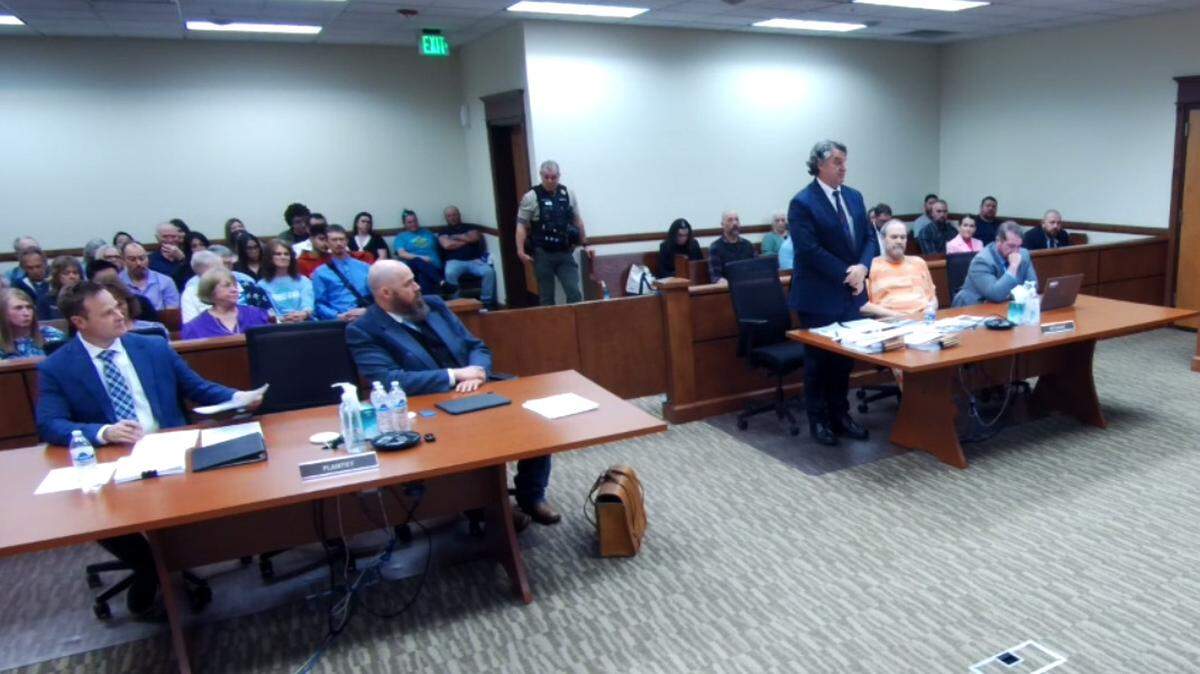
Last July, four people from rural Idaho were murdered by a man who believed he was sent on a mission from otherworldly beings. On Monday afternoon, the victims’ loved ones gathered to watch a judge sentence the 57-year-old at the Cassia County Courthouse.
Fifth District Judge Blaine Cannon sentenced Benjamin Naylor, of Burley, to four fixed-life terms on four counts of first-degree murder, meaning Naylor will spend the rest of his life in prison without the possibility of parole.
Prosecuting attorneys from Cassia and Minidoka counties said they chose not to pursue the death penalty to spare family members from having to go through a lengthy appeals process, which could have dragged on for years because of Naylor’s mental illness.
Naylor was diagnosed with schizophrenia at the age of 23, and his symptoms played a significant role in the murders, according to Cannon.
Judge sheds new light on events, families mourn
Before sentencing him, Cannon walked the courtroom through the chain of events that led to Naylor’s arrest as detailed in the presentencing report:
Naylor began to believe he could communicate with two beings, either aliens or higher powers, through an imagined device implanted in him, according to Cannon. Around July 4, Naylor heard these “imaginary friends” talking about the need to stop local children from being trafficked and sold, the judge said.
“He believes the solution is to kill those traffickers himself,” Cannon explained.
Naylor heard voices telling him that trafficking was happening at Connor’s Cafe in Heyburn, and near that restaurant on an unknown date before July 8, he found 77-year-old Dennis Mix inside a vehicle. Believing Mix to be a security guard for the traffickers, Naylor shot him, the judge said.
Mix’s cousin Milton Banner gave a victim impact statement in court Monday. He said Mix was a talented artist at painting, sculpting, jewelry and carpentry. Mix was also a Vietnam War veteran who struggled with PTSD, drugs and managing his finances. He had been homeless and living out of his vehicle when he was shot.
His cousin said that after Mix’s death, he found a letter from a parent whose son was hit by a car. The letter thanked Mix, a bystander, for his quick thinking to use a stick and a shirt to apply a tourniquet to the victim’s bleeding leg while waiting for help to arrive.
“I’m told by the doctors that had it not been for the fast, efficient and effective action taken by Mr. Mix, my son would have lost his life from loss of blood,” Banner read from the letter.
Banner lamented that Naylor had stolen “all the benefits that these people could give to the world.”
A killing spree in Idaho
Cannon said Naylor went to the post office on July 8, where he saw children who he believed were trafficked get into a car. Naylor tried to follow the car but lost it, and instead began following a different vehicle that the voices apparently told him the children were in, the report said.
Naylor followed the car to a Rupert home where Angela Medina, 35, lived, and she was the next victim. Naylor shot her.
Medina was a mother of four, the youngest of whom was only 11 months old. As part of the plea agreement, Naylor will have to pay child support to Medina’s children.
Isaac Medina spoke in court Monday about losing his wife of 14 years, and he described her as “an angel, pure-hearted and graceful.”
“No man should endure the pain of finding his wife cold and lifeless in the safety of her home,” Isaac said.
In a letter read aloud in court, one of Medina’s daughters said that every day she wishes she’ll hear her mother knock on her bedroom door and ask if she’s ready for school.
The judge said Naylor then left the Medina home and drove until voices told him to stop at a Burley house. Naylor went inside there and shot Kelly Jenks, 66, while he was on the phone with his best friend. He then found Donna Jenks, 62, inside a closet and shot her.
The Jenkses’ daughter, Jerica Harper, said the “emotional impact” of losing two constant presences in her life was “overwhelming.” Harper said she, her husband and young daughter spent every holiday with her parents and would have dinner together multiple times a week.
The Jenkses were in the middle of planning a trip to the Oregon coast because they wanted to show their granddaughter the ocean for the first time, according to Harper.
“(My mom) watched Adalee while I worked, and any other time we needed her, she was there,” Harper said. “My parents were beyond excited to be grandparents.”
Mental health played role in murders
Cannon, as well as the two prosecuting attorneys from Cassia and Minidoka counties, took an unusually personal tone in court as they described how, as community members themselves, they had seen the way Naylor’s crimes had affected the area.
“To see the suffering and pain that you have caused to our community, no sentence justified by man can restore that,” Cassia County Prosecuting Attorney McCord Larsen said. “... Thanks to you, Mr. Naylor, people in my community can’t feel safe in their own homes. How are we going to get over that?”
Law enforcement arrested Naylor during a traffic stop at about 10 p.m. July 8 while he was driving a vehicle that police had linked to the killings. Cannon said Naylor was on his way to kill a Lincoln County sheriff’s deputy, but the voices told him it was OK to cooperate when pulled over by Burley police.
Cannon said that while he understands the role Naylor’s mental illness played in the murders, he felt Naylor was responsible for his decision to go off his medication.
“I’m not saying by that our system is perfect,” Cannon said. “I’m sure it can be improved, but Mr. Naylor had chances to make better choices and to get the treatment that he needed.”
Cannon also said he was impressed by Naylor’s ability to be honest about his crimes since receiving treatment. Naylor said he was “horrified by what I did, and I deserve the punishment that I’m getting.”
“Since I’ve been put on this other medicine, I can see clearly that it was just totally fictitious,” Naylor said. “What was going on in my mind, and that’s not an excuse for taking these beautiful lives, and I hope that by being put away for life with no parole, the victims, families and the community can heal.”
After the sentencing, Larsen and Minidoka County Prosecuting Attorney Lance Stevenson issued a joint statement in which they called for better solutions for addressing mental illness.
Naylor’s daughter, Kayla Makar, told KTVB that she twice requested that Rupert police remove Naylor’s weapons and bring him to a hospital for mental health treatment, but police said there was nothing they could do.
“We as a community have to reckon with how we address mental illness before it reaches the point of tragedy,” the attorneys said in a news release. “We have to fund mental health services. We have to reduce the stigma that keeps people from seeking help. We have to support law enforcement who encounter mentally ill individuals and need better tools and training than we currently provide.”