Where Meridian police chief says officer went wrong in knee-on-neck arrest
Like millions of others, Tracy Basterrechea has seen the videos of a former Meridian police officer kneeling on a young man’s neck during an arrest last June.
He saw the officer, Bradley Chambers, command 21-year-old Samson Allen to take a dirt bike out of the bed of his truck, heard Allen refuse, and watched Chambers take Allen to the ground and begin to press his knee to Allen’s neck.
But Basterrechea has a unique perspective on those events: He’s the man in charge of the police department that hired, trained, and gave Chambers a badge and a gun.
Now, for the first time, Basterrechea is able to speak about the encounter, which went viral in September and culminated in Allen being found guilty on charges of resisting arrest and obstructing justice in a trial on May 7.
In an interview with the Idaho Statesman, Basterrechea described his reaction to learning about the arrest three months after the fact, when Allen’s parents began raising alarms. He also explained why he came to the conclusion that Chambers violated neither department policy nor law — and why, as chief, he’s standing behind that policy.
Below is a transcript of the May 14 conversation, which has been edited for brevity and clarity.
Thanks for taking the time to sit down with me.
“Absolutely. It’s sometimes clunky for police agencies — I understand why it is the way that it is — but there are times we would like to speak more clearly right up front and we can’t, because the prosecutors tell us very clearly not to. We’re bound by certain ethics laws, and we understand it’s frustrating for the public at times, but we work very, very hard every single day with the community in Meridian. And the vast majority of them have had extremely positive interactions with us, and when these types of things come out, they afford us a lot of grace, and say, ‘Let’s wait and see what they’re going to do.’ ”
I’m curious as chief what your impressions were when you first learned of Allen’s arrest and the concerns about Chambers’ use of force. What was that process like?
“Well, looking at a doctored video, where they cut and paste and narrate, obviously skews people’s views of it. So the first thing I did was look at our body-worn camera footage, at the totality of everything. I looked at it from that viewpoint of: Is this legally defensive, and is it defensible policy-wise? And the answer was yes. However, I sent it to our Office of Professional Standards and our training unit, and we all agreed, absolutely, things could have been done better. First, slow things down. That’s the number one thing I notice with use of force is normally, if we can slow the process down, things seem to go smoother for everybody involved. So that was my initial impression: There is room for improvement.
“When we evaluate use of force, while it may fall within policy and statute and what the Supreme Court has said, we also have to ask, does this meet our expectations? And it certainly didn’t. So we’ve gone back to our sergeants and we’ve reiterated, you need to be basing these things upon our expectations. That doesn’t change whether it’s legal or within policy, but what it does change is training. Is this somebody that needs better training on our arrest and control tactics? Are there areas we can train all of our officers on, for better deescalation, the importance of slowing things down, the importance of having an assist officer with you before you attempt to initiate an arrest? So the sergeants share those in briefings. Then, the training unit that reviewed this, they decide what we need to focus on going into this year’s block training.”
So I’m hearing two aspects of training. There’s training going forward for the whole unit, and then there’s potentially training for the officer involved?
“Yeah, and we’ve done that with officers in the past, where we’ve sent them to remedial training. If we have an officer who’s been involved in an accident while driving, we maybe will send them to work with our driving trainers or emergency vehicle operation instructors. So I look at: Is there a training gap here we need to fill?”
Did you issue remedial training to Chambers?
“He was gone. He left to go work for Boise.”
In September, correct? And the arrest occurred in June.
“Yes, but the concerns with this were not brought to our attention until a later date, and that’s when I saw the video. I think initially (Allen’s) father came and brought those concerns. And then we reached out to the family several times, and they never returned our calls.”
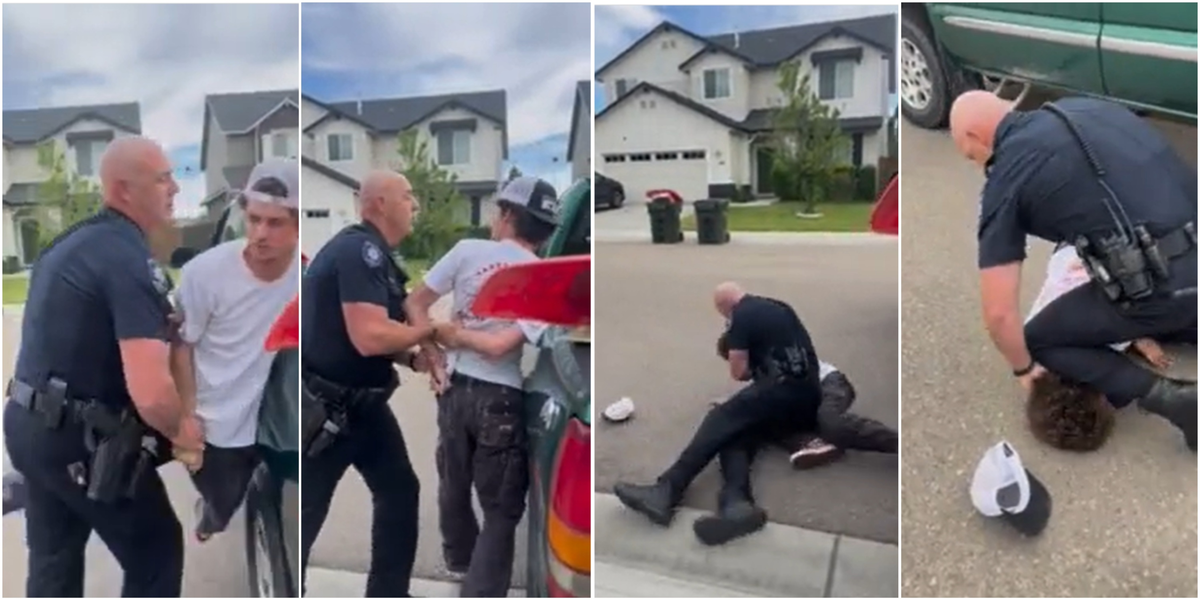
Backing up, at the time of the arrest, Chambers wrote a report stating that he put his knee “on top of (Allen’s) head,” which was approved by his sergeant. Did they not find that it raised any red flags that you should be made aware of?
“There were no red flags raised on it. And let’s put into perspective, when we’re talking about kneeling on a neck, there’s a difference between kneeling on a neck for seconds and kneeling on a neck for eight minutes. Officers are taught traditionally, if you were kneeling over somebody, to put a knee across the shoulder blade. Oftentimes, you’re going to see where a knee will slide over to the neck. Certainly, we don’t teach you to put your knee there. But is there potential for your knee to go there? There certainly is. Are you going to sit there for several minutes or a minute? No, you shouldn’t do that.”
In our review of the footage, we counted 56 seconds that Chambers’ knee appeared to be on Allen’s neck.
“I’d have to go back and look at the video. But what I could say is, you have to look at the totality of the circumstances. He’s surrounded by several people, one person who’s trying to get into the pickup and he doesn’t know why. He obviously has divided attention around himself. So for us to go, ‘It should be picture-perfect every single time’ — that’s an impossible threshold to give a police officer, or give anybody actually.”
When you initiated the internal review, Chambers had transferred to Boise. As I understand it, to transfer, you need to be in good standing with your previous agency.
“I can tell you, since he’s moved on (from Boise), the agency that hired him, they saw the same video. They came and talked to us about the incident, and they were comfortable enough to rehire him.
“In terms of standing, we have high expectations, so there are people who are naturally going to fall short at times. Not in good standing would be, you’ve got policy violations, you have ongoing issues. Not everybody’s perfect on every arrest, and you have to view it from that point of view as well. There are things that are so egregious that you are going to lose your job the first time you do it, and there are things that are training issues, where we’re going to get you remedial training and hopefully see you improve.
“We have what’s called progressive discipline. So, it may be a day off without pay the first time, and then if you do it again, it may be two days or more. We’ve actually terminated people based upon just being jerks to people repeatedly. We’ve had officers we’ve sent to remedial training, we’ve counseled them, and it’s gotten to the point where finally, we just can’t have you behaving this way. Even if it’s just, you talk down to people. That’s not what our expectations are. We’ve let people go based upon those grounds.”
Is that common?
“It’s not super common, because most people figure out that we’re serious. Especially when it comes to treating people poorly. It’s one of the things our command staff knows I take very, very seriously. So if they’re going to have a counseling session, a lot of the time, that counseling session is with me. Which no one wants, their first counseling session to be sitting in the chief’s office. And I’m very clear of outlining what those expectations are.”
Given that high level of expectation and how serious you are and convey yourself to your sergeants and command staff, were you surprised when this issue was brought to you three months after the fact?
“Yeah, absolutely. And I think, you have all kinds of things that play into this. (The Allen brothers) obviously were not listening. They were arguing back and forth. Even then, the bigger issue is, it escalates rather quickly. Over the years, we talk about it quite often: If you slow things down and wait for your backup, that changes the dynamics of the whole situation. If there are two officers as opposed to one, it probably changes everybody’s behavior on the scene.”
It sounds like there are three categories of evaluation you’ve touched on. There’s the law, there’s your policy, and there are your expectations. Can you explain how Chambers’ actions fell within policy?
“We judge our use of force based upon the Supreme Court’s ruling (Graham v. Connor), the Graham factors, and the totality of the circumstances. That’s our policy. Now, your policy can be much stricter. We’re not going to do that to our officers, because we’d be putting them in a bad situation.
“Where we are stricter, policy-wise, is when it comes to how we treat people. There’s nothing in the law that says you have to be courteous to people. That you have to deescalate the situation. We emphasize deescalation. We emphasize how we treat and talk to people. The Supreme Court has said, we can do car chases ‘til the wheels fall off. We don’t do that, because it’s dangerous. We’re stricter when it comes to pursuits, because there’s other factors involved that are dangerous to the public that we can’t control at all.
“When it comes to use of force, we go very strictly by Graham v. Connor, because you can get your officers injured and killed if you are too strict on policy, where you’re limiting so much that your officers can’t make those decisions. That’s just not a step I’m willing to take.”
(Editor’s note: Graham v. Connor was a 1989 Supreme Court case which established that an officer’s use of force is judged by what an “objectively reasonable” officer would do in that moment, rather than using hindsight. The Graham factors are three factors used to evaluate use of force: the severity of the crime, the threat posed by a suspect, and whether a suspect was resisting.)
You referenced eight minutes on a neck. After George Floyd was killed in 2020, many police departments across the country banned or restricted the knee-on-neck restraint. Why not Meridian?
“Because use of force is extremely dynamic. And so, are you going to punish someone because they’re trying to keep someone who’s violent and resisting them, and their knee slips onto their neck? There are agencies that literally say, you can only use the techniques we teach you to use. And I’ll just be very blunt and honest, most techniques that police agencies teach are not that effective, because one, they don’t train them enough, and two, they’re training to the lowest common denominator.
“If I have someone — and I have several in our agency including myself — that is a black belt in jiu jitsu, and they use a technique that is safer and more effective in controlling someone, they’re going to get in trouble because you didn’t teach it to them? That doesn’t make any sense. The public expects us to be able to control people. If I have an officer who is even greater trained than he’s been given through the academy, and he can use that to their advantage, and it’s safer for themselves and the suspect, absolutely we’re going to allow them to do that.”
Your policy discourages intentionally targeting the head and neck except when an officer “reasonably believes the suspect poses an imminent threat of serious bodily injury or death to the officer or others.”
“Again, the courts said, totality of the circumstances. We can’t second-guess an officer in that situation. Would an officer in the same situation possibly use the technique? Absolutely. So, was he in fear for his safety? I can’t say whether he was or not. He can tell me, ‘I was concerned about all these people around me.’ Do we expect them to get every technique perfect when they’re dealing with all these other dynamics? It’s not fair or reasonable. If you’ve ever seen a fight, even between two people who are talented, it doesn’t look like it does in the movies. It’s ugly. A term we’ve used many times within law enforcement: It’s lawful, but it’s awful-looking. It’s within the law, but it doesn’t look good. I can’t judge somebody because it doesn’t look good. I have to look at: What does the law say?”
So, in this case, you find it’s legally defensible, it aligns with policy, but it’s not up to your expectations. You can’t do remedial training because the officer has left. Then what? A new training?
“We’re not necessarily implementing a new training. In this situation, with training that we’ve been providing, we’ll emphasize the importance of not putting your knee on the neck, of slowing down, and most important, deescalation. The most important tool that we have to deescalate and get people to cooperate is always going to be our ability to communicate. That doesn’t mean it’s going to work out every single time. We’re humans. We’re going to make mistakes. We get frustrated, just like everybody else. But the emphasis is: If you talk to people, if you can slow it down, if the situation allows it, it just goes better for all of us. Whether it’s a use-of-force situation or a traffic stop or just a call to somebody’s house — when we’re trying to speed things up, we miss things. Things are missed in translation and communication.
“There will be an emphasis in the academy as well. But it’s not like this is new. If you ask any of our officers what my expectations are for interacting with people, whether it’s a suspect or victim or witness, they’ll tell you, because I explain that on their very first day at our training academy. I bet if you walk over to the academy right now and ask them, when you sat down for your meeting with the chief, what did he tell you was the quickest way to get fired from the Meridian Police Department? They would tell you, ‘Treat people poorly.’
“I realize we make mistakes. As long as it’s not a mistake of the heart, we’re going to be OK. If you’re doing those things because that’s who you are, we’re going to have a lot of issues.”
Do you think that this scenario was a mistake of the heart?
“I don’t. I think there’s all kinds of factors. This officer was very close with Tobin Bolter. We’ve reviewed other videos of Officer Chambers, and he does things picture-perfect. My bigger concern here was — and what I’m really upset about on the initial review is, somebody should have said, ‘That was pretty quick for you. Why?’ We want to know why. Why is that occurring? Because that seems out of character for you. Those are the things I emphasize for our sergeants and people reviewing those things. Have those discussions so we make sure we’re catching these things before they escalate.”
(Editor’s note: Bolter was an Ada County sheriff’s deputy killed in the line of duty in April 2024.)
Besides speed and the use of force, did you have any other concerns in reviewing this incident?
“There was no attempt of deescalation.”
When you and others found these actions align with your policy, does it make you question your policy at all?
“The use-of-force portion? No. I can tell you, if he was still with our agency, there would absolutely have been remedial training, at a bare minimum on our deescalation tactics.”
This story was originally published May 27, 2025 at 4:00 AM.