Boise area’s 1st new freeway in 40+ years is almost here. What’s changing
Afternoon commuters heading west on Interstate 84 near Meridian’s western border can crane their heads right and see dirt moving. Looking north, they’ll see bulldozers jutting up from mounds of earth and concrete piled high at even intervals over checkered fields.
By 2027, officials say, a new freeway will link those piles — soon to be overpasses — from the interstate to State Street, where the old, two-lane Idaho 16 will continue on to Emmett.
The construction is the homestretch of an Idaho Transportation Department vision since the early 2000s to create a north-south corridor connecting Ada, Canyon and Gem counties via Idaho 16.
It’s been a long haul. A 2.5-mile, $111 million segment of the highway, from State Street south to Chinden Boulevard, was completed in 2014, already years in the making. It took the next eight years for ITD to start construction on the second and final phase in 2022, estimated in November to cost $364 million, including $86 million in right-of-ways. Workers are extending the highway from Chinden to the interstate and building five interchanges and a series of overpasses.
It will be the Treasure Valley’s first new freeway in over four decades. And it is expected to bring drastic change for travelers, businesses and residents.
These are six things readers can expect once the freeway is complete:
1. A Flying Wye-like interchange
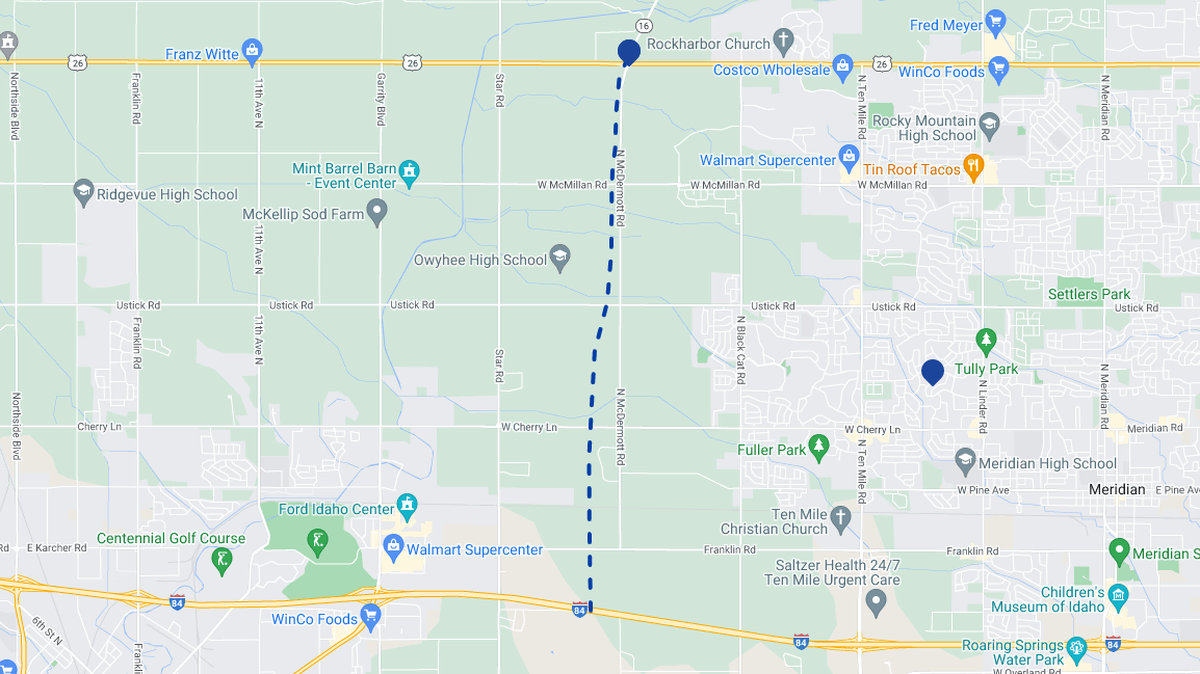
Once complete, Idaho 16 will run for seven miles from I-84 to State Street, with additional interchanges at Franklin Road, Ustick Road and Chinden Boulevard — and no other local access.
The most complex of those interchanges is at the highway’s southern terminus at I-84, situated west of McDermott Road, just shy of the Nampa border. That interchange includes four new ramps — two on and two off to account for each direction of I-84. Two of the ramps will “fly over” the interstate, elevated by bridges. The interchange will include five bridges.
Sophia Miraglio, ITD’s public information officer, told the Idaho Statesman that the interchange would be akin to another Flying Wye, the interchange where the I-184 Connector splits from I-84 west of downtown Boise. That interchange cost $86 million, the Statesman reported in 2005 ($145 million in today’s dollars, according to NerdWallet).
The interchange would allow drivers to exit the interstate and get onto Idaho 16 without having to stop or even slow, according to Dan Gorley, an ITD design construction engineer.
This would be particularly helpful for drivers in the Franklin Road area, Gorley said. Now, drivers getting onto I-84 from Franklin, or vice versa, hit stoplights. With the new interchange, they wouldn’t.
“They just keep going, 65 miles an hour, over the top of everything,” he said.
2. High-speed north-south travel
Miraglio told the Statesman that once the freeway is open, drivers would be able to get from the I-84 interchange to Emmett in about 20 minutes, “cutting down travel times by almost half.”
An ITD analysis in 2018 found that Idaho 16 would reduce vehicle delays by 5,000 hours on an average weekday, compared with what’s anticipated for 2040 if the freeway were not built. Traffic counts on the freeway are expected to rise steadily over the years, Miraglio said. By 2045, daily two-way volumes are expected to be about 65,000 vehicles from I-84 to Franklin, 76,000 from Franklin to Ustick and 70,000 from Ustick to Chinden.
For Miraglio, tens of thousands of travelers getting north and south more quickly is about “connecting community,” and she notes that the highway connects three counties.
Gorley noted that it’s good for certain industries, too, particularly trucking.
“I think it’s needed … just commerce getting from one side of the Treasure Valley to the other,” Gorley said.
North-south travelers could also include commuters, construction workers or developers bringing materials to development sites, residents of new subdivisions, and outdoor enthusiasts or tourists attracted to activities in McCall and Cascade, he said.
3. Alleviated traffic on nearby roads
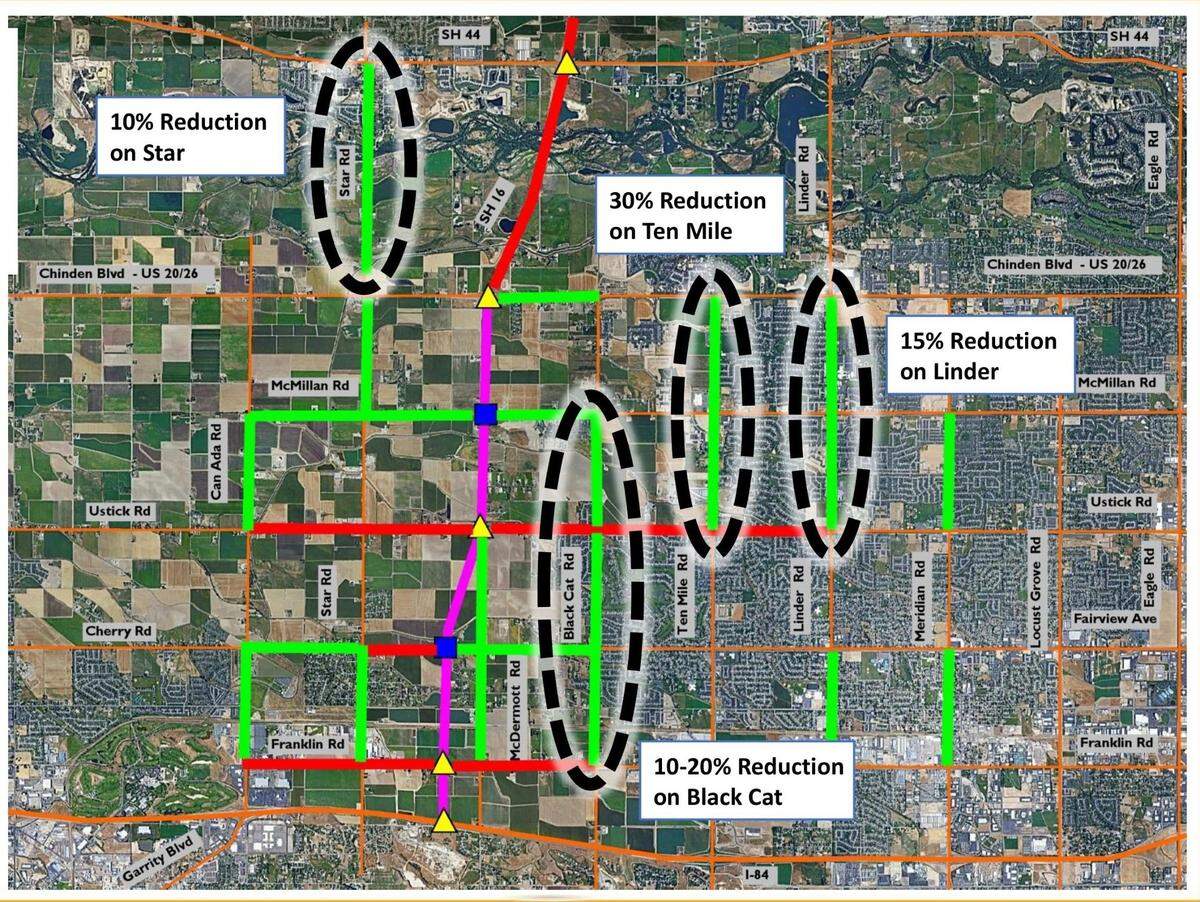
Traffic is supposed to decrease on nearby roads, especially others running north-south.
Traffic demand is expected to drop most dramatically on Ten Mile Road, for example, according to ITD’s 2018 analysis, which was informed by data from the Community Planning Association of Southwest Idaho, or Compass. That analysis projected that in 2040, Ten Mile would see 30% less traffic with Idaho 16 than if the highway were not built. Demand would drop 15% on Linder Road, 10%-20% on Black Cat Road and 10% on Star Road.
Other roads would see less significant changes, the analysis said. Traffic would increase on Ustick from Linder to Can Ada Road, for example, but by less than 10%.
These projections align with what officials in the area anticipate. In Meridian, Idaho 16 has long been touted as a way to help traffic flow within the city.
“This new corridor will enhance connectivity, alleviate congestion on other streets, and create new opportunities for business and neighborhood development,” city spokesperson Trevor Smith told the Statesman in an email.
City Council Member John Overton told the Statesman by phone that he believes that Idaho 16, coupled with the new I-84 overpass in construction at Linder, will help “reduce traffic on some of our major routes,” especially Ten Mile, Eagle and Meridian roads.
Caleb Hood, Meridian’s deputy director of community development, told the Statesman that Ten Mile and Black Cat roads “weren’t built to handle the traffic that is coming from the north.”
Because Idaho 16 now terminates at Chinden, Hood said, drivers heading south get off of the highway there and transfer to Ten Mile and Black Cat to keep going south. That won’t happen once the extension is complete, so Hood thinks traffic will ease on those roads.
Further north in Star, Mayor Trevor Chadwick says the extension will provide residents of his city, Eagle and Emmett with “quicker fluidity” and reduced commute times.
Rachel Bjornestad, a spokesperson for the Ada County Highway District, said she “definitely … expect(s) impacts to ACHD roads” and said the highway district has planned some improvements to support the new highway. This includes widening Ustick, which Bjornestad said would see an increase in traffic in Ada and Canyon counties.
In Canyon County, the Nampa Highway District also has plans to widen Ustick.
4. More development. But where?
“The crazy thing is … when we started we were clearing out corn stubble,” said Chanc Meyer, an engineer with HMH Engineering, one of ITD’s contractors, looking north from a work site near the I-84 interchange. Now, he said, development is coming “right up against the highway,” especially near Owyhee High School.
Twenty years ago, when the freeway was first being discussed, the city of Meridian put a moratorium on development near McDermott Road, because planners didn’t know where exactly the highway corridor would go, Hood told the Statesman. A few years later, the route was determined, and city planners began to prepare for growth.
They started with a comprehensive plan update roughly 15 years ago, and followed with a specific area plan in 2021 for what is called the Fields subarea.
The Fields plan calls for a mix of neighborhood and commercial uses in the 4-square-mile area bound by Ustick, McDermott, Chinden and Can Ada. That northwest Meridian area is expected to be a development hot spot in coming years, especially with the highway extension. In recent months, developers have filed preliminary applications with the city to build on hundreds of acres there.
Owyhee High is the main development that’s already built, Hood said, but eight other developments have been approved and one is pending — all residential.
In recent years, ITD has been in a scramble to secure right-of-ways for the extension, as the populations of Ada, Canyon and Gem counties keeps growing and as growth pushes insistently north and west. With the corridor coming, officials say they expect development to keep moving north.
“I believe it will also change the development patterns to North Eagle, North Star and Emmett, where folks can live further away” from the central Valley while being able to easily access it, Chadwick said.
Star is 10 times larger than it was in 2000, having grown from fewer than 2,000 people to almost 20,000, according to Compass. Compass data shows Star is Ada County’s smallest city but has been its fastest-growing in the past four years. It was Idaho’s second-fastest-growing city from 2020 to 2023, the Statesman last reported from Census data.
5. Not another Eagle Road
ITD’s Miraglio emphasized that the elevated, limited-access freeway will not be “like Eagle Road, where you have businesses and everything that are getting access.”
Also running north-south, Eagle Road, or Idaho 55, has become increasingly congested and built out. Over 60,000 vehicles travel the road between I-84 and State Street daily, twice as many as in 2000, the Statesman reported last year.
Instead, Miraglio said, Idaho 16 would function more like a north-south I-84.
6. More improvements … and another highway?
There’s still a question of if ITD might expand the 13-mile segment of Idaho 16 that continues north to Emmett. For now, it’s a two-lane country road.
According to ITD’s website, the department is “completing an environmental reevaluation” of that section. The reevaluation, started in 2023, includes gathering updated traffic numbers and developing “a range of potential improvements.”
Miraglio said design for the freeway north to Beacon Light Road will start this year and take about 16 months. Construction funds for that section are planned for 2028 and expected to take “a couple years to complete,” Miraglio said.
Chadwick is already starting to look beyond Idaho 16. As north Ada County and Gem County grow, he thinks “it will become necessary for ITD leadership to work with the communities of Star and Middleton to plan for a new northern highway that will connect Interstate 84, northwest of Middleton, to Highway 16 northeast of Star.”
This highway would run east-west, and though it has no official title, Chadwick says he likes to call it “the Mid-Star Northern Highway.”
This story was originally published April 28, 2025 at 1:50 PM.