84 apartments were proposed on State Street. Here’s what the City Council just said
Passerby without knowledge of Tuesday night’s programming at LifeSpring Church might have assumed that the 200 or so devotees gathered there were praying for salvation from apartment builders.
“I wouldn’t have bought the house if they had known that apartments were going in,” said one man.
“I am opposed to development,” said another. “It’s not the right thing for this place and this time.”
In fact, it was a meeting of the Star City Council, which had relocated to the church off State Street to accommodate the large crowd anticipated to show up in protest of 84 apartments proposed a mile up the road.
Residents’ reaction might have been expected. For as long as developers have wanted to build apartments in Star, there have been neighbors standing in their way.
In 2015, a small group of resisters effectively forced a 37-apartment complex for low-income renters planned for State Street to move further south. Two years later, residents attempted to recall the mayor and a city councilman who voted in favor of an apartment complex on State.
This development wasn’t much different: The Northwest Development Co. of Meridian had proposed to build apartments at the rear of a 7-acre parcel at the northwest intersection of State Street and Seneca Springs Way. Along State Street, the developer would build three commercial buildings, including an auto parts shop.
Even the Northwest Development Co. owner, Travis Stroud, admitted that he didn’t want to build apartments on the lot — at least, not originally.
“We do commercial, and that was our primary intent … That being said, I couldn’t get any traction,” he said.
Stroud typically works with tenants like Dollar Tree, Pita Pit restaurants, and coffee stores, like The Human Bean. He said that he had also gotten D&B Supply Co. interested in the project.
One major problem got in the way of the deal, though: access from State Street.
The street, Idaho 44, is overseen by the Idaho Transportation Department. According to the developers, ITD said it would not install a traffic light at the intersection with Seneca Springs Way, nor would it permit cars traveling eastbound on Idaho 44 to turn left into the development.
Then there was the problem of access from Seneca Springs Way. The neighboring development, a subdivision called Rockbridge, owns the narrow strip of land between the road and the 7-acre lot. Its developers already added landscaping along the strip from their subdivision to State Street and have blocked Stroud from building a cut-through.
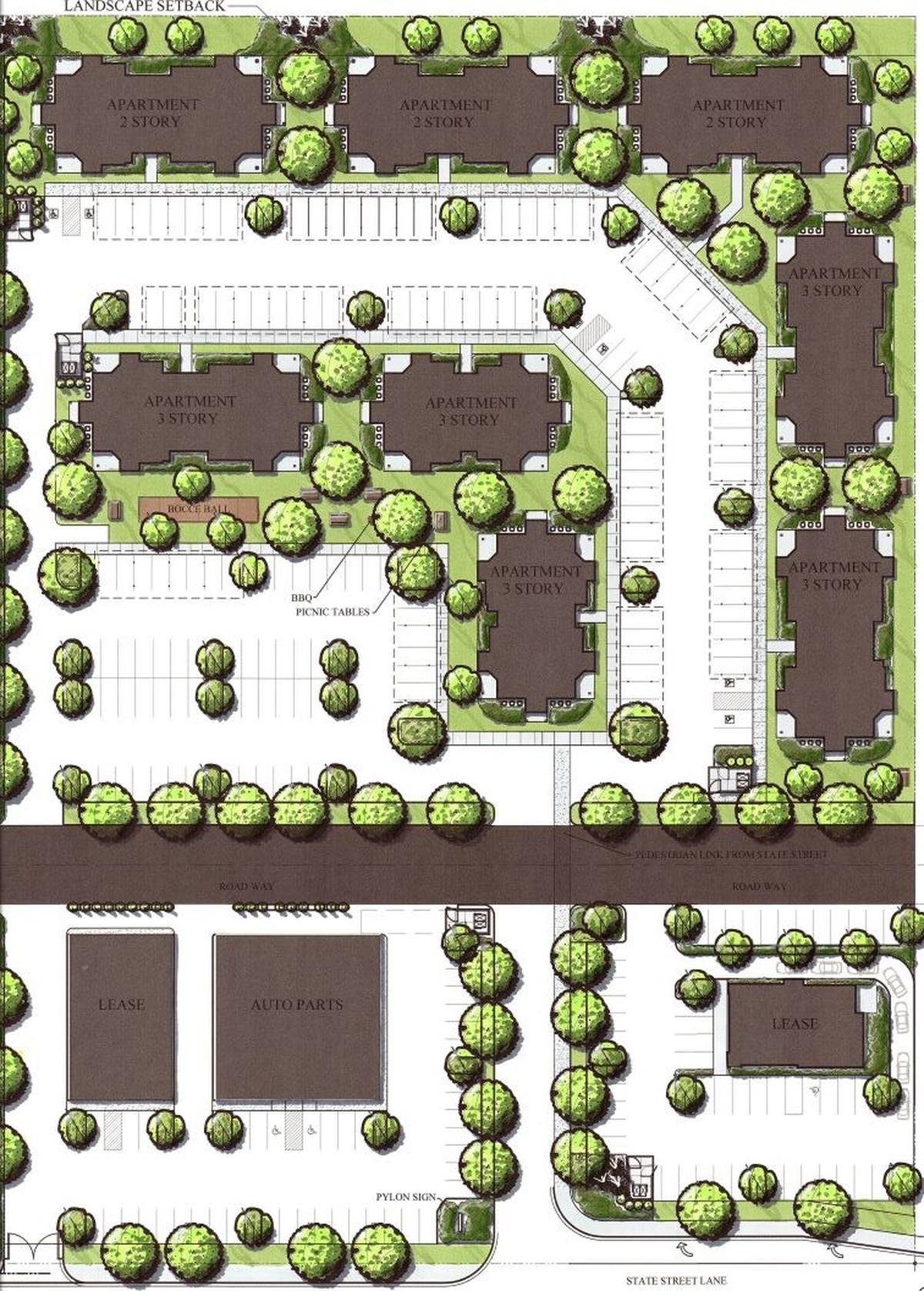
With the prospect of attracting only drivers going westbound on Idaho 44, many large retailers told Stroud they wouldn’t locate at the corner.
Stroud said that limited his options. He decided to redevelop the site as multifamily, which would generate fewer trips than a commercial property. The multifamily development he proposed was “garden-style” — five buildings, two to three stories tall, each surrounded by surface parking.
Residents’ arguments against his project repeated many of their previous apartment battles: The project wasn’t a good fit for the area. It would create too much traffic along State. It would reduce property values.
In the end, the council made a decision based not on property values, but property taxes.
“Star is 90% residential,” said council member David Hershey. “I have a real hard time giving up any of that valuable commercial land for anything other than commercial.”
Hershey was referring to the city’s share of commercial property in its tax base. By having more high-value commercial properties within their limits to pay property taxes, cities can reduce the share of property taxes that homeowners pay.
Some council members cited Star’s new comprehensive plan. The plan envisions the State Street area as a central business district, with mostly commercial uses. Residential uses are allowed, but the plan suggests that apartment buildings include first-floor retail or office space. That’s typical of mixed-use buildings seen in downtown Boise and advocated by planners around the Treasure Valley.
But it’s also expensive, Stroud said. The rents he would have to charge within a mixed-use building would be too expensive in Star — at least, given the city’s population today, he said.
In response, the council opted to deny the project. They said the developer could come back with another proposal. Star’s new mayor, Trevor Chadwick, stressed that the decision on this parcel will affect downtown for years to come.
Councilman Kevin Nielsen agreed.
“Star is in such a unique position right now,” he said. “We need to grow more before we can do the things people want us to do. But we also don’t want to see the fields go away and turn into subdivisions. And if we don’t want the fields to disappear, then we need to grow up.”
Councilwoman Jennifer Salmonsen also asked Northwest Development Co. to make the project more pedestrian-friendly by moving the commercial buildings closer to the street.
Even if Stroud does redesign the project to feature a denser, Main Street-style development, the issue of access from the state highway remains.
The highway, which narrows to a three-lane road west of Idaho 16, could continue to affect the type of growth that Star sees within its downtown central business district. Because ITD controls the road, Star may have less ability to build wider sidewalks and on-street parking.
“I hearken back to the decision made by city officials years ago: ‘No, Star won’t need a bypass, we’ll let traffic come through town,’” said Councilman Michael Keyes. “I don’t want to have regrets in 15 years.”
This story was originally published January 21, 2020 at 11:41 PM.