Preservationists fought to save the Nampa depot in the 1970s. It’s in danger again.
In 1972, historic preservationists saved Nampa Train Depot from destruction by turning it into a museum. Now that museum could be forced to close if it can’t more funding.
“We are starting to run out of money,” said Aldis Garsvo, president of the Canyon County Historical Society, which owns the 116-year-old building. “Costs are going up, maintenance requirement is already going up. It takes $30,000 just to keep the lights on.”
The Nampa Train Depot Museum is a Nampa icon. It offers visitors insight into the Treasure Valley’s past and serves as a reminder of the vital role railroads, especially the Union Pacific, have played in the region’s growth since the 19th century.
Even today, with train passengers gone, Nampa has a major Union Pacific rail yard that is one of UP’s two terminals in Idaho (Pocatello has the other), and it is fed by local freight shipments along the Boise Valley Railroad from the Boise area.
If the depot closes, Garsvo says Nampa will lose part of its identity.
“It removes the opportunity for citizens of Nampa and Canyon County to experience history — to learn about how their grandma and grandpa created this county,” he said in an interview.
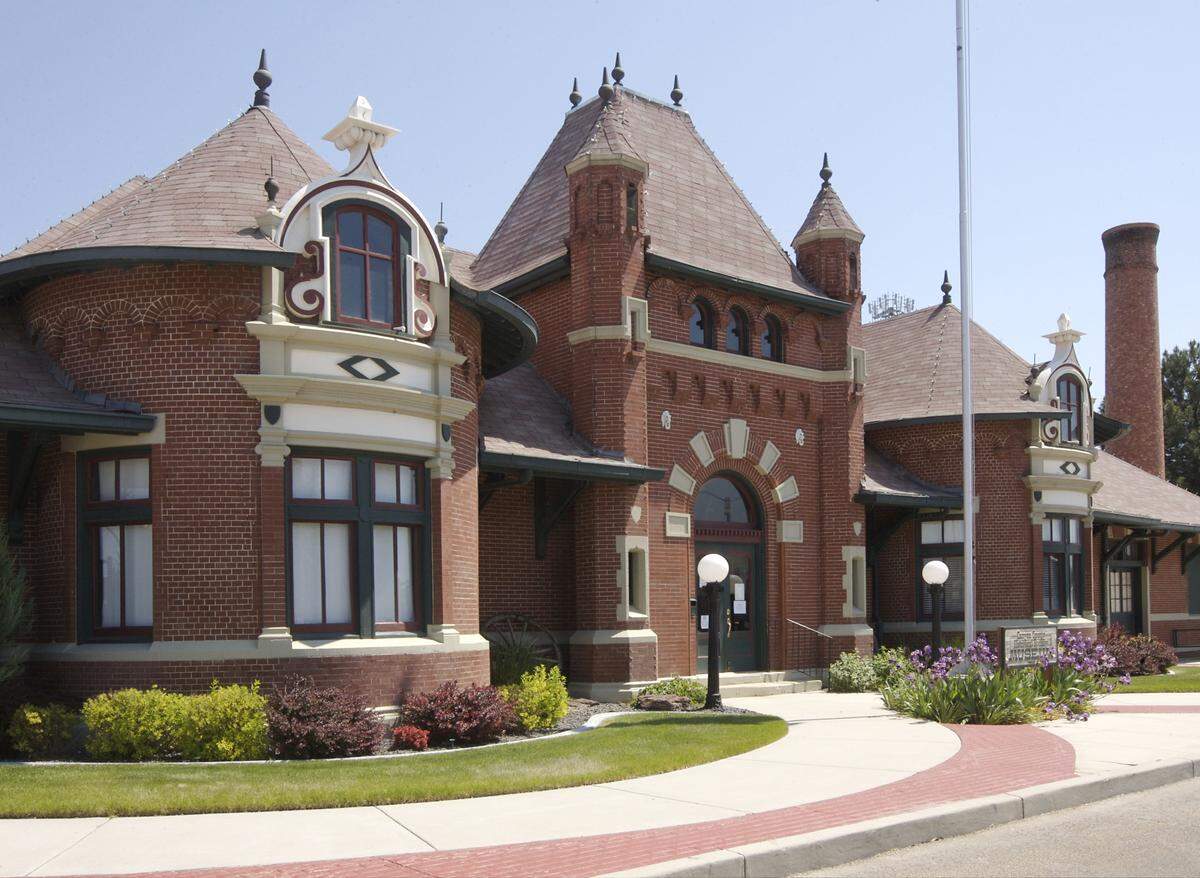
But the building needs repairs and its displays need updates. Gutters need to be stripped and replaced, Garsvo said. The mortar of the exterior brickwork has cracks that must be filled in. He’d also like to replace the carpet — blue and stained since it was installed in the 1970s — with hardwood floors that resemble the original.
“We have a real jewel sitting here,” Garsvo said, “but it needs work.”
The depot’s funding shortfalls
The depot museum relies on a core group of about eight volunteers to keep it open from 10 a.m. to 3 p.m. Thursdays through Saturdays. Volunteers not only staff the front desk, they’ve written all of the descriptions of artifacts, printed out on white computer paper and pasted on the display cases.
Until 2016, the Historical Society had enough funding to employ an executive director of the museum. The money came from a historic preservation levy in Canyon County whose proceeds went directly to the society — about $100,000 each year.
But Nampa was the only city that had benefited from the funds of the historic preservation levy. In 2012, the Canyon County commissioners decided to change that. They changed the way levy funds were distributed: Now, historic preservation groups must apply annually for grants to be used for specific infrastructure projects, rather than for staffing.
Joe Decker, public information officer for Canyon County, said the change brought cities like Middleton and Parma new resources for their preservation efforts. “The commissioners at that time decided to empower some of the smaller communities to preserve history,” he said.
That shattered the Historical Society’s annual budget. The levy supplied the society with just $4,500 in 2018 and $7,000 in 2019.
To compensate, the historical society this year increased the ticket price to the museum to $5 from $3. It has also worked to expand the Society’s membership, which costs $25 a year for individuals.
The group’s volunteers have spent hours organizing fundraising events, like a a party in March that transformed the depot into a 1920’s speakeasy for a night. While the event sold out, it raised less than $1,000.
“We can only do so much through grants, festivals, donations and fundraising,” Garsvo said.
The second depot is the one that survived
Before the railroad, Nampa was just a few shacks, according to Larry Cain’s 2014 book, “Nampa.”
The Oregon Short Line railroad, a part of Union Pacific, turned the town into a transportation hub for the Treasure Valley.
At the peak of the railroad’s popularity, Nampa was at the junction of four railroad lines, each running in a cardinal direction to link the city to Idaho’s mining towns, farm communities and regional economic centers, according to the Society of Architectural Historians.
1n 1903, Union Pacific asked a Nebraska architect, Frederick Clarke, to design a new depot to replace a wooden one that had been imported years earlier from King Hill in Elmore County. Clarke’s design was a melange of the period’s most celebrated styles — French Renaissance, Baroque and Romanesque revival. Located at the center of the town, the depot symbolized the railroad’s central role in Nampa.
But 20 years later, train traffic outgrew the 1903 depot. Union Pacific built a new train station across the tracks in 1925 and turned the 1903 depot into company offices and freight storage.
Decades later, with the automobile on the rise and train ridership declining, even that 1925 station had become a relic of the past. It was demolished.
The 1903 station would have been next had it not been for a group of citizens that came together to form the Canyon County Historical Society. Their group raised funds to restore the exterior and renovate the interior into a museum.
Finding sustainable revenue
This isn’t the first time that the Historical Society has struggled with funds. In 2011, the society asked the public for donations to pay for repairs to the heating and air conditioning, and to keep the basement from flooding every time it rained. At the time, they estimated the expenses needed to repair the building at $500,000.
Beyond money, there’s also the fact that many of their volunteers are “aging out,” Garsvo said. “Right now the challenge is bringing in younger people to volunteer.”
Garsvo has labored many unpaid hours at the depot. In 2017, he and his son, Eriks Garsvo, led a four-year effort to restore a 1942 Union Pacific caboose that had traveled the rails for over four decades before landing at the museum.
“The caboose is one of our pride points,” he said. ““Because of this, we have increased our visitors.”
He said that the museum gets about 2,000 visitors each year. It’s a number that Garsvo would like to see grow — but he can’t do it alone.
“From a sustainability standpoint it would be great if we are able to bring a director to the museum so that there is someone at the helm, to take this Canyon County Historical Society and the depot into the future,” Garsvo said.
A position like that would cost about $35,000 to $45,000 each year. Garsvo imagines that the staff member would oversee the operations of the Nampa Train Depot as well as the “Our Memories” Indian Creek Museum in Caldwell at 1122 Main St.
“I’d like to see this museum coming to life,” he said. “It is a place where the community, whether it is Nampa, or even Southern Idaho, can experience Idaho history in a tangible and exciting way.”
The Idaho Press first reported the threat of the depot’s closure.