
Remembering Boise’s own Mert Lawwill, a ‘legend’ on two wheels
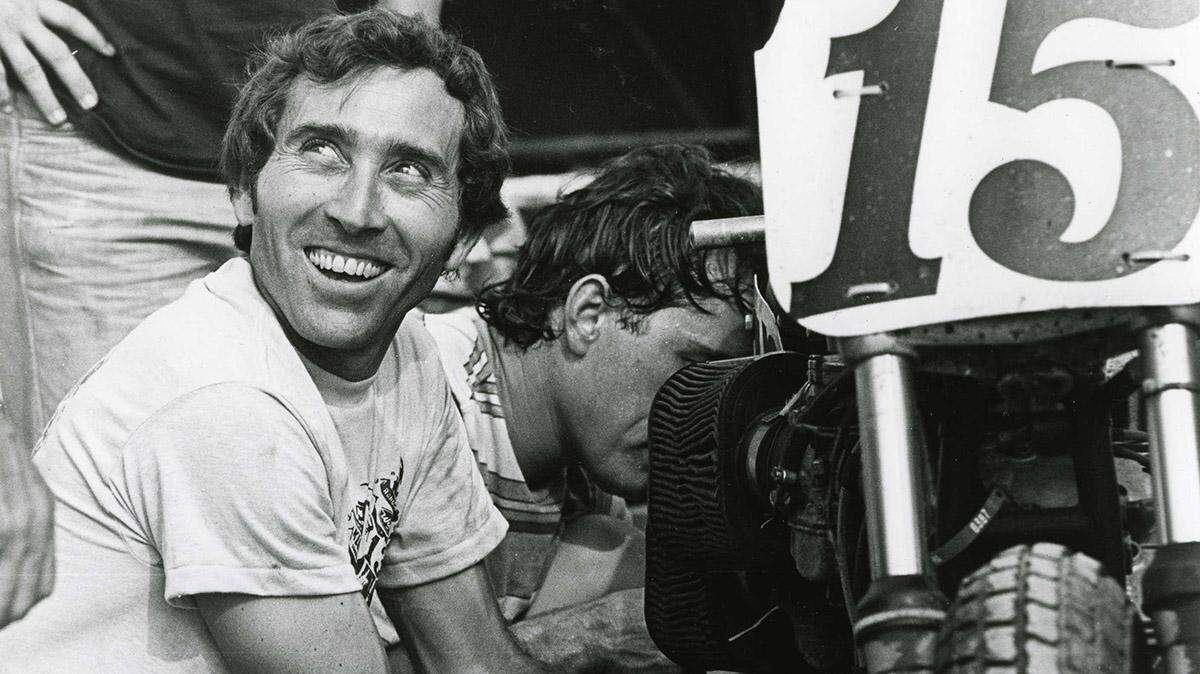
Mert Lawwill, a national champion motorcyclist turned mountain bike trailblazer, died Wednesday in Boise, the city where he was born.
Lawwill was 85 years old. His death was reported by Cloverdale Funeral Home and confirmed in a press release from the American Motorcylcist Association, an organization that inducted him into its hall of fame in 1998.
Casual fans met Mert Lawwill as a 5-foot-6, 29-year-old in banker’s garb on the streets of San Francisco during the opening scenes of Bruce Brown’s 1971 Academy Award-nominated documentary “On Any Sunday,” a dive into the culture and competition of flat-track motorcycle racing. That was Lawwill’s world.
“His profession: motorcycle racer,” Brown narrates as Lawwill tears around a flat dirt oval tucked behind a raceplate emblazoned with the No. 1. “Mert makes his living in one of the most dangerous sports in which man participates.”
By then, Lawwill had already earned that number, which was given to the top racer on the American Motorcycle Association Grand National Championship circuit, a title he claimed in 1969.
That was the highwater mark of Lawwill’s first professional act, a racing career that began joyriding with friends on the dirt roads of midcentury Boise.
The son of a housepainter and a schoolteacher, Lawwill was one of seven children, his son, Joe Lawwill, wrote in a press release. A restless youth, Lawwill found his outlet when his brother Roy put him on the back of a motorcycle.
He took that passion to local tracks around Boise before moving to Los Angeles in 1963. In 1964, he earned a spot on the famed Harley-Davidson factory team, launching him onto the national circuit. Lawwill went on to claim 15 AMA Grand National victories, including the 1969 championship. That season, Lawwill was voted “Most Popular Rider of the Year,” according to a press release from the association.
Still, the career choice ruffled feathers in Lawwill’s home, he told American Motorcyclist Magazine in 1977.
“Didn’t you know that anyone who rides a motorcycle is a Hells Angel?” he recalled family members asking. “My folks were concerned about my safety and wanted no part of the racing. We had a lot of fights about it and some discipline problems. The problems were finally resolved when they let me have a motorcycle!
“It took a while to dent the circle, but now my folks are my biggest fans.”
The success couldn’t have hurt. Neither could Brown’s depiction of Lawwill in “On Any Sunday,” which chronicled Lawwill’s title defense during the 1970 season.
“Mert Lawwill is a gentle man in a violent world,” Brown narrates in the film’s opening minutes. He never became a Hells Angel.
“I think many people changed their minds about motorcyclists after watching the movie,” Brown said in a 2001 interview. Brown noticed that Lawwill was a “black sheep,” but recalled a moment when family members saw the film. “… Lawwill’s grandmother-in-law, went to see the movie and in the middle of one of the scenes featuring Lawwill she stood up and shouted, ‘That’s my grandson!’ Suddenly, he was the big hero of the family.”
Lawwill retired from motorcycle racing in 1977 after an inner-ear condition compromised his balance. A technician and a tinkerer, he found his second act in the garage. Lawwill designed and built race motorcylces, which went on to propel other riders to checkered flags.
He built human-powered bikes, too: Developed soon after he retired, the Lawwill Knight Pro Cruiser is widely credited as the first production mountain bike ever made, manufactured before most cyclists knew the discipline had a name.
Lawwill’s fingerprints are still on modern mountain bikes. After a rough ride down Marin County’s Mount Tam on his Pro Cruiser, Lawwill spent the late 1980s developing a motorcycle-style suspension for a pedal bike, he told Mountain Bike Action Magazine in 1991.
“The bike was jumping all over the place and my eyes were bugging out!” he told the magazine.
He teamed up with fellow pioneer Gary Fisher to develop the Fisher RS-1, the first full-suspension mountain bike, the magazine reported. The four-bar suspension they developed is still the most common design on trails.
His work on bike design — particular later at Yeti Cycles — earned him induction into the Mountain Bike Hall of Fame in 1997.
Lawwill, though, was most proud of his third act, Joe Lawwill said.
Inspired after a friend lost an arm in a racing accident, Lawwill pivoted to prosthetics in the late 1990s. Built around a ball and socket, “Mert’s Hands” offered a way for those without hands of their own to get back on motorcycles, while safely releasing if they fell.
“This work opened the door for countless adaptive athletes to return to riding and represented, in Mert’s eyes, his most meaningful contribution,” Joe Lawwill wrote.
Lawwill was elevated to “Legend” status by the American Motorcyclist Association Motorcycle Hall of Fame in 2012, an honor “reserved for those whose accomplishments transcend their induction category in impactful ways throughout the motorcycle community,” according to the association.
“From an early age, I understood that my father lived a life that was anything but ordinary,” Joe wrote. “As I began to recognize the respect and admiration people had for Mert, the attention that came with it — even being asked for my own autograph as a child — felt surreal. I started calling him ‘Mert’ as a way to navigate that spotlight. As I grew older and pursued my own career in mountain bike racing, he remained my most steadfast supporter, always encouraging and standing behind me. It was never a question of pride — I have always felt a deep sense of gratitude and honor to call someone so impactful my father.”
Mert Lawwill was preceded in death by his wife, June Lawwill.
He is survived by his son, Joe Lawwill; his daughter, Marcella Lawwill; his stepsons, Rick, Mike and Tim Suchomel; three grandchildren; and extended family and friends, according to the funeral home.
A celebration of life will be held at a later date.
“It’s not hyperbole to say that an entire generation of motorcycle enthusiasts the world over grew up with Mert in the ’70s,” journalist and friend Zapata Espinoza wrote in a tribute to Lawwill in Cycling World. He recalled the impact of seeing Brown’s documentary as a child, particularly its last shot: Lawwill and rivals Steve McQueen and Malcolm Smith cutting clean tracks though sand along the California coast, riding, literally, into the sunset.
“Deep into his bones, Mert was a racer,” Espinoza wrote. “Indeed, motorcycling was his life. And now, with his passing, along with McQueen and Malcolm — Brown’s famous three amigos who rode into our hearts and enthralled millions, are no more. Rest in peace, champ.”