Biden-era climate rules are going away. What’s about to change in Boise
AI-generated summary reviewed by our newsroom.
- Boise plans to move EV parking mandates into an optional sustainability incentive.
- 5% EV-ready stalls required for some projects using the sustainability incentive.
- State law and federal shifts have created headwinds for EV efforts.
Drive an electric car or want one? You may be out of luck in the search for a charger, as the city of Boise is trying to roll back requirements for developers to build electric vehicle, or EV, charging spaces.
City officials included required EV parking for some apartment projects and other buildings in the 2023 zoning code as part of the city’s ambitious climate goals. But developers complained about the “onerous” regulations and how much they cost, according to Maureen Brewer, Boise’s director of planning and development services.
“There’s likely to be fewer EV ready parking spaces as a result of this adjustment,” Brewer said during a video call.
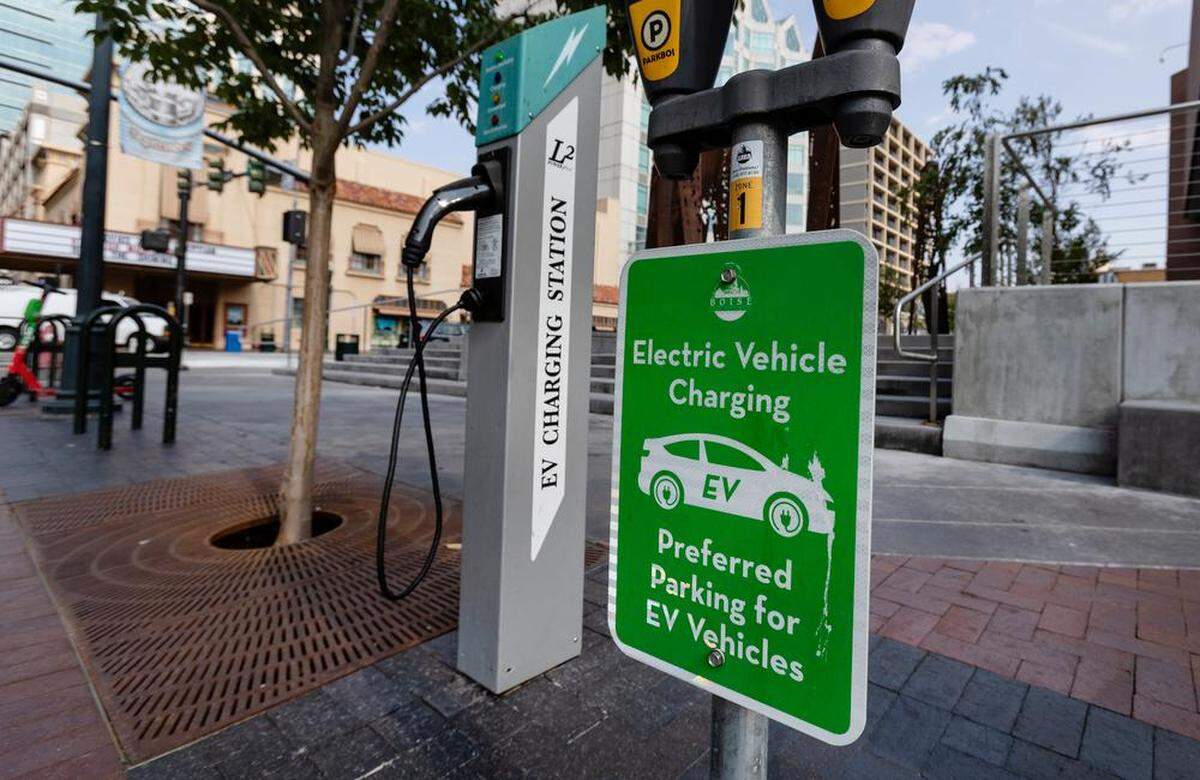
Instead, city staff proposed adding an EV requirement to the city’s optional sustainability incentive, she said. So if developers take advantage of the incentive, they’ll have to make at least 5% of their parking spaces have the wires and the plug installed, she said. The requirement applies only to developments with at least 20 parking spaces, Brewer said.
The sustainability incentive is designed to provide benefits to a developer like more density or less parking if the project is deemed sustainable because of characteristics such as reduced water usage. But officials are reworking the city’s incentives after the city learned the incentives weren’t valuable enough to developers.
So far, five projects have used the city’s sustainability incentive, totaling 422 units, Boise spokesperson Maria Ortega said in an email.
Developers argued that the market will tell them if people want EV parking, Brewer said.
“That’s a compelling argument,” Brewer added. “It’s in their best interest to develop or build buildings that are oriented to their customer base. If that includes EV charging … those will get included.”
The uncertainty surrounding Boise’s incentives and the changing desires of Idahoans make it hard to predict how many builders will include EV parking spaces in future projects.
Opposition to electric vehicles
But the adoption of electric vehicles faces headwinds from state and federal governments.
During former President Joe Biden’s administration, some carmakers tried to brand themselves as climate-friendly, and electric vehicle sales surged in the United States and other countries. During that time, the number of electric vehicles registered in Idaho, though small, grew substantially to 4,500 vehicles as of July 2022. That year, Idaho had 2.3 million total registered vehicles.
In December 2025, that number is 14,100 registered electric vehicles out of 2.53 million total, according to Idaho Transportation Department spokesperson Britt Rosenthal.
After President Donald Trump took office, however, he undid many of the electric vehicle incentives and policies favored by his predecessor.
Idaho was set to get close to $30 million from a Biden-era climate program called the National Electric Vehicle Investment program. The Trump administration froze those funds in February but in August started to make the money available with new guidance, according to National Public Radio. Idaho “complied with the new guidance,” and its plan was approved in October, Rosenthal said.
“The funds have been approved,” Rosenthal said.
Idaho already levies an additional $140 annual fee for electric vehicle owners and in 2021, lawmakers unsuccessfully attempted to double these fees. The fees are to offset the revenue loss from state fuel taxes charged when drivers fill up their tank, according to the Idaho Capital Sun.
Rep. Joe Palmer, R-Meridian, introduced a bill in the Idaho Legislature in 2025 to preempt local EV charging regulations. The bill passed largely on party lines, and Gov. Little signed it into law in March. Boise Mayor Lauren McLean said during a Dec. 2 work session that she didn’t believe the law affected Boise’s EV requirements.
Regardless, the council is expected to vote on removing the only EV charging requirement in its building code in the coming weeks. The provision, approved in 2020, required new homes with residential garages to have the technology to support EV charging. At the time, McLean said the change removed a barrier to EV ownership.
A rollback of the zoning code’s EV requirements is expected in spring 2026, Brewer said.
Ryan McGoldrick, program director for Conservation Voters for Idaho, said a large chunk of Ada County’s emissions come from transportation. But he was also sensitive to the city’s goals.
“As much as I would love to keep the full requirements, I also understand that we have extremely expensive housing in the city,” McGoldrick said. “If we want to have places where people can live, we need to have requirements that match that and allow us to actually build housing.”
This story was originally published December 10, 2025 at 4:00 AM.