
Judge gives pro-Palestine protesters in downtown Boise a legal victory. Here’s why
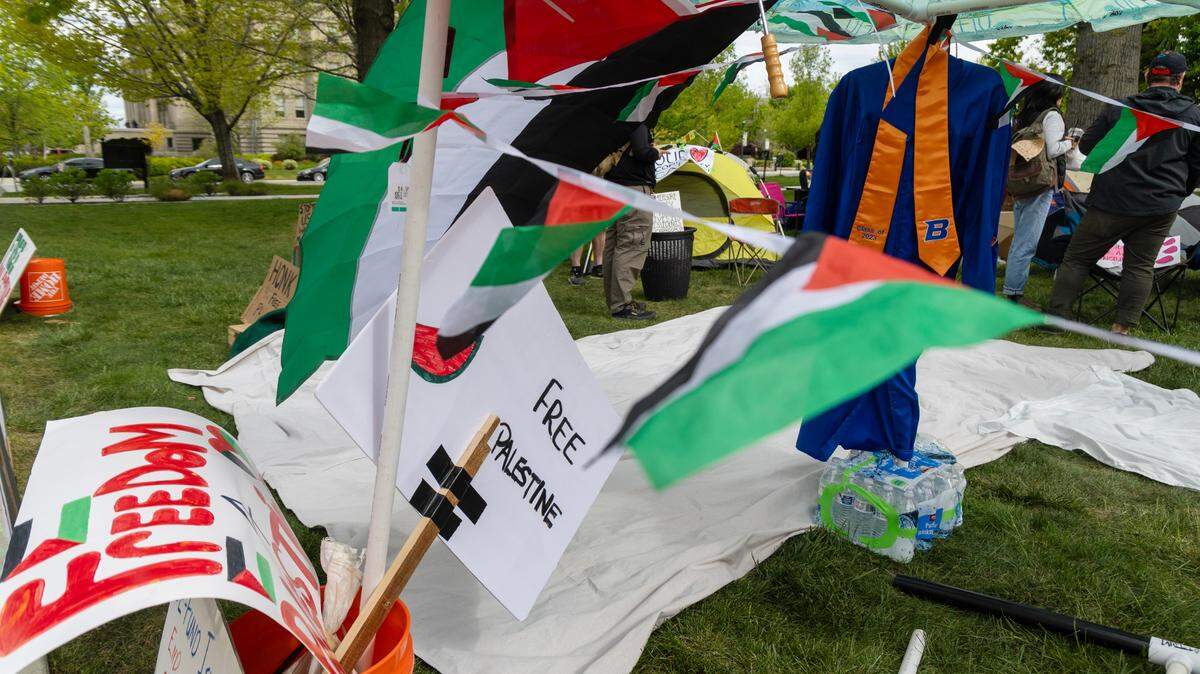
A judge in Idaho on Thursday granted a legal victory to the pro-Palestine protesters at the Capitol Annex — preventing the state of Idaho from removing tents or seizing property from the ongoing demonstration in most instances, according to court documents.
The protest, known as the People’s Liberated University, started in early May around the time of nationwide college protests over the Israel-Palestine conflict.
The demonstration was initially protected under a 2014 decision stemming from the Occupy Boise protests that said symbolic tents were allowed.
A federal judge ruled in May that the protesters would have to file a new lawsuit. The state filed suit one day later, accusing the protesters of damaging grass, smoking outside of designated areas and marking up and obstructing sidewalks in violation of Idaho statutes, according to previous Statesman reporting.
Since then, both sides have gone back and forth about what is camping, to what extent the First Amendment applies and what should happen during periods of scheduled lawn maintenance.
“The outcome here protects the First Amendment rights of the people demonstrating at PLU,” Casey Parsons, an attorney for the protesters, said in a statement. “We look forward to the Court continuing to uphold the rights of the protesters there.”
The Idaho Department of Administration, whose director brought the suit, did not immediately respond to a request for comment.
Judge Jonathan Medema said that the state is unlikely to be able to prove that anyone was camping. The state has also not shown that the tents will cause “irreparable harm,” so Medema decided not to grant an injunction on the basis of saving the lawn.
“The evidence shows the grass has been trampled in some spots and is thinning in others,” Medema said in a memorandum decision and order. “The Court is not persuaded the grass will be irreparably harmed.”
Medema also wrote that there was no evidence that anyone was in harm’s way. Two of the protesters were rude to law enforcement, the memorandum said, but are entitled to do so under the First Amendment.
On the other hand, someone is likely to succeed in proving that Idaho State Police have been seizing property outside of what is allowed, in violation of the Fourth Amendment, the memorandum said. However, Medema wrote that he wasn’t sure if the defendants themselves would be successful because none of them have said what property is theirs.
“The videos show police seizing property on at least two occasions without first citing anyone for camping, without telling the person cited that he must remove his property and giving him an opportunity to do so and seizing property that seems to be attended,” the memo said. “In one video Defendant Manwill attempts to remove property and Lieutenant Kish prevents her from doing so, apparently so the property can be subsequently seized.”
The protesters have been willing to move off the lawn, the memo said. However, at times when they went somewhere else on the Capitol grounds, the Idaho State Police told them they were blocking entrances and exits. The court will require the state to designate an area where the protest can continue during periods of lawn maintenance.
Medema denied a request from the protesters to require the Idaho State Police to inventory any seized property soon after its seizure.
“This Court knows very little about the protesters’ message. …However, in general terms, the ability to protest on a particular day and to have one’s message heard by whoever happens to be passing by on that particular day, once denied, is something one can never get back,” Medema wrote. “That is sufficient in this context to show irreparable harm.”
This story was originally published July 27, 2024 at 6:24 PM.