Are more planes flying over Boise? Not quite, but they sound louder. Science explains why
Since October, Meridian resident Erik Woken has witnessed an increase in noise from airplanes coming and going at the Boise Airport and wondered what might account for the noticeable change.
Convinced the rise in plane roars must be from adjustments to air traffic over his home near the Meridian-Eagle border or an uptick in the number of flights during the busy end-of-year travel season, Woken filed a complaint requesting that the Federal Aviation Administration investigate. He was surprised when the FAA responded a week later to tell him its analysis showed nothing had changed at all.
“It was definitely unexpected to hear that the flight track paths have not changed over the past three years and that the procedures for arrivals and departures remain unchanged from what has been done for the last several years,” Woken told the Idaho Statesman.
The information may come as news to many across the Treasure Valley who feel they’ve experienced a greater incursion on their eardrums in recent months. But it turns out they may not be wrong, either; Woken and other residents have likely heard more noise from overhead, but not because of increased air traffic.
It’s because of the winter weather.
What’s making Boise air traffic sound louder?
The Treasure Valley is relatively unusual in that it’s particularly susceptible to inversions. The weather phenomenon happens when warm air traps colder air beneath it, leading to an inverse in the temperature profile. In other words, rather than getting colder the higher you go under normal conditions, it becomes warmer at higher altitudes.
This gradual gradient in the temperature results in sound waves refracting — or bending — back toward Earth, according to Jeffrey Johnson, a professor of geoscience at Boise State University.
“Refraction is based upon atmospheric structure, and these inversions are particularly effective for bending sounds back to Earth,” Johnson told the Statesman in a phone interview.
Sound travels at 343 meters per second for 20 degrees Celsius or 68 degrees Fahrenheit, but its speed can increase by as much as 10 m/s (3%) in a warmer atmosphere and, inversely, reduce by 10 m/s (-3%) slower in colder temperatures. When there’s a gradient in temperature — such as during an inversion — the change in speed results in the sound waves bending toward Earth.
The more sound waves that are being bent toward you, the louder something sounds. Inversions also typically come with low-level cloud cover, but clouds don’t make sounds louder by bouncing the sound waves back toward Earth. In fact, Johnson said, clouds can diminish sound density if they’re packed with moisture.
Louder air traffic is an issue that Treasure Valley residents will more likely deal with in the winter months when inversions are more frequent. For instance, Johnson said he remembers growing up and hearing noise from a train station more than 5 miles away, noting it was only on nights when there was an inversion.
“Inversions are more common around now, so yeah, I would say that there is (more chance of aircraft sounding louder),” Johnson said. “I’m not surprised that people are saying they can hear sounds they don’t normally hear.”
Noise complaints in the Treasure Valley
The Boise Airport fields noise complaints within a 3-mile radius and asks that residents, like Woken, who live beyond that distance instead file them with the FAA. Since October, the airport has received six noise complaints — three of which related to military aircraft, which the FAA does not regulate.
A fleet of A-10C Thunderbolt II planes is housed at Gowen Field Air National Guard Base at the airport. Annually, in August, the Idaho National Guard hosts the Gowen Thunder Airshow, which this year included demonstrations by the A-10s, F-35s and the Air Force Thunderbirds elite squadron. The Boise Airport received 15 noise complaints from neighborhoods throughout the city after this year’s event, according to airport data.
Earlier this year, Sen. Jim Risch, R-Idaho, who lives 1 1/2 miles from the Boise Airport, attempted to reduce nearby aircraft noise through the uncommon maneuver of adding language to the Senate version of the federal bill that funds and sets the policies of the FAA, as the Statesman previously reported. He sought to force all commercial and military planes to fly through the heart of Meridian toward Nampa before later pulling the provision from the bill.
Woken, in his complaint to the FAA, cited concerns that Risch’s demands were eventually met outside of the federal bill with flights rerouted to ensure they flew over Meridian rather than along primary flight paths near the senator’s neighborhood. The FAA, in its response to Woken, which he shared with the Statesman, said that was not the case.
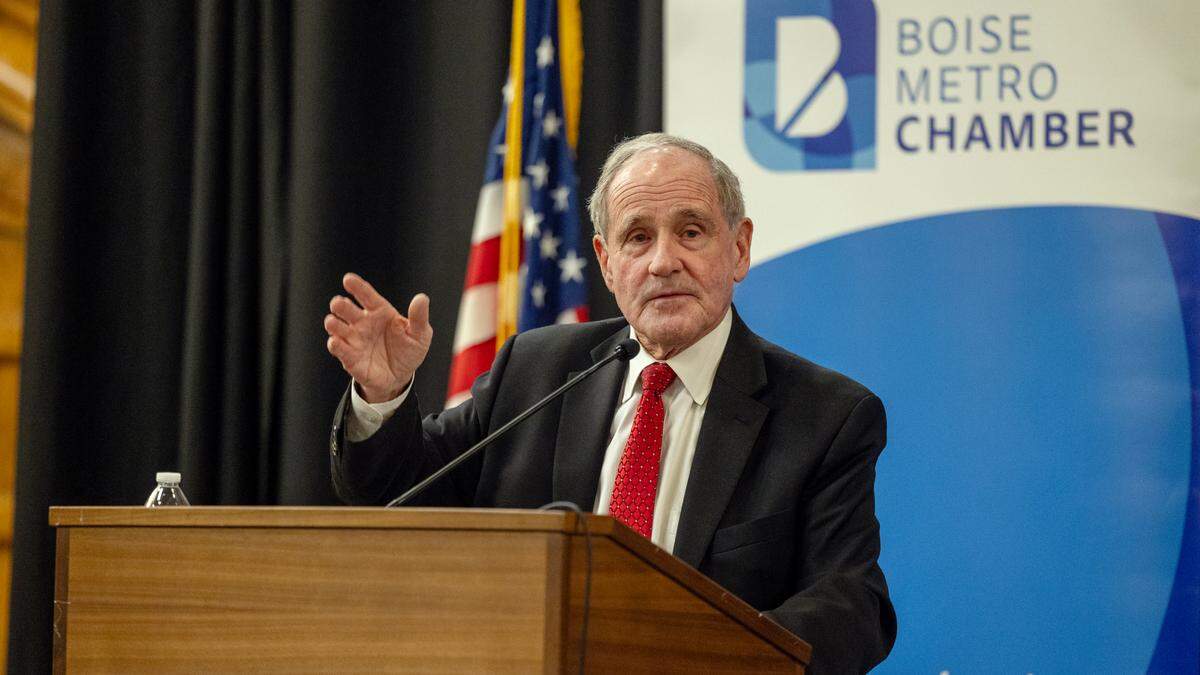
“Sen. Risch did initially attach language to a bill that would have aircraft departing (Boise’s runways) continue straight out further than they do today,” the FAA told Woken. “The FAA administrator advised the senator that the FAA’s safety and efficiency measures would preclude the FAA from accommodating his request. The language was removed from the bill and never became law.
“The procedures today remain unchanged from what has been done for the last several years, both for arrivals and departures.”
The Boise Airport has had no changes to its flight paths, Tammy L. Jones, an FAA spokesperson, confirmed to the Statesman in an emailed statement.
How long will inversion conditions remain in Boise?
If you’re one of those who have been frustrated by the sound of planes overhead, bad news: You’ll have to put up with it for a few more months.
Even once the current inversion conditions clear out, it likely won’t be long until another settles in, National Weather Service meteorologist Josh Smith told the Statesman
“Unfortunately, I think we’re going to be stuck with fog and poor air quality for a while,” Smith said. “That’s pretty common this time of year. Typically, our inversion seasons run from Thanksgiving to Valentine’s Day. That’s the peak season for us.”
This story was originally published December 18, 2023 at 4:00 AM.