Commission decides on Boise’s plan for more affordable housing, density. What you missed
Boise’s revamp of its zoning code has gotten one step closer to passing.
The Boise Planning and Zoning Commission voted unanimously to recommend the rewrite on Thursday, setting up an overhaul of the code for the first time in six decades.
The code is scheduled to go to City Council in June, when the council will decide whether to turn it into law.
The proposed code includes major changes, adding incentives for affordable housing and sustainability, mixed-use districts along transit corridors, encouragements for more urban development and changes to the public hearings process for some applications.
Late Thursday night, the commissioners moved to greenlight the new code, arguing that it is in line with Boise’s established aim to grow up and in rather than to sprawl, and to seek solutions to a housing crisis that in recent years has brought sharp rises in rents.
While the commissioners recommended the code be adopted, they did have notes and suggested tweaks for city planning staff, drawn from the public testimony of over a hundred residents earlier this week.
What did the public say?
Over several hours of testimony split across three nights, more than 130 residents and 13 neighborhood associations testified about the drafted zoning ordinance.
Those in favor said they wanted more housing for the growing city, allowing different housing types for a diverse population with different incomes. Advocates said they felt a more compact Boise would make it easier for people to choose to drive less in the future and would reduce the city’s sprawl, protecting undeveloped land in the Foothills.
Gerri-Lynn Graves, who said she is homeless and disabled, told commissioners Wednesday that she has been looking for employment and has been unable to find a home that she can afford.
“Had we had adequate housing, I think I would be OK,” Graves said. “But now I’m not. … I don’t know why all of a sudden we want to close the floodgates and act like we want to keep everyone out.”
Ellen Nelson said she is a certified planner, and that many cities have failed to modernize their zoning codes but believed that Boise is on a path to success.
She said opponents often cite neighborhood character, parking, traffic, taxes and an overly friendly approach to developers in opposing allowances for greater density.
“Time and again those arguments really have not proven out, and … the market has not done a good job at giving us the times of things that we need in our communities,” Nelson said.
Groups in favor of the rewrite included the Boise Bicycle Project, Idaho Walk Bike Alliance, the Idaho Conservation League and the Conservation Voters for Idaho.
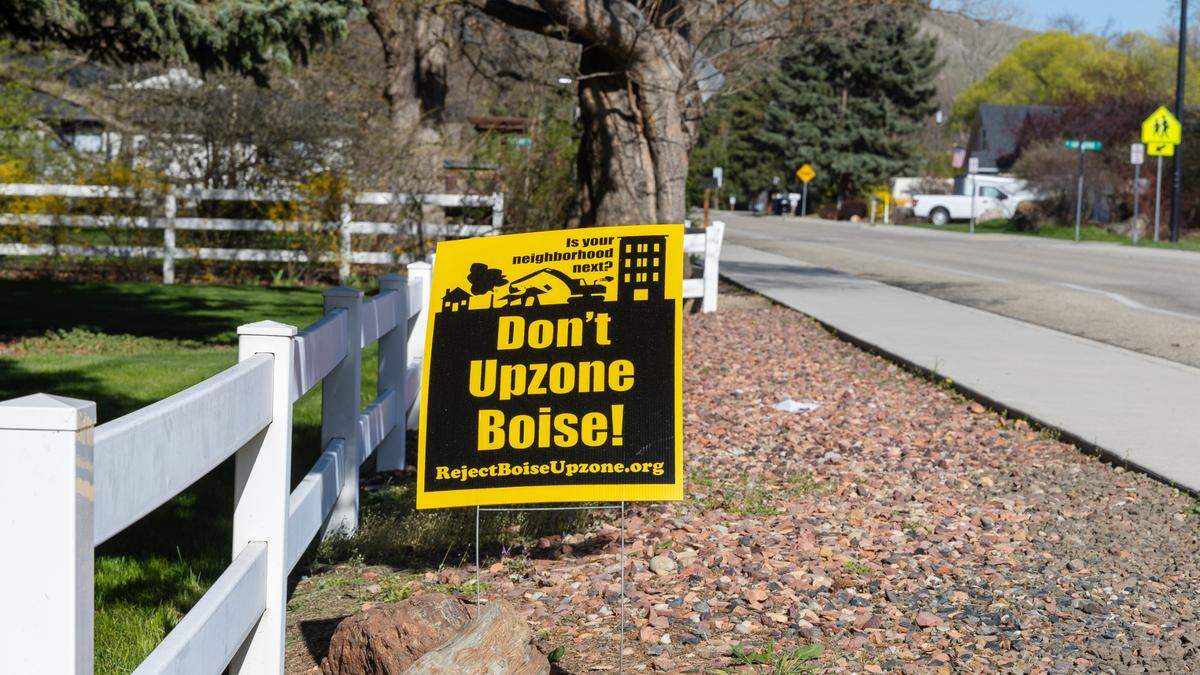
Opponents of the rewrite argued it would harm existing neighborhoods by allowing larger buildings to be built nearby, thus changing the feel of the city’s neighborhoods. Others worried about insufficient parking because of reductions in the minimum requirements in residential areas, or said public transit infrastructure is not yet widespread enough for many people to give up their automobiles.
Some critics said the effects of the new laws would have unequal effects on different neighborhoods, and that the largest changes would occur in Boise’s poorer communities.
“I feel like the zoning changes are aggressive towards low-income, less affluent, older neighborhoods,” said Karen Scriver, a resident of Veterans Park.
John Gannon, D-Boise, said he does not think there has been enough contact with the public about the plan. He said there should be an executive summary of the more than 600 page document posted on the city’s website, as well as a list of frequently asked questions coupled with responses.
What issues did commissioners discuss?
On Thursday, commissioners had a wide-ranging discussion about the minutiae of the code, talking about tree canopy requirements, parking minimums, conditional use permit requirements, hearing notice requirements, building heights and more.
Commissioners said they had heard a lot about the parking problems during testimony, but that the changes were an important shift in how the city thinks about cars.
“There is no free parking. Someone always pays for parking,” Commissioner Milt Gillespie said.
“If society is trending towards less car use, I think this code does a nice job of striking that balance,” said Commissioner Bob Schafer.
Commissioner John Mooney said that he hopes the city lays out the changes in the code more clearly for the public.
“How difficult is it for a lay person to read the code?” he said. “The suggestion that an executive summary would help … maybe there’s a way to simplify it and make it a little easier for a lay person to understand.”
The commission also discussed density incentives’ effects on different parts of the city. As part of the rewrite, the code would allow triplexes and fourplexes to be more easily built in the largely single-family residential areas of the city so long as some of the units were priced affordably.
For a triplex, one unit would have to be priced at 80% of the Area Median Income or less, and for a fourplex, two units would have to be priced at that level.
The commissioners noted that some testifiers said the changes could drastically remake neighborhoods, whereas others said the affordability incentives would have no effect on neighborhoods and therefore not create more affordable housing.
Commissioner Chris Danley noted that Idaho does not allow the city to require some units to have below-market rents.
“If people want that to change, the building to do that is right up the street,” Danley said, referring to the Idaho Capitol.
In response to criticisms that the effects of the changes would be disproportionate across neighborhoods, Gillespie said he thought lots of the changes would affect many parts of the city.
He said the extra units allowed in residential areas — and smaller lot sizes and allowances for accessory dwelling units — would spread out density, as all parts of the city have such neighborhoods.
While he said it might result in some tear-downs of smaller single-family homes that could be replaced with duplexes, ultimately that’s a good thing.
“It increases more housing units in a neighborhood, because in the long term that process leads to more density — more housing — which improves affordability over time,” Gillespie said.
In an email, Lindsay Moser, a spokesperson for the Planning Department, said the city was “very intentional” about how the provisions would affect neighborhoods.
“Each planning area was treated equitably and provides opportunities for different housing types so residents are able to choose where they want to live in our city,” she wrote.
Commission discusses politics
Some critics said the passage of the new zoning ordinance should wait until after the November elections, when the entire council will be elected by district. Two of the six council members were appointed by the mayor, since Elaine Clegg left her seat to lead Valley Regional Transit and Lisa Sanchez lost her seat when she accidentally moved out of her district.
Danley said the rewrite process has been going on for years, and that it shouldn’t stop because of recent circumstances.
“If the new council that’s elected decides to undo these things, they have that right,” he said.
The commissioners also discussed the issue of private wells running dry in areas southwest of the city, and whether that issue should be addressed in the zoning code. Ultimately a city lawyer advised the commission that the issue is a matter for state regulation.
In recommending its passage, multiple commissioners also encouraged the city to play close attention to whether the new zoning results in the changes they want to see, and to make changes if it does not.
This story was originally published April 28, 2023 at 9:39 AM.