Boise wants to be carbon neutral by 2050. How can it do that? What’ll it need from you?
Emblazoned on the windows of Boise City Hall is a message: Carbon Neutral by 2050.
How will the city make that happen? And how will the lives of Boiseans need to change for the city to meet its climate goals?
How buildings are heated and cooled will have to change. The energy that powers our cars will have to change. The ways we get to work, how we live and where our food comes from may also have to change.
Read on to see what’s coming to Boise and how your gas-powered car, home furnace and water heater will change.
The situation
Though per capita emissions have come down since 2015 in Boise, the city’s overall emissions have risen by 3%, and fast-paced growth in the Treasure Valley is expected to increase the demands for electricity and natural gas, as well as the number of gas-powered cars on the road, according to a 2021 city climate plan.
By 2050, the city’s growth is expected to increase carbon emissions — the main contributor to human-caused global warming — by 34%, according to the city government’s review.
Heating and cooling buildings and transportation make up most of the city’s emissions, with each accounting for a little under half.
Idaho Power has committed to powering up its customers with 100% clean energy by 2045, which will help Boise cut its emissions by 23%, the review said. Updated building codes may also help decrease the amount of heat or air conditioning that leaks out of buildings. An additional 9% could be cut by the expected shift from gas-powered to electric vehicles.
These changes could reduce the city’s 2050 emissions by 32% from what they would otherwise be, according to the review.
“... The remaining emissions shown in the adjusted forecast need to be mitigated through climate action,” the 2021 review said. “This requires immediate and high-impact action, both to reduce emissions and prevent them from increasing as Boise continues to grow.”
Boise’s climate action manager, Steve Hubble, said the city government’s focus comes down to three main tenets.
“It’s really about people, health and jobs,” he told the Statesman in an interview. “As we work through the technical solutions, we try to make sure that we’re checking those boxes and not only taking climate action but tying those benefits back to people,” especially those residents who are “likely to be more impacted by climate change than others.”
He also pointed out the emerging climate jobs sector, which could bring more employment to the region.
Mayor Lauren McLean created the city’s climate action division in the summer of 2020, and the team now has four members charged with implementing the city’s sustainability goals.
What else has to change?
Adapting to and preventing climate change will require that we change some of the ways we live.
Boise’s goals paint a picture of the future. They could mean you bike to work and have an electric heater at your apartment. On weekends, you drive an electric vehicle into the Boise National Forest to go camping.
Boise has set an array of goals across many sectors to meet its carbon aims. The array includes a ‘stretch’ goal of getting the city government to 100% clean electricity by 2023 and to carbon neutrality by 2035.
“There’s one path where we’re really working to reduce emissions,” Hubble said. “And then there’s another side of climate action that I would describe as more focused on adaptation and resilience.”
What changes can we expect? Here are five:
1. How houses are heated and cooled.
A lot of the emissions reduction efforts will be in housing, which will require major alterations.
“To achieve the target for this opportunity, virtually every housing unit and business will need to undergo some form of energy efficiency retrofit in the coming decades,” the city’s plan said.
That will require political change and economic shifts, like removing gas-fired furnaces and hot water heaters.
“Eliminating heating emissions would require local policy changes and market transformations that support all-electric new construction and retrofitting existing building stock to electric heating systems and appliances,” the plan said.
2. Denser development, with more people living in apartments.
More compact development, which can reduce vehicle trips, could also reduce the “need for expansive roadways, thus reducing urban heat islands,” the plan said.
3. More geothermally heated buildings, and rooftop solar.
Further, Boise wants to expand the number of buildings that use geothermal energy. Two percent of the city’s energy now comes from the underground resource.
It also wants to increase the number of buildings with rooftop solar in the city.
4. A switch to electric vehicles, with charging stations on street corners.
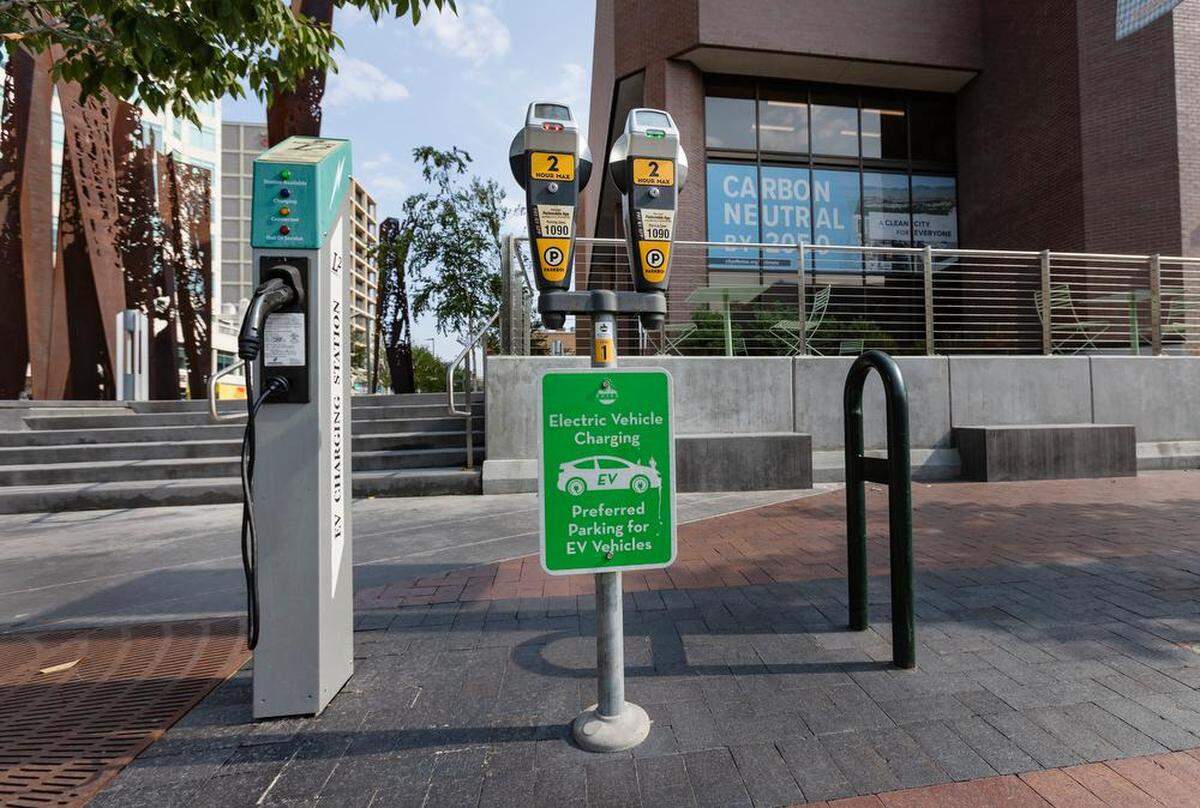
Other big changes will come in the transportation sector, with the electrification of the city’s fleet of vehicles, including the city’s bus system, which is operated by Valley Regional Transit. Many more electric vehicle charging stations will need to be installed around the city, and Boise could implement such measures as setting parking space maximums to discourage driving.
5. Protected bike lanes on more streets, and better bus routes.
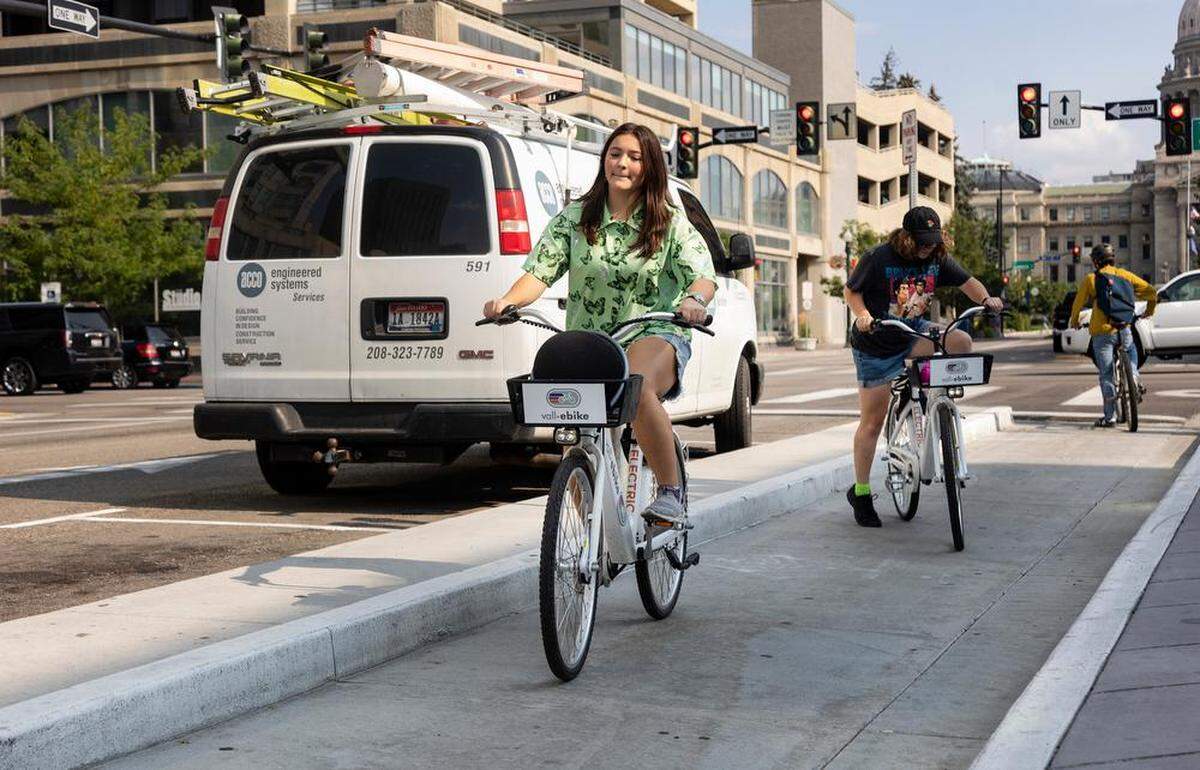
The city also plans to add more protected bike lanes — bike pathways separated from the street — and to expand bus routes to decrease the reliance on cars.
A fifth of city’s reductions to come from unknown sources
A lot of these changes could be difficult to implement and will require major investments. The city wants to get more people walking, but about 30% of the city’s streets don’t have have sidewalks, according to the city’s plan.
Municipal services, like trash collection, would have to convert to electric. The plan mentions deploying 10 electric trash trucks in 2021. The city’s trash contractor, Republic Services, now has three such trucks on the road and plans to have 10 by the end of 2023, according to a September presentation by the Public Works Department.
A significant proportion of the city’s reductions will come from as-yet unknown sources. Eighteen percent of the city’s emissions reduction goals are accounted for with “emerging technologies” and carbon offsets — reducing emissions or storing carbon in one place to make up for emissions elsewhere — according to the plan.
“To become carbon neutral, innovation is needed to reduce or offset the harder-to-reach emissions sources for which cost-effective commercially available technologies are still under development,” the plan said. “Innovation will also spark creative ways to scale and accelerate existing efforts and new opportunities.”
The city’s efforts could get a boost from federal efforts to fight climate change, both by helping the city get more electric vehicles into its fleet and by helping transition the public to electric vehicles.
Climate resilience
A second emphasis of the city’s plan is resilience, which leaders say will be needed to adapt to and prevent the effects of environmental changes.
The plan to plant 100,000 trees by 2030 will help sequester carbon. Existing trees in Boise store an estimated 356 million pounds of carbon, adding 13 million more pounds of storage each year as they grow, according to the city’s plan.
Bolstering local farming could reduce food-related emissions by simplifying extensive supply chains. The city operates a 4,225-acre farm, called Twenty Mile South Farm, which grows crops using treated waste from the city’s sewer plants that is sold to livestock producers.
Even with mitigation, what climate impacts can Boiseans expect?
With more than 150 years’ worth of emissions from Europe, the U.S. and other nations already in the atmosphere, reduced emissions will still leave significantly more greenhouse gases in the air than would otherwise be there, which scientists predict will have major effects.
While considerable warming has already occurred, scientists predict warming rates will be faster this century.
The effects of human-caused climate change have already made wildfires more intense, extreme weather more frequent and flood risks more unpredictable, according to an Ada County Multi-Hazard Mitigation Plan published this year.
In this century, further warming could worsen landslides and severe droughts and make dam failure more likely, according to the plan, which evaluated an array of risks in the county.
Scientists have developed high-, medium- and low-emission scenarios, which link predictions for how large future climate impacts will be to whether nations are willing to drastically curb greenhouse gas emissions over the coming decades.
In high-emission scenarios — meaning nations worldwide continue to pump gases into the atmosphere at current or higher levels — snowpack in the mountains north of Boise is expected to drop by a third by the middle of the century.
Idaho’s annual mean temperature would rise by 11 degrees by midcentury, according to the hazard preparation plan.
In the 30 years before the turn of the millennium, Boise saw an average of less than one day per year with a heat index — what temperature and humidity combined actually feel like — over 100 degrees. By 2050, close to two weeks of the year could have temperatures that high, according to the hazard plan.
This past summer was one of the hottest ever, with a record 27 days over 100 degrees. The previous record was 20 days.
Boise’s vulnerability to extreme weather is high, and ranks first before seven other natural risks in the hazard plan.
A 2016 study found that drought is expected to come more frequently, with moderate drought anticipated to happen in one of every two years, rather than in one of every four years, as it does now.
The drought increases are expected even with the higher precipitation days because of “increased evaporative demand with warming,” according to the city’s plan.
By 2050, “exceptional” drought is expected to occur in one of every three or four years, versus one of every 12 years, as it does now. And the study predicted a 400% increase in the frequency of “low flow levels” in the Boise River, also by midcentury.