Could your home burn in a wildfire? New tool shows which Boise properties are at risk
A new analysis of wildfire threats to property shows thousands of homes in Boise are at risk of burning in wildfires, and that risk will only grow in the next 30 years.
According to a model created by First Street Foundation, a nonprofit that analyzes climate change risk to communities, more than 67,000 Boise properties — or about 77% of all existing properties — are currently at risk of burning in a wildfire. In 30 years, the organization predicts that number will increase to nearly 75,000.
The model, which is considered the most comprehensive look at wildfire risk for property to date, was based in part on U.S. Forest Service projections that showed Idaho homes have a greater wildfire risk than 94% of other states. But it doesn’t take into account growth, a major risk factor in Boise as more people move to the Treasure Valley and development sprawls into higher-risk areas.
Experts said they plan to improve upon the model in the future and, in the meantime, hope it will raise awareness about wildfire risk and offer property owners and future buyers information they may not have had access to before.
Wildfire models show growing risk
First Street Foundation took inspiration from existing models, including the Forest Service map and Cal Fire’s fire hazard maps, to create its analysis.
“Our model kind of complements those models,” said Jeremy Porter, chief research officer at First Street Foundation, in an interview with the Idaho Statesman. “It’s geared toward property owners specifically understanding their own risk as far as fire hazard and building materials of their specific building.”
First Street combined data about weather, fire fuels and historic fire ignition points and applied a fire behavior simulation to estimate the likelihood and intensity of fire across the U.S. The organization ran millions of simulations based on that data and used the outcomes of those simulations to calculate the likelihood that a property will be affected by wildfire.
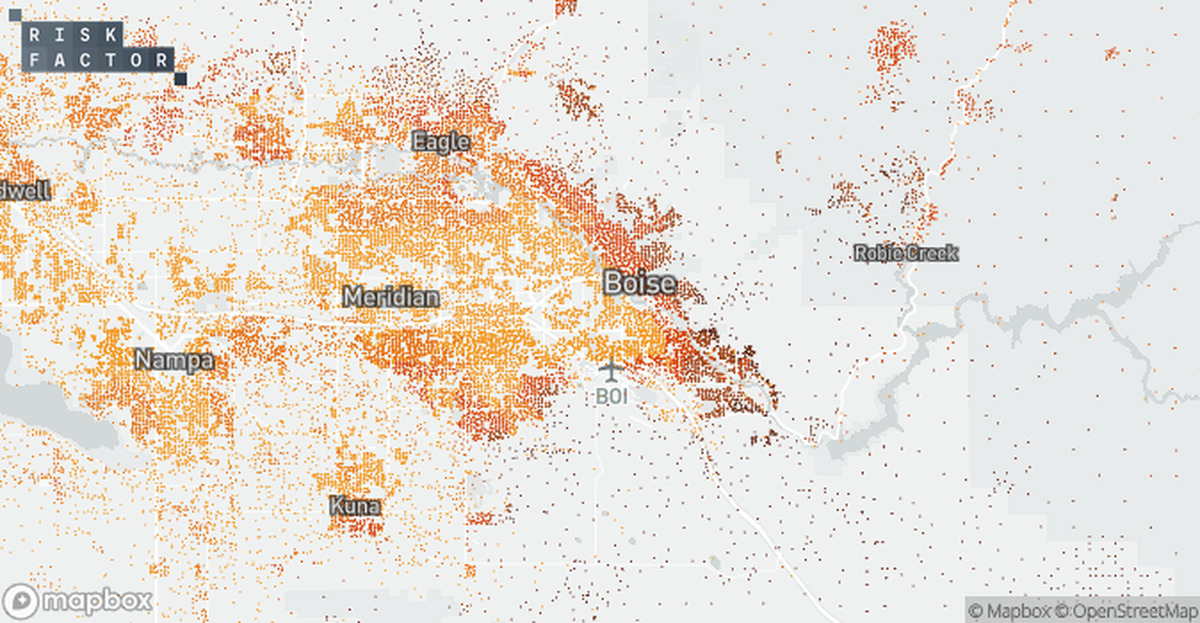
Boise has already started to push into what’s known as the wildland-urban interface, where less dense housing meets forest or Foothills. The Forest Service has considered all of Idaho land that’s likely to burn in wildfires, but according to First Street’s modeling, the areas of extreme wildfire risk will grow by 2052 to include almost all of the Boise Foothills, as well as parts of unincorporated Ada County south of Boise
Porter said that translates to roughly a 1% to 2% chance every year that existing homes in the highest risk areas will burn. Nearly all of the Treasure Valley, with the exception of swaths through the center of Boise, Meridian and Nampa, will have a 0.1% chance of burning in 2052, according to First Street’s models.
“In user testing we found that if you told somebody, ‘There’s a 1% chance you’ll be exposed to a wildfire,’ people felt that was (significant),” Porter told the Statesman.
Wildfire data doesn’t account for growth
Porter said First Street plans to continue improving its wildfire property risk model, including integrating a version that can better understand vegetation and fuel load changes over time.
Moji Sadegh, an assistant professor of civil engineering at Boise State University who studies wildfires, said there are a few ways the model could be fine-tuned to better predict risk in Boise.
“A lot of the work they have done is valid. It’s really valuable work,” Sadegh said. “But some of the assumptions can be a little overestimating — and underestimating, depending on the assumption.”
For example, Sadegh told the Statesman, the current model relies on historic fire ignitions that grew into blazes over 100 acres.
“(Disregarding smaller fires) may be fine in the historical context, but those small fires can become really destructive in the future context,” Sadegh said.
Sadegh also said he thought the 87% at-risk property figure for 2052 was “apocalyptic.”
“All structures around the city in the Foothills are at risk, but I can’t buy the idea that you’ll start burning from the edges and continue into the city,” Sadegh said. “For rural communities, maybe. Not for a big city.”
And the First Street model doesn’t take into account that Boise is a swiftly growing city. Porter said the models “hold everything constant” by comparing risk to structures today with risk in 30 years.
Sadegh said even though enforcement and education have shown trends toward fewer human-caused wildfires, growth still represents a major wildfire risk.
“In areas like Boise where a lot of newcomers are coming in, by virtue of more people and more recreation, there is more chance of fire,” he said.
Porter said First Street is excited to see how the models will change with more detailed data — much of which doesn’t currently exist in a comprehensive way.
“It really is a starting point,” Porter said. “We want people to build on it.”
Idaho property owners can assess their risk
Property owners can determine the potential threat to their own homes by using First Street Foundation’s assessment tools. Riskfactor.com shows overall risk for a community and features an overlay comparison of risk today and in 30 years. It also shows a property’s “Fire Factor,” a rating out of 10 that lets property owners or potential buyers know the likelihood that a specific address will be impacted by wildfire.
The Fire Factor tool is integrated with Realtor.com to make the model more accessible, Porter said. First Street Foundation also created a flood risk tool, but while there is a 100-year flood standard that warns property owners of flood potential, no such risk assessment exists for wildfire.
“This information generally was not available to most property owners,” said Porter. “Insurance adjusters have these types of models, but regular property owners don’t have that understanding and they really don’t have that type of model that looks into the future.”
Porter and Sadegh said they still expect people to live in wildfire risk areas.
“People live (in wildland-urban interface areas) for a reason,” Porter said. “It’s beautiful. People know there’s a lot of risk in these places.”
Sadegh said his criticisms don’t undermine the overall message of the study and the need for awareness.
“What’s most important is bringing awareness that the Boise Foothills are being developed and it’s high fire danger,” Sadegh told the Statesman. “The Foothills are fair game — and that’s fair game every year, not just into the future. “
This story was originally published June 16, 2022 at 12:16 PM.