How did Idaho’s Treasure Valley get its name? Buried treasure? Lost pirates? Not quite …
The name Treasure Valley brings to mind fantasies of long-forgotten adventures and hidden treasures buried in the hills and valleys of Southwest Idaho. The origin of the name isn’t quite as fanciful, but it’s just as interesting.
So how did a large swath of land earn such a unique name?
Answers can be found in the Boise Public Library’s archived copy of a 1972 edition of the now-defunct Treasure Valley Magazine, and in a 1985 obituary in the Idaho Statesman.
Begin with some history. Over 300,000 Americans traveled the 2,000-mile Oregon Trail in the mid-1800s from Missouri to Oregon, beginning a movement that would result in Americans seeking land and opportunity out West well into the 1900s. As a result, several locations in the western third of the country adopted or changed their names to sound appealing to potential settlers looking for a new life. Hence the Magic Valley in South Idaho and the Inland Empire in Southern California.
Southwest Idaho was no different.
In the 1860s, when Oregon had just earned statehood and Congress had created the Idaho Territory, the southwest portion of what would one day be the state of Idaho was called the Lower Snake River Valley or the Boise Valley.
The city of Boise was founded there in 1864, and 26 years later, Idaho became a state.
In those days, the Lower Snake River Valley consisted of 12 counties across the two states. The valley’s boundaries were determined by the locations where several rivers, including the Boise and Owyhee, drain into the Snake River.
The Idaho gold rush of 1863 opened up prospecting grounds for mining, according to the Oregon Historical Society. Mines were dug in the Boise Mountains to the north of Boise and the Owyhee Mountains to the south.
White settlement had negative consequences on the region’s Native American population. The Shoshone and Bannock tribes had lived and traveled through the valley since time immemorial, but their numbers were diminished and surviving members forcibly relocated in 1869 to a reservation called Fort Hall in East Idaho. Today, the Shoshone-Bannock have over 5,900 members, according to their official website.
By the latter part of the 19th century, canals were built to support farming. The region benefited from food processing and forest and lumber products.
But it wasn’t until 1959 that the moniker Treasure Valley was first used.
According to Treasure Valley Magazine, Pete Olesen from Caldwell was serving as president of the Treasure Valley and Caldwell chambers of commerce in 1959. According to Olesen’s 1985 obituary in the Idaho Statesman, he decided that the Lower Snake River Valley needed a new name to draw potential business owners to the area who could take advantage of the land’s rich resources.
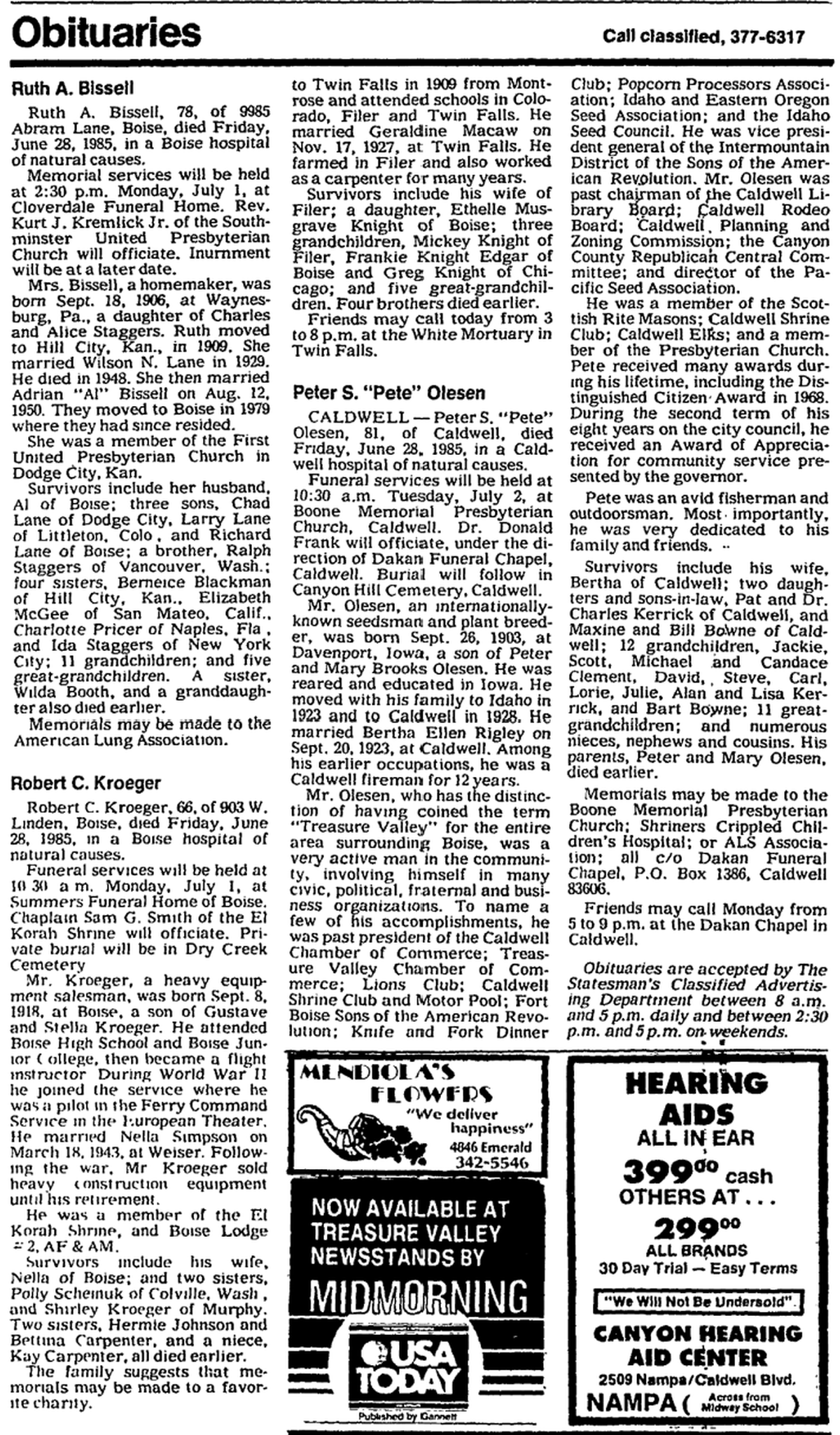
Olesen was a national sales manager for a seed company along with his duties with the chamber of commerce. According to the obituary, he approached the chamber’s board of directors with a pitch to market the valley’s assets. He wanted to project an image of wealth and opportunity.
His idea: Treasure Valley.
The board of directors approved and endorsed Olesen’s idea, which led him to proclaim that the region shall “henceforth be known as Treasure Valley.”
“This valley is a virtual treasure chest of natural resources, abundant recreational and cultural opportunities, agricultural diversification, commercial development potentials,” Olesen said, according to Treasure Valley Magazine. “All tied together with an enjoyable — yes, you might even say an enviable — four-seasons climate that truly makes this region a treasure chest of unexcelled living plus being a great place in which to do business.”
But where are the Valley’s boundaries?
A common question for Southwest Idaho residents today is: What parts of their region are in the Treasure Valley, and what parts aren’t?
That’s a subject of endless debate, just as whether Idaho is in the Intermountain West or the Pacific Northwest. Here’s what the Idaho Statesman Stylebook says:
Different people define the Treasure Valley’s geographic area differently. Generally, it is thought to extend from the Foothills north and east of Boise (which is in the upper Treasure Valley) west to Ontario, following the valley of the Boise River to its end in Caldwell and then the Snake River north to Ontario (which, like Caldwell, is in the lower Treasure Valley).
Some Elmore County residents think it includes part or all of their county. There is widespread acceptance that the Treasure Valley includes all of Ada and Canyon counties, and those counties are what our stories most commonly refer to when we use the term. The term is not synonymous with the Boise-Nampa Metropolitan Statistical Area, which is defined by the U.S. government to include all of Ada, Canyon, Boise, Gem, and Owyhee counties.
Tell us what you want to know:
Business Editor David Staats contributed.
This story was originally published April 13, 2022 at 1:00 PM.