
Boise wants to incentivize housing that’s affordable or historic. What a commission said
Boise planning officials hope that a “housing bonus,” which would offer developers incentives in exchange for projects that benefit the public good, would help Boise get a little closer to meeting its housing needs.
Not everyone agrees.
More than two dozen people testified before Boise’s Planning and Zoning Commission on Monday, many to speak against the ordinance that the city has brought forward.
Officials who designed the ordinance see it as an attempt to fill the gap between the housing that exists in Boise and the housing needed now and in the next 20 years. Residents felt it could create problems.
Here’s how the debate shook out.
What is in the ordinance?
The “housing bonus” ordinance, as the city has dubbed it, offers incentives to developers willing to build projects that, in some way, would benefit the public.
That takes three key forms: Building affordable housing, building near an activity center or building in “adaptive use,” which typically means preserving historical buildings or other existing structures.
Affordable housing, according to the ordinance, is built for anyone who makes between 80% and 100% of the area median income, or AMI. For a single person, 80% of the area median income is about $41,250, while 100% of the area median income would be $51,562 annually.
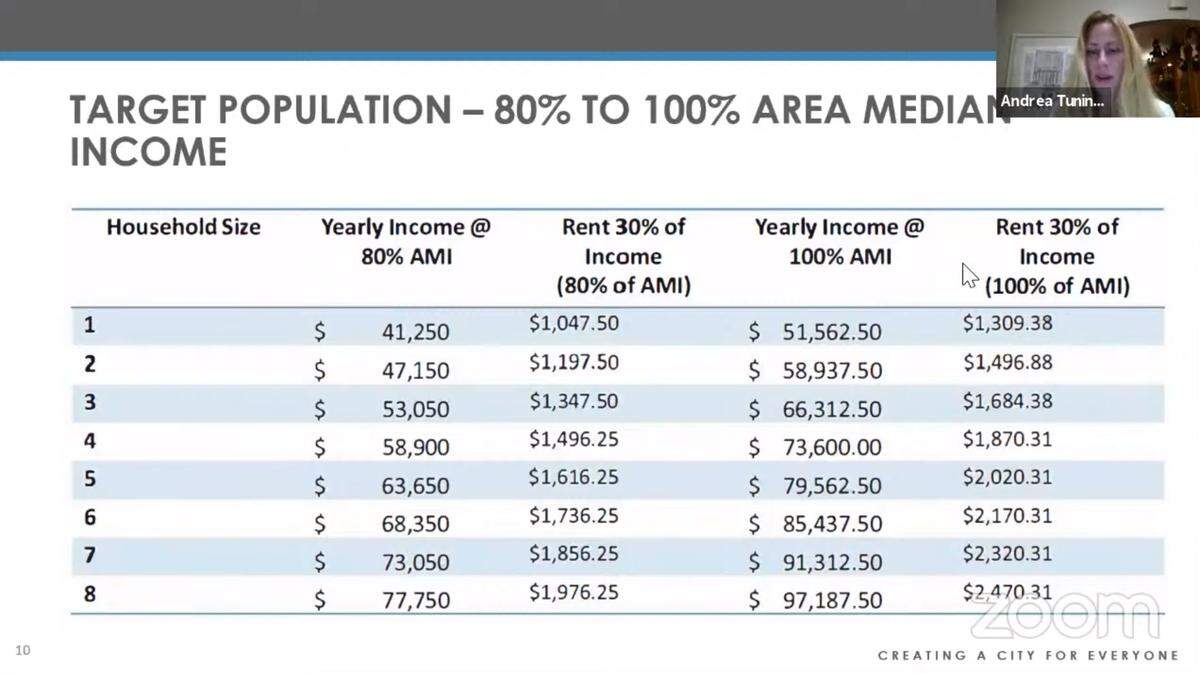
Developers can opt in to the bonus, helping the ordinance to avoid running against state laws against rent control, program manager Leon Letson said.
If a developer chooses to build a project that meets the affordable housing qualification, they would need to dedicate between 10% and 20% of the housing in the project to being income-restricted — or only eligible to people in that median income group described before — and they would need to build in specific zones named by the city. The zones under the affordable housing umbrella include one residential zoning (R3, for multifamily housing) as well as certain office zones and most commercial zones.
The city proposed that developers willing to do that would be eligible for more density than code otherwise allowed, additional height on their building (which means more floors) and fewer parking spaces than typically required for such a project, known as a parking reduction. A developer could also get a “streamlined process” for their project, which would essentially fast-track projects with fewer than 25 units through the standard meetings required for projects.
The second is building near activity centers, which are areas with shopping, workplaces, schools and recreation. Building near one of those could also grant density flexibility, additional height and a parking reduction. It would apply in many of the same zones as the affordable housing incentives.
The third, adaptive reuse, would help to protect existing buildings. The incentives for developers are limited if they take that route, according to the city’s proposal — it would only be eligible for a parking reduction — but it could be done in more zones, including most residential zones.
In past conversations about the ordinance, city officials cited the Travis Apartments, which were in an Art Deco building built in 1937, as an example of how a bonus ordinance could have come into play. If the ordinance had existed then, one city official told the Boise City Council in July, it could have been used to potentially save the building.
The end goal? To increase housing stock.
Boise officials have said in order to meet the housing need of the next 20 years, the city must build 1,000 housing units (which could include houses, apartments and townhomes) annually. By offering developers incentives, city planning officials hope that developers are willing to build something beyond just more-lucrative luxury units
Why are people against it?
Some people didn’t like the change it could potentially bring to neighborhoods. Others didn’t think the ordinance did enough.
Lauren Pennisi, a West End resident, said she felt like the ordinance “put all the power with the developers and leaves the residents of the neighborhoods out.” She spoke of a development in her neighborhood that she felt looked like a “big square box” that did not fit in with nearby buildings.
“This is what everyone is telling us the city needs and that we must have, yet we have to live with the way it looks,” she said.
Michael Prentiss, who lives in Boise’s North End, said he felt that the 80% AMI threshold should be brought closer to 60% to include more people. Richard Llewellyn, president of the North West Neighborhood Association, agreed, saying that building for 80 to 100% AMI would just result in the properties already being built.
If that threshold was lowered, he said, “we’re actually moving the ball down the field in the direction we need to go.”
“It doesn’t solve the big picture,” Llewellyn said, “but at least we’re doing something.”
Many took issue with the fact that the proposed ordinance suggested “streamlining” projects to help them move more quickly through the development process.
“The proposed approval process circumvents the process currently established by the zoning code,” Jenny MacTaggart told the commission. “By doing this, it removes the checks and balances that are essential for high-density projects. These checks and balances ensure that developments are beneficial to neighborhood citizens, to the city and to the developer.”
She said she feared that if that was taken away, neighbors living near proposed projects wouldn’t get the same chance to weigh in.
What did the commission decide?
Commission members voted unanimously to recommend approval of the ordinance, but not before making clear that there were some elements of it they had problems with.
“I believe that there is the potential for abuse of the streamline process,” Commissioner Jim Bratnober said, suggesting that part of the ordinance be removed entirely. “And even when it’s not abused, there will be the appearance of abuse. That’s just the way these things go. So this message is for the City Council: It would be highly unwise to leave that in there.”
Commissioner Milt Gillespie said he felt an ordinance like this was the only way to make sure Boise could get a more robust public transit system by creating denser housing. Commissioner Jennifer Mohr agreed, adding that she was excited to see how the ordinance could evolve.
The ordinance will now go before the Boise City Council. A hearing date has not been set.
This story was originally published December 14, 2020 at 11:50 PM.
.jpg)