
Boise boosted police budget. What councilors say after protesters came to their homes
After a contentious budget season and a failed recall effort, members of the Boise City Council say they’re on the receiving end of demonstrators coming to their homes. An Ada County commissioner says she endured the same thing from anti-mask demonstrators.
The protests feel invasive but have not changed their decision making, they say. The protests also have led to an increased police presence near their homes.
Amid a national debate on the role of police departments in communities, the Boise City Council voted this summer to pass an annual budget for the 2021 fiscal year that increases funding for the Boise Police Department.
Two members, Jimmy Hallyburton and Lisa Sánchez, voted against the budget. The other four council members approved the budget in two votes, first in July and again upon final passage in August.
That decision angered some people, who started to show up in organized demonstrations at homes of Mayor Lauren McLean, who proposed the budget, and the four council members.
Activists with the Boise chapter of Black Lives Matter drew chalk outlines — commonly associated with homicide victims — last month at the home of Council President Elaine Clegg. The outlines had red chalk smears over where the hearts would be. A spokesperson told the Statesman at the time that they aimed to hold Clegg accountable for her vote. The chapter did not respond to a request for comment for this story.
‘Not seen it like this’
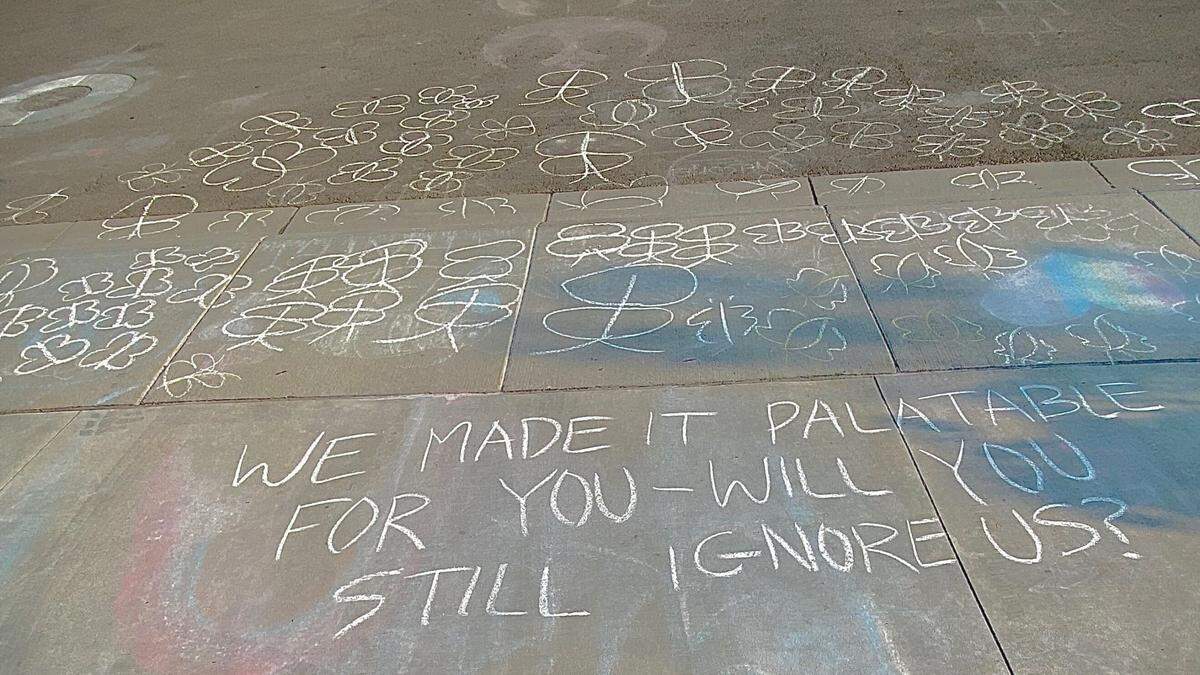
In the early hours of Sunday, Aug. 30, protesters drew butterflies on sidewalks in front of the homes of Council Members T.J. Thomson, Holli Woodings and Patrick Bageant.
Woodings’ daughter, a fourth-grader, found the drawings. Woodings told the Statesman that since joining the council in 2018, she hadn’t seen that level of mordancy from constituents.
“I was used to this more in the partisan Legislature, but not on the City Council,” she said by phone. “I’ve not seen it like this.”
Woodings represented northern Boise as a state representative in 2013 and 2014 and was the Democratic nominee for Secretary of State in 2014. She said she has been living with “the dynamic” of being a public official for many years but had never had people come to her home.
“I understand people feeling the need to bring it to council members homes,” she said. “On the other hand, our homes are our place where we should feel safe and comfortable.”
Thomson said that while he ran for elected office, his wife — who he said had received hateful messages since his vote on the budget — and 6-year-old daughter had not. In his 11 years on the council, he said, showing up at members’ homes had been a place people “hadn’t gone.”
“I think it’s just a tasteless tactic that does not help their efforts,” he said by phone. “I want to work with them, and I plan to work closely with groups to make sure we have the best police force possible. But I think this hurts their cause.”
Bageant said he was frustrated when neighbors told him about the butterflies on his driveway — he had not been home at the time — because demonstrators had never asked for a meeting with him or tried to talk to him in other ways.
“I would never negotiate with an angry mob,” he said by phone.
.jpg "pjimage (6).jpg")
Commissioner’s children slept on her floor
Diana Lachiondo, an Ada County commissioner and a member of Central District Health’s board, said her children slept on her floor for a week after anti-mask demonstrators came to her home on her son’s birthday in August.
She told the Statesman that she empathized with people having a tough time and that she respected people’s right to hold officials accountable, but that she considered showing up at her home “unacceptable.”
“What does this mean for democracy going forward? Who is going to choose to run?” she said by phone. “Is it only going to be people in gated neighborhoods?”
Thomson said what he had gotten was nothing compared with what Sánchez had gotten. Sánchez voted against the budget, but a group recently tried to recall her for what some members called a racist Facebook post she addressed to the parents of Michael Wallace, suspected of firing a gun at a Black Lives Matter protest June 1 at the Idaho Statehouse.
Sanchez wrote that Wallace had “won the race lottery,” because he was able to be arrested and taken into custody after the incident. She signed it, “Love, Lisa Sanchez, Brown woman who chose not to have children for fear of their abuse and murder by white people.”
Sánchez, a Latina and the only person of color on the council, said Monday that she was simply pointing out racism.
She later posted on Facebook several hateful messages she received, some of which came as a result of the recall. One person who messaged her called her “disgusting.” Another expressed hope that someone would kill her.
That recall effort ended Sept. 4 after organizers failed to gather the number of signatures needed.
Increased Boise Police Department presence near homes
Even before demonstrators went to the elected officials’ homes, the Boise Police Department began to prepare for the possibility that they would, according to departmental emails obtained by the Idaho Statesman from a public records request.
An email from Captain Matt Jones to Alison Tate, chief administrative officer, said department members should know where officials live, “in case protests begin affecting them ... as the chief (Ryan Lee) pointed out to me.”
Sgt. Brett Powell worked with other officers in early July to determine where private property lines end at council members’ homes “for trespassing issues.”
Later in July, Allison Stone, a crime data analyst, collected social media posts and screenshots about protests and counter-protests into an email that was shared with Lee and several other members of the department. Similar emails continued roughly weekly through August.
The police department began to assign staff members to some rallies and gatherings. Eventually, the department decided to increase staffing to cover council members’ homes. It also decided to cover McLean’s house, where antimask protesters as well as people associated with the recall had gathered; and Lachiondo’s house, where anti-mask demonstrators gathered just once to her knowledge.
The department decided to have have a public information officer present for videos and statements “in the event we take enforcement action,” and a member of the police records team present “to redact video if this is required for public release.”
Jones wrote that he also wanted officers to be briefed on how to explain enforcement actions.
“For a disturbing-the-peace situation, we are simply responding to a citizen complaint about the noise,” he wrote in a Aug. 18 email. “For anything violent, we are here to ensure public safety, etc.”
He also wrote that he wanted officers to be aware that their actions were likely to be filmed or live-streamed.
Haley Williams, a BPD spokesperson, told the Statesman on Tuesday that “there are no ongoing plans to have an increase in officer presence at those homes or in those neighborhoods.”
Elected officials look ahead
McLean declined to comment for this story.
Lachiondo and Bageant said that showing up at their homes would not change their decision making. Lachiondo said she would continue to look at data and listen to public health experts. Bageant said he would continue to base his on what he thought was best for Boise.
Clegg told the Statesman that she respected protesters’ right to gather but the protests directly outside her home were part of a larger, divisive national narrative.
“I’m going to keep working on policy that betters our community, and that includes supporting community policing,” she said. “That also includes making sure our transit is equitable for Boiseans,” and emphasizing policies that support the health of the environment.
Sánchez said she believed the number of messages has tapered off. She said that six months ago, she got messages from people “passionate about issues,” but nothing like what she has more recently received, which she said attack her for her race, appearance and personal life.
She said she felt the messages were the result of a lot of stress in people’s life, including coronavirus-related shutdowns.
“It’s been a recipe for what we’ve experienced,” she said, ”which is people just being very aggressive toward elected officials.”
She said she had heard from people who, after seeing how she had been treated in recent months, were deciding not to run for office. That is what she said bothered her the most — the idea that other qualified people wouldn’t run because of how they would be treated.
“I may be the first Latina ever on the Boise City Council, but I won’t be the last,” she said. “I’m hoping that these people, these women will stay tuned. We’ve got a lot work to do, and it’s worth it.”
This story was originally published September 16, 2020 at 4:00 AM.
.jpg)