Boise talked plans for a new urban renewal district last year. Now, it’s moving forward again.
Nearly a year ago, Boise announced that it was considering a new urban renewal district on State Street, with a goal of revitalizing an area that is home to a hodgepodge of strip malls, drive-thrus, car washes, parking lots and auto body shops.
And then: nothing. There wasn’t much to be heard from either the city or the Capital City Development Corp., the agency that oversees Boise’s five urban renewal areas.
Now, that’s changing. CCDC said Thursday that it will begin working with businesses and homeowners along the corridor to come up with a shared vision for how an urban renewal district could reshape the area.
“All of a sudden, we had a new mayor,” said Matt Edmond, assistant director of parking and mobility for CCDC, referring to Lauren McLean, who succeeded David Bieter in January. “We wanted to hang back to make sure we were going in the right direction, and we got the go-ahead from McLean.”
In the downtown district, which expired in 2018, urban renewal helped to fund the Grove Plaza Downtown, wider, brick-lined sidewalks, new trees, and private development.
CCDC plans to spend the next 15 months talking with local business owners and nearby neighborhoods about what improvements they want along State Street.
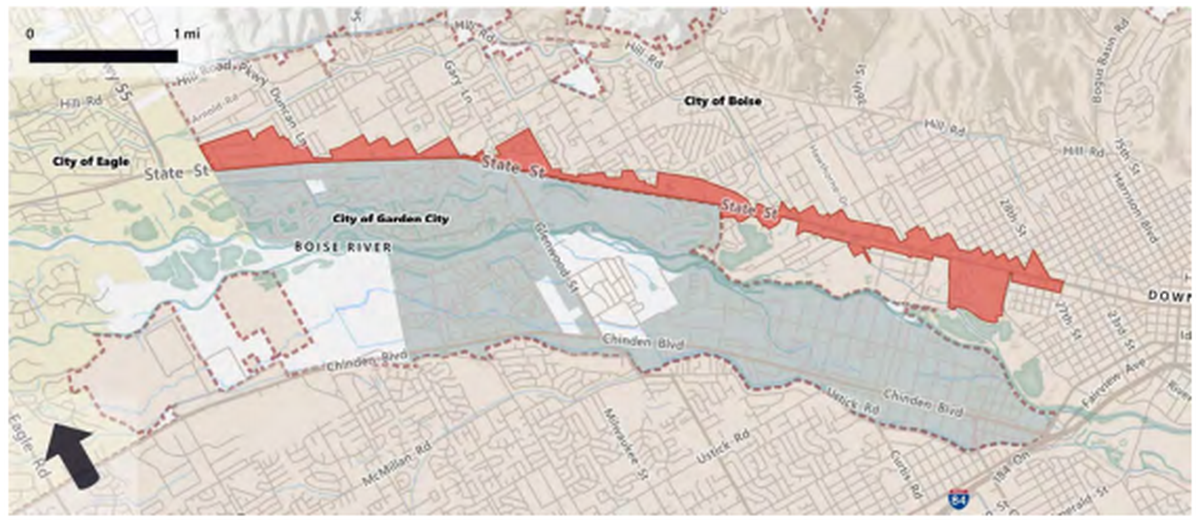
One of Boise’s main east-west corridors, State has long been a sore spot for city planners, and a vision to remake it is already in place. A plan 15 years in the making envisions State Street as a major route for a new bus-rapid transit line, surrounded by “transit-oriented development” — dense residential, office and retail development that provides passengers for the transportation network.
Redevelopment would be focused on four major intersections: Whitewater Park Boulevard, Collister Drive, Glenwood Street and Horseshoe Bend Road.
A key part of improving State is transportation.
ACHD is midway through widening the street from five to seven lanes between Whitewater Park Boulevard and Horseshoe Bend Road, starting with the intersections. The project estimated to cost nearly $185 million.
The city of Boise and Valley Regional Transit are pushing ACHD to dedicate the outer two lanes for a bus-rapid transit system, which would run on 15-minute intervals, and eventually, more frequently.
Already, the No. 9 bus along State Street is Valley Regional Transit’s most popular route. Redevelopment must go hand in hand with improved transportation, planners say. The city needs denser uses than the current strip malls and parking lots along the street to provide a customer base to the bus system.
While most of the momentum behind the redevelopment of State Street has been city-driven, developers are already building the kind of higher-density projects along the street that planners want to see.
Roundhouse, a firm with offices in Los Angeles and Boise, is building The Clara in Eagle, which will include 277 apartments and townhouses west of Linder Road and just south of State.
Scott McCormack, of the Boise-based American Pacific Advisors, has proposed building 85 compact apartments — mostly studios and one-bedrooms — off State and west of Gary Lane.
But urban housing — the kind that faces the sidewalk, with retail on the bottom and apartments above — is much more expensive to build than single-family homes or the typical garden-style apartments seen in Boise, surrounded by surface parking lots.
That’s where CCDC can come in. It can help to pay for public improvements on a site, like parking garages, sidewalks and landscaping. It could also build shelters to go with the improved bus route.
Edmond sees urban renewal as powerful way to spur redevelopment in the area.
“It’s really difficult to do infill development without some kind of tool,” he said.
The tool he means is tax-increment financing. Urban renewal districts are funded by property taxes. The year a district is created, the property taxes collected by authorities like the city, county and highway district freeze. For 20 years after, any increase in property taxes as a result of new development or increases in property values are diverted to the urban renewal agency, which spends those funds on public improvements.
Steve Jaeger, managing partner of Argonaut Investments, which owns the Collister Shopping Center, said he’s supportive of the plans for a new urban renewal district but doesn’t have any plans to redevelop his property.
“As development occurs throughout the corridor, I think Collister will be a centerpoint,” Argonaut said. “We’re supportive of growth and density in this corridor.”
Moira and David Elcox own the house at 4906 W. State St. that’s home to the Enchanting Objects Antique Store. Moira said she would consider redevelopment but needs incentives from the city to help them replace their sewer line with a larger one to allow for a higher-density building.
“Without it, it ends up being so expensive to do, it’s almost not worth doing,” Moira said.
She looks forward to seeing improvements on State. “Right now, it’s sort of a no-man’s land,” she said. “If there were incentives, that would make it more attractive.”
Those interested in participating in the process and learning more about the potential district can visit ccdcstatestreet.com.