
They’re real human bodies on display — and this Boise exhibit will teach you about your own
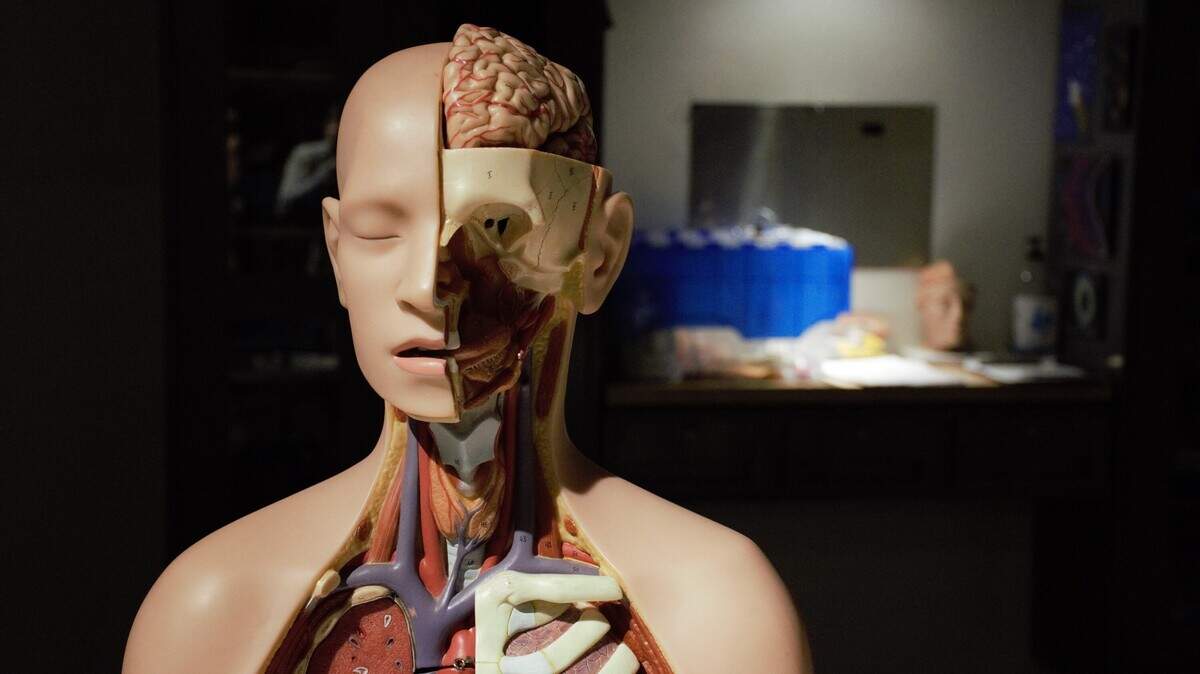
Several large glass cases now stand, arranged strategically around a large room in the Discovery Center of Idaho. Many hold human forms, arranged in different poses. Their veins and muscles are clearly visible to the visitors, employees and volunteers who peer at them, trying to reconcile what they see with what they know functions inside their own bodies.
The Discovery Center’s newest exhibition, “Bodies Human: Anatomy in Motion,” opened Friday. The exhibition focuses on the human body and how it moves by offering a chance to examine over 100 real human specimens. Entry to the exhibition costs $6 on top of the center’s usual admission, or $3 extra for members.
It’s the first time the center has hosted this particular exhibit, though it had a similar one in 2012.
The human specimens on display include individual organs, other specific body parts and more complete bodies. Each emphasizes different systems and how they interact while the body is in motion. In addition, the exhibit features organs in varying states of health, showing visitors what effects certain drugs or lifestyles can have.
“Often when we study the human body, it’s from a textbook. (In this exhibit) you can look at these systems and really see what they look like and how they work,” said Jessica Burke, education director for the Discovery Center. “The hope is that we can generate a greater understanding and appreciation of the human body, and perhaps that will influence the choices we make in our everyday lives.”
The specimens were preserved through a process called plastination, in which body fluids were replaced with plastics by Nanjing Plastinated Labratory in Taiwan. The exhibition is owned by Lynx Exhibits, a museum in El Paso, Texas, which obtained the specimens from various medical schools for the purpose of study or education.
Discovery Center employees are enthusiastic about the merits of the exhibit, Burke said, but decided it would be best to make sure visitors opt into the experience before being exposed to it. The center offers materials about the exhibition at the front desk so visitors can get a sense of whether they’d like to participate.
“It’s very important to us that visitors have a choice,” Burke said. “We recognize that this exhibit isn’t necessarily for everyone. When seeing the human body, everyone will experience that differently — they’ll have different feelings and reactions.”
The Discovery Center is located at 131 W. Myrtle St. The exhibition is available to visit until March 23.
This story was originally published December 14, 2018 at 11:19 AM.