
Bodies of work await students at new ISU cadaver lab in Meridian
Susan Schram gently inserted her gloved hand into the incision on a dead woman’s chest and felt the firm but soft tissue on her fingers.
“It kind of gives you a depth and some sort of perception of what the human body feels like,” said Schram, a 22-year-old physician assistant student at Idaho State University’s Meridian Health Sciences Center. “When I become a physician assistant I will be seeing the surface (of a patient). I need to understand what is underneath.”
Schram and 41 other physician assistant students are among the first at ISU’s Meridian center to learn about the human body’s structure through studying cadavers — donated bodies that serve as a laboratory for understanding anatomy and physiology. The program includes 12 students, such as Schram, who are attending through a partnership with The College of Idaho.
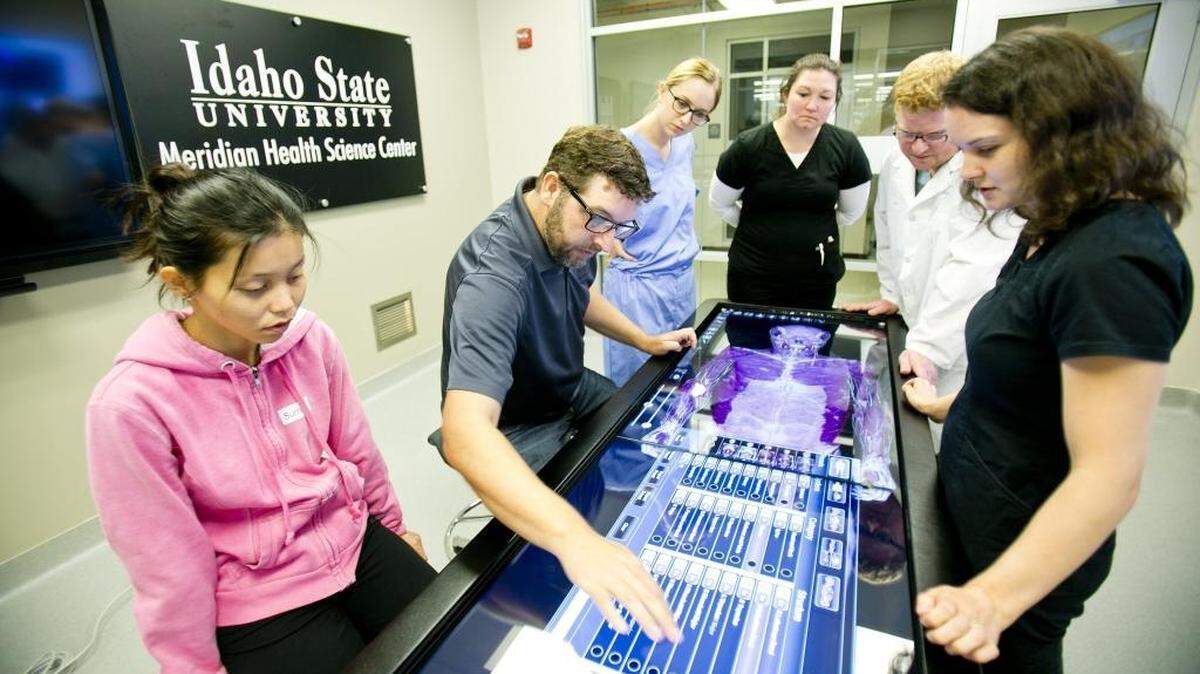
They are studying in the L.S. and Aline W. Skaggs Treasure Valley Anatomy and Physiology Laboratories, a $6 million complex that opened in August. It houses a lab with seven cadavers, a high-tech virtual cadaver table and a bioskills lab, where medical professionals can practice procedures on cadavers or learn new techniques that will be used in hospitals or clinics.
The Skaggs lab is named for the founder of the Skaggs drugstore chain. The deceased couple’s charitable trust, ALSAM, was the lead donor for the project, which was paid for through a private-public partnership. Idaho lawmakers put up $3 million. ALSAM and other groups, including Blue Cross of Idaho, St. Luke’s Health System, Saint Alphonsus Trinity Health System and others contributed the rest. ISU declined to say how much each contributed, citing donors’ confidentiality.
Besides physician assistants, the lab also will be open to dentists, emergency medical technicians, speech and language pathologists, and others who will study the human body.
On a recent school day, more than 30 physician assistant students gathered in the cadaver lab. They listened as Dr. David A McClusky, medical director of the ISU physician assistant studies program at both the school’s main campus in Pocatello and in Meridian, explained blood flow while he stood over a body whose chest had been pulled away from the neck to reveal the body cavity.
This depth of training is essential to physician assistant students, McClusky said. “Whether they are going to assist in surgery or going to be out doing the physical exams, the better you know the human body, the better you can feel it and appreciate it,” he said.
ISU’s cadaver lab has 12 workstations, including a place where students can study actual body parts, such as lungs or a heart. Cadavers are typically kept in a cold storage room, but several of them can remain for much of the semester on tables under metal hoods that clamp at the top.
The entire lab has down-draft technology. Cold air drops from fixtures in the ceiling and the tables are equipped with vents that pull the air out of the room. The technology is not done to avoid the unpleasant order of decomposing bodies in the lab. The cadavers are embalmed with chemicals that keep them from decomposing for a long period of time. But the down-drafting does keep those embalming chemicals from wafting into the air and into the students.
ISU got its bodies from the University of Utah donor program. Typically, donors make arrangements for their bodies’ use in a laboratory before they die. An embalmed cadaver can last for two decades, said Noah Harper, lab specialist in the cadaver lab. Donors, however, often restrict the use of their bodies to a couple of years, he said.
From the lab’s beginning just weeks ago, ISU has laid out rules for respecting the donors who have agreed to let students study them:
“We never joke at the donor’s expense,” Harper said. If students do, they can be removed from the lab and possibly the program, he said.
“Don’t show up not being prepared,” he said. “Learn as much as possible.”
Across the hall from the student lab is the Bioskills Learning Lab, where medical professionals will be able to come to work on procedures.
Creation of the lab grew out of discussions with the medical community as the project took shape starting in 2011. ISU Meridian’s bioskills lab will open in the spring,
“It’s basically for doing demonstrations for emerging medical technologies and new medical devices,” said Bessie Katsilometes, associate vice president for programs at the ISU Meridian campus.
Next year, the lab will hold sessions on procedures that update a product used to draw blood or insert medication when finding a vein is difficult, especially in emergency situations.
“These skills help to prepare students to make an immediate and meaningful contribution to our staff as soon as they graduate, and help to develop and retain top talent right here in our own communities,” said Rodney Reider, Saint Alphonsus Health System CEO. “The bioskills center is using some of the most advanced technology available.”
The bioskills lab uses a different type of cadaver than the student lab. The bioskills cadavers are not embalmed. “The chemicals fix the tissues together,” Harper said. “We want (practitioners) to have as realistic an experience as possible.”
ISU will bring in cadavers that have been frozen. They will be thawed as used in the lab, typically for several days, and then refrozen and shipped from the university.
Back in the student lab, Joel Mathews, a physician assistant student, held a human heart in his hand. He ran his fingers through the openings where veins and arteries carry blood.
He’s held a variety of jobs in his 30 years, from mechanic to cook to a cardiology technician conducting stress tests. Now he has settled on being a physician assistant, like his father. He said he had not seen a cadaver before going into the class.
“To lay hands on the body and explore structures inside-out and outside-in ... it makes it real,” he said. “It cements things in a different way.”
This story was originally published September 24, 2015 at 12:00 AM with the headline "Bodies of work await students at new ISU cadaver lab in Meridian."