
Measles on the rise in Idaho after school vaccine mandate ban. What to know
During a recent legislative preview, Idaho Gov. Brad Little was asked whether he believes the state’s new vaccine mandate ban protects families against the dangers of measles.
“Measles is terrible and a very, very highly infectious disease,” Little responded.
However, he said, the Idaho Medical Freedom Act “doesn’t say anything about educating and about telling the parents ‘If your child is not vaccinated you better not bring them’ ” to school.
The Idaho Medical Freedom Act, which went into effect July 1, prevents governments, businesses, schools and colleges in the Gem State from requiring vaccines, face masks and other medical interventions.
That includes preventing children from attending both public and private Idaho schools or daycare centers due to their vaccination status.
Supports of the Idaho Medical Freedom Act belive medical decisions should be based on individuals’ need, while critics worry the new law ignores medical research proving the effectiveness of vaccines.
The federal Centers for Disease Control and Prevention encourages the use of vaccine mandates for school admission.
“I’m concerned about it,” Little said of a potential measles outbreak. “Our vaccination rate particularly, in certain parts of the state, is starting to get down to a number where we’re going to be susceptible.”
Here’s what to know:
What are measles?
Measles is a “highly contagious virus” that “spreads easily through the air when an infected person breaths, coughs or sneezes,” according to the Idaho Department of Health and Welfare.
The virus has an infection rate of 90%, the CDC said.
“Measles is one of the most contagious viruses on earth,” Dr. Jaime Butler-Dawson communicable disease control program manager for Central District Health, told the Idaho Statesman via phone.
Idaho has the lowest percentage of residents vaccinated against measles in the nation, at 78.5%, according to the CDC.
“That’s why we’re so concerned about when children have measles,” Butler-Dawson said. “If there’s an outbreak, we really need to have a lot of public health action to alert the community and prevent spread.”
What are symptoms of measles?
Measles symptoms typically show up seven to 14 days after you’re exposed to the virus, according to the CDC.
Common symptoms of measles include
- High fever
- Cough
- Runny nose
- Red, watery eyes
- Rash
Measles can lead to “serious health complications,” the CDC said, including ear infections, diarrhea, pneumonia and encephalitis, or, swelling of the brain.
Pneumonia is the most common cause for death in children who contract measles, the CDC said.
Who’s most at risk of measles?
“Anyone who is not protected against measles is at risk,” the CDC said, noting that children younger than 5 years old are especially vulnerable.
Other groups that are more likely to suffer from measles complications include adults older than 20 years old, pregnant women and people with weakened immune systems, the federal health agency said.
“This is a serious disease,” Butler-Dawson told the Statesman. “Kids could get severely sick and hospitalized. Even death could occur.”
How bad are measles cases in Idaho?
As of Wednesday, Jan. 21, there were 16 confirmed cases of measles in Idaho, according to the Idaho Department for Health and Welfare, which began tracking cases over the summer.
The state agency’s measles tracking dashboard is updated every Wednesday.
All of the measles cases either involved people who were unvaccinated or whose vaccination status was “unknown,” according to the dashboard.
The majority of measles cases involved patients ages 5 to 12, the dashboard shows.
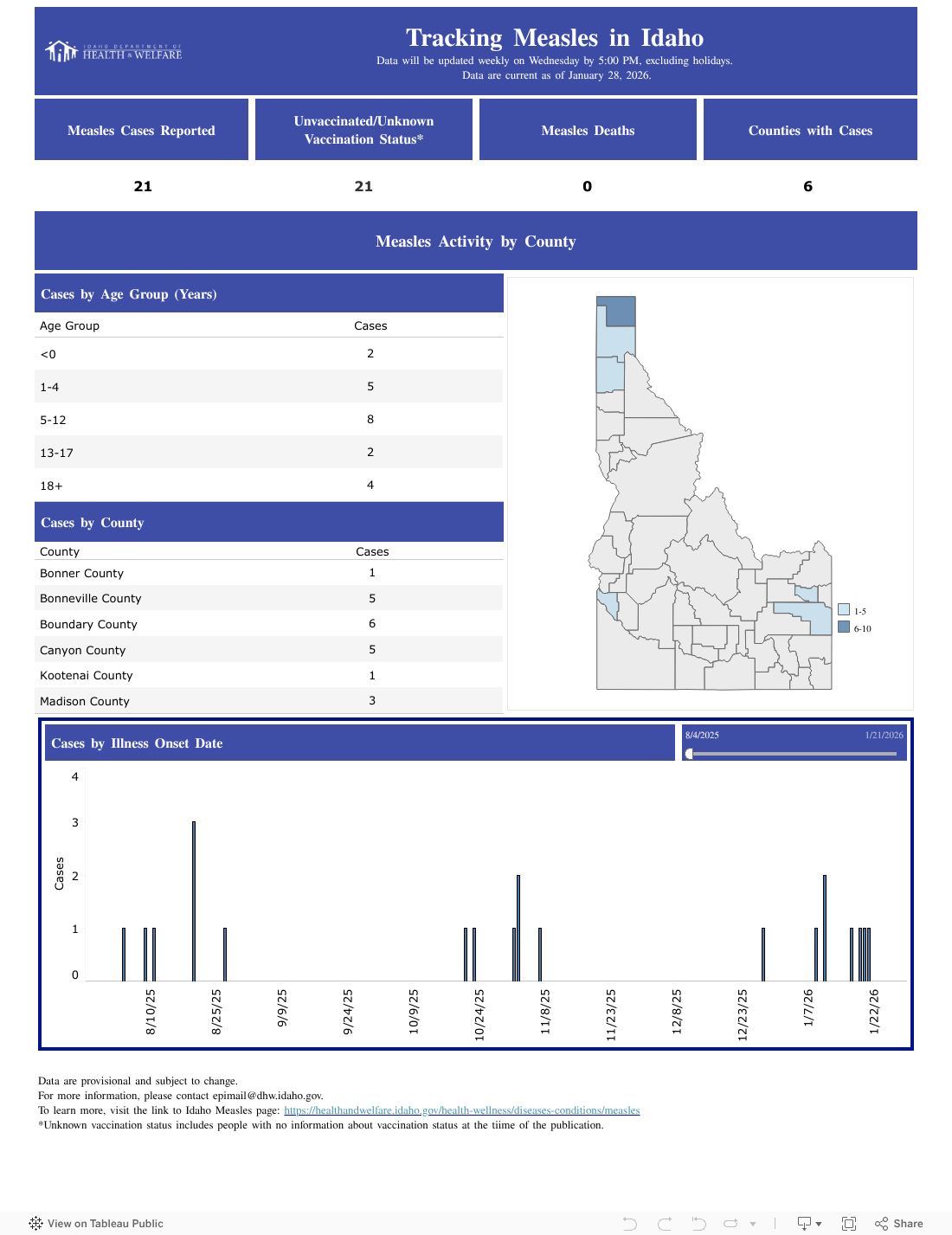
According to the dashboard, measles cases were reported in a total of five Idaho counties concentrated in the northern and far-eastern parts of the state.
Boundary County had a total of six confirmed infections as of Wednesday, Bonneville County had a total of five confirmed infections and Madison County had three.
One measles case each has been reported in Bonner County and Kootenai County.
According to the dashboard, Idaho rounded off 2025 with a total of 14 confirmed measles cases and has already confirmed two infections in 2026.
How can Idaho schools help prevent a measles outbreak?
Schools are “common sites for rapid spread due to close contact and large numbers of children in proximity,” Cynthia Floyd, the Idaho school nurse liaison for the Idaho Department of Education, told the Idaho Statesman via email.
“If we were to have an outbreak, outpatient clinics may be overwhelmed and hospitals may reach capacity due to isolation needs and pediatric care demand,” Floyd said. “The biggest concern I have is the public’s misperceptions.”
With the Idaho Medical Freedom Act in place, Idaho schools and daycares cannot prevent children from accessing their services due to their vaccine status.
However, schools can participate in promoting vaccination and taking other precautions, Floyd said.
These include:
- Reinforcing illness policies so children with symptoms stay home.
- Promoting hand hygiene and respiratory etiquette.
- Maintaining environmental controls such as ventilation, clean facilities and isolation protocols.
- Establishing clear communication with parents and guardians.
- Ensuring staff are trained to recognize measles symptoms.
- Knowing when to refer to medical care.
“These measures collectively reduce transmission, provide clear, calm communication to prevent misinformation and strengthen infection-control practices to protect vulnerable students,” Floyd said.
How to prevent the spread of measles
“The best way to protect against measles is with the measles, mumps and rubella vaccine,” the CDC said, calling it “safe and effective.”
The Central District Health encourages all residents to know their vaccination status and reach out to their doctors to learn more about the MMR vaccine.
“We do encourage getting vaccinated to protect your child, your community and your family,” Butler-Dawson said. “I know that parents are hesitant to vaccinate their children, but I definitely would strongly encourage that you have a conversation with your health care provider to learn more about the MMR vaccine for children.”
You should also get tested if you are experiencing symptoms “to really stop the spread of measles before it gets out of control,” she said.
The Idaho Department of Health & Welfare and Butler-Dawson recommend calling your physician before going in to get tested, so everyone can take necessary precautions in preventing further spread.
“It’s much more effective to prevent measles than to treat it after someone gets measles,” Butler-Dawson said. “There are no treatments except maybe reducing pain.”