Gov. Little left mask mandates to health districts. Some trustees call COVID-19 a hoax
Gov. Brad Little had three words for Idahoans last week as he announced the state had again failed to exit Stage 4 of its reopening plan amid surging coronavirus cases: “Wear your mask.”
However, Little has left decision-making on mask mandates to local entities, deferring to the state’s seven health districts or individual cities to enforce regulations on coronavirus, which has infected more than 11,000 Idahoans with confirmed cases to date. Several cities, including McCall, Ketchum, Boise and Moscow, have enacted such orders. On Tuesday, Boise-based Central District Health became the only health district so far to implement a mask mandate, when all but one health board member voted in favor of enacting an immediate mask order for Ada County.
The districts’ health boards, made up of a county commissioner from each county in the district, as well as an advising physician, are in charge of voting on any mandates — and some of those commissioners in recent weeks have expressed confusion or skepticism about best scientific practices related to coronavirus, while some have gone as far as suggesting on social media that the pandemic is a hoax.
Left unchallenged, those attitudes could hamstring health districts’ abilities to make anything stronger than recommendations to their residents. Meanwhile, health care leaders in Idaho are sounding the alarm that the coronavirus situation is worsening here and could reach crisis levels if it continues unchecked.
Adams County commissioner’s comments on coronavirus raise concerns
During a special meeting of the Southwest District’s health board on July 7, Adams County Commissioner Viki Purdy told her colleagues she felt more concern about the economic effects of the coronavirus pandemic than the threats to public health.
“What is the big deal here with this virus? We know who it affects,” Purdy said via video conference.
She also suggested Idaho should encourage people who test positive for COVID-19 but are asymptomatic to return to work rather than self-isolating. Purdy cited an anecdotal case in Adams County in which, she said, an individual returned to work while infected before his test results had returned. Purdy said no one who came in contact with the man, who never showed symptoms, became infected. (The World Health Organization has repeatedly stressed that there is not enough information on transmission from asymptomatic individuals. The organization reiterated that point last Thursday.)
“Nobody is saying anything positive about where we’re going here,” Purdy added, referring to discussions about increasing COVID-19 diagnoses. “The mental health problems we’re going to be dealing with after this are going to be much worse than the virus.”
Purdy was one of multiple county commissioners on the seven-member health board who expressed opposition to a mask mandate, health advisory for travelers entering the district, or other measures. She doubled down on resistance to masks in public posts on social media in the days ahead of and following the special meeting. A screenshot of one of Purdy’s posts was shared on Twitter last weekend, where it garnered attention and criticism, including from retired physician and former St. Luke’s CEO David Pate.
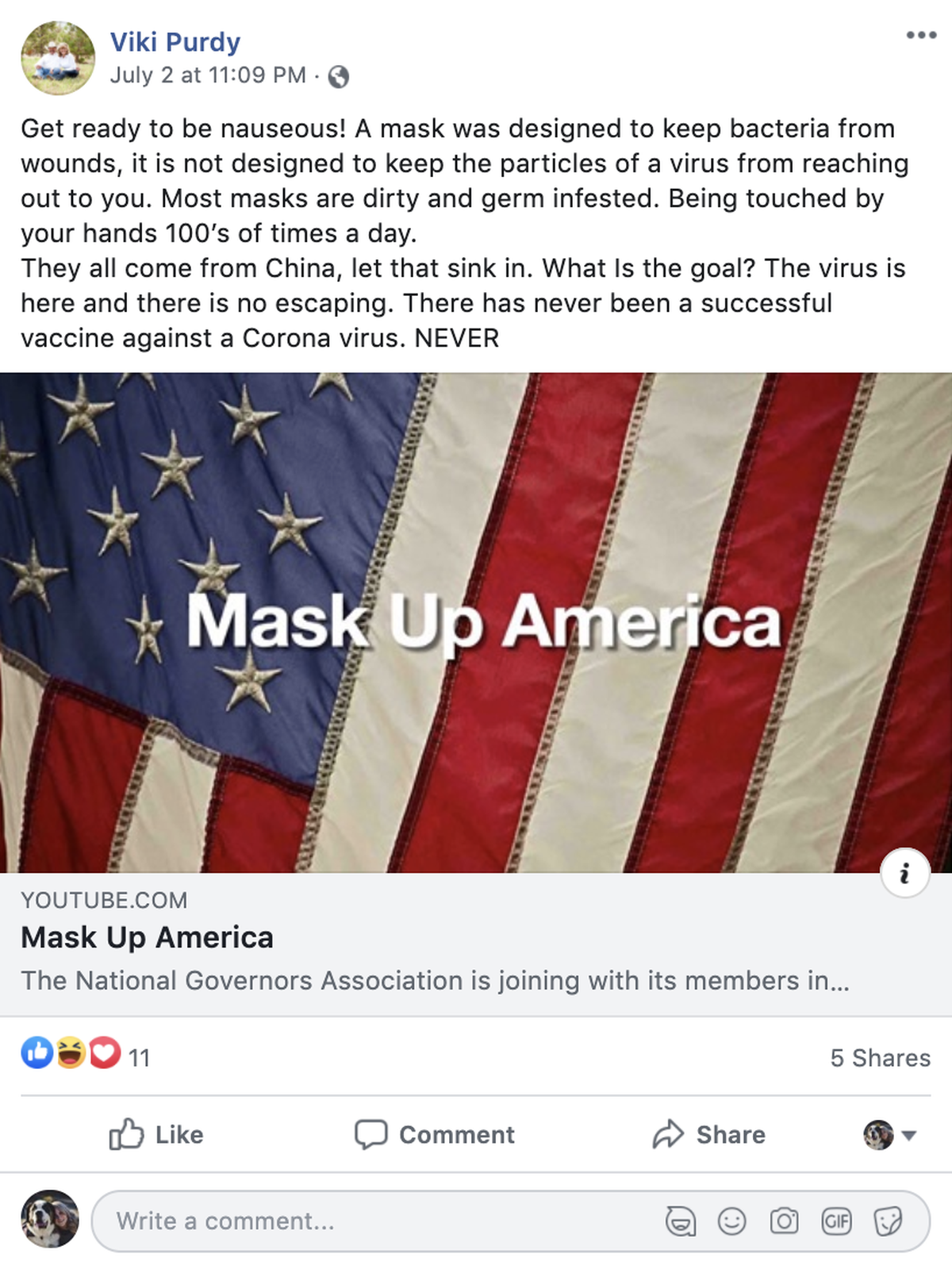
“Get ready to be nauseous!” Purdy wrote in the July 2 post, which included a link to a YouTube video from the National Governors Association promoting face masks. “A mask was designed to keep bacteria from wounds, it is not designed to keep the particles of a virus from reaching out to you. Most masks are dirty and germ infested. Being touched by your hands 100’s of times a day. They all come from China, let that sink in. What Is the goal? The virus is here and there is no escaping. There has never been a successful vaccine against a Corona virus. NEVER”
Pate responded to the post on Twitter: “How can you be on a public health board if you don’t understand public health?”
Purdy did not respond to email or Facebook Messenger requests for comment from the Statesman. A phone number listed for her on the Adams County website is disconnected.
How are Idaho’s public health boards created?
There’s actually little in Idaho code requiring public health board members to understand public health. The Idaho public health districts and their health board structure was created by the state Legislature in 1970 to ensure rural communities had the same access to health expertise as more urban areas. Part of that law requires the boards to be made up largely of commissioners from their member counties, as well as a single licensed physician.
“All members shall be chosen with due regard to their knowledge and interest in public health and in promoting the health of the citizens of the state and the public health district,” the law states.
But most commissioners on Idaho health boards are not public health experts, and they receive no special health training outside of a required orientation when they’re appointed to the board, according to Christine Myron, spokeswoman for Boise-based Central District Health.
“Most board members attend the state annual meeting of boards of health, which provides training on various topics,” Myron explained in an email. “Board members also have the opportunity to attend the National Association of Local Boards of Health annual meeting, which provides additional opportunities for public health training.“
Potential health board members can volunteer or be appointed by another county commissioner. Those appointments are voted on by all member counties’ commissioners.
“The health district staff, including the director, do not provide input,” Myron said of the process.
Pate said he’s puzzled over the inclusion of politicians who are now denying medical advice and wondered whether the voting commissioners were aware of the appointees’ views when they voted.
“Why would they have someone on a public board that doesn’t believe in public health principles?” Pate said. “It does not make any sense to me.”
By public health principles, Pate means “basic infection control measures, basic epidemiology, basic infectious disease” science. These are things “that most every expert in the world agrees about,” he said.
“If I was finding a board member for the St. Luke’s Health System, I probably wouldn’t select somebody who has a religious or philosophical belief that you shouldn’t take treatments from the medical profession,” he continued. “If that was your philosophy, that’s probably not a good role for you ... .”
How much do Idaho health boards know about public health, and how much influence do they have on it?
Several of Idaho’s health districts have an additional medical professional on the board alongside the required physician. But in every district, medical professionals lack the numbers to outvote their non-medical expert counterparts.
Members of the health boards can seek advice or input from medical experts. Central District Health’s board members heard from experts from St. Luke’s and Saint Alphonsus during its July 7 and July 14 meetings. Both times, the medical professionals stressed the importance of face coverings and social distancing.
“I felt like it was really important for us to hear them, as a board, to hear their perspective,” said Diana Lachiondo, Ada County commissioner and Central District Health board member, in a phone interview ahead of the July 14 vote.
Lachiondo said she has an interest in public health as her husband and sister are both physicians. She said she volunteered to be on the board after taking office in 2019. Lachiondo said she frequently seeks out medical and science advice from experts to inform her actions on the health board.
“For me, it’s been so important to listen to our hospital leaders and I have to hope other districts are too,” she said.
Another member of the Central District Health board, Ryan Stirm of Boise County, pointed to medical advice as the best basis for his vote in favor of the Ada County mask mandate during that meeting.
“From someone that came out of literally nowhere into politics, I’m getting an extremely crazy crash course in politics in the last 12 months,” said Stirm, who joined the board last year. “It is a hard decision to make and I feel like ... at the point we’re at right now, I have no choice outside of going with what information we have.
“There’s no right answer,” he said. “But I would like to think that the doctors of these health care systems that we trust with our lives, they don’t work for us. They don’t work for the government. They don’t work for Central District Health. And I would like to think they have everyone’s general safety and concern in mind. I would like the public to know that, too.”
Southwest District Health was slated to hear from medical professionals during a special meeting on Thursday morning. The meeting agenda included discussion on face covering research and a “discussion and vote regarding public health measures.” The meeting was canceled shortly after 9 a.m. Thursday due to safety concerns as anti-mask protesters showed up.
During a district meeting last week, Southwest District Health medical director Clay Roscoe attended and offered input on the rising infection rates, testing shortfalls and more.
Still, commissioners balked at a mask mandate during that meeting. Tom Dale, Canyon County commissioner and former Nampa mayor, encouraged residents worried about coronavirus to continue to stay home and wear masks, though health district officials clarified during the meeting that current recommendations for face masks show the masks protect others from the wearers’ respiratory droplets rather than protecting the wearer.
Across Idaho’s seven districts, each county is represented by a commissioner, and it’s unclear how informed each commissioner is about the pandemic or what their attitudes may be toward measures like mandatory masks.
In addition to her publicly criticized post, Purdy has also shared multiple posts that have been flagged by Facebook for containing false information about COVID-19. Purdy addressed that in another post showing a screenshot of the alert she received from Facebook.
“I seem to be censored daily now and you can bet I would not ever go along with anything the WHO puts out,” Purdy wrote in the post with the screenshot. “The counties [sic] running the WHO have leaders that would kill their citizens for any reason they see fit. A healthy world population is not their goal. AMERICA FIRST!”
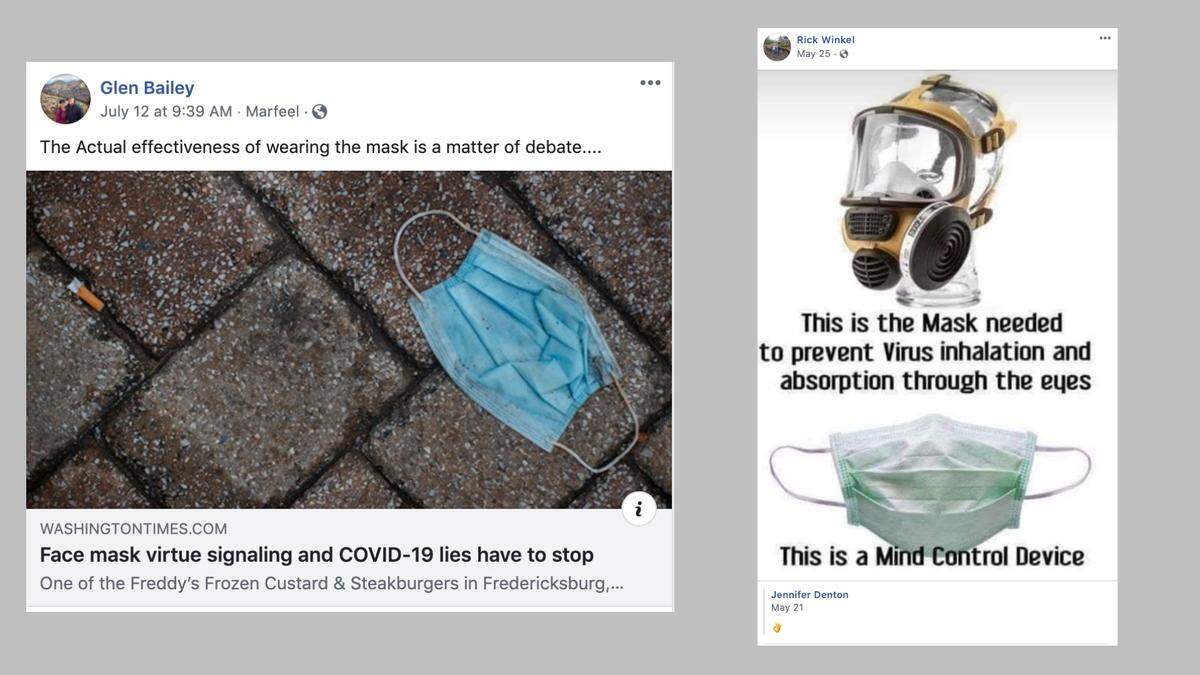
At least two other commissioners — Glen Bailey, Bonner County commissioner on the Panhandle Health District board; and Rick Winkel, Clearwater County commissioner on the North Central Health District board — have shared public posts on Facebook that heavily criticize the use of face coverings.
Bailey recently shared a post of COVID-19 infection numbers that states: “WHY ARE WE WEARING MASKS? Last year alone, in Utah, flu killed 358 people and no one wore a single mask.” The post also says the coronavirus situation “does not even register as an epidemic, let alone a pandemic.” In another post, Bailey shared a link to an article in conservative newspaper the Washington Times which called mask-wearing “virture signaling.”
The Centers for Disease Control and Prevention says coronavirus has proven to be more contagious than the flu and more conducive to “superspreading,” meaning it “can quickly and easily spread to a lot of people and result in continuous spreading among people as time progresses.” Additionally, preventatives such as vaccines exist for the flu, while no such preventative or universally accepted treatment has been developed for COVID-19.
“The Actual effectiveness of wearing the mask is a matter of debate...” Bailey wrote on the July 12 post.
In recent weeks, Winkel shared a meme showing a gas mask and a surgical mask. Text under the gas mask image reads, “This is the Mask needed to prevent Virus inhalation and absorption through the eyes.” Text under the surgical mask reads, “This is a Mind Control Device.”
Pate, the former St. Luke’s CEO, said there’s no place for those attitudes in a body meant to make critical health decisions for the public.
“I don’t think the purpose of the public health board is to debate public health science,” Pate said. “I think it’s to bring expertise to make public health decisions.”
He notes that it’s not just Idaho where face coverings, social distancing and other facts of the pandemic have become politicized.
“We’ve seen this play out on the national front,” Pate said. “We couldn’t get the president and vice president to wear a mask, when we’re saying all the evidence says ‘wear a mask.’ ... We’ve got the same thing. We’ve got the members of some of these public health boards that won’t role-model these behaviors.”
Reporter Audrey Dutton contributed.
This story was originally published July 16, 2020 at 11:16 AM.