Unconcerned, or stir crazy: Young Boiseans gather despite calls for social distance
Camel’s Back Park was bespeckled with picnic blankets Thursday afternoon. Frisbee games broke out amid the trees. A circle of beanie-wearing bongo drum players kneeled at the top of the grassy lawn, providing the perfect soundtrack to a perfect day.
You’d have hardly though a pandemic was wreaking havoc on the globe.
“It’s a nice day, but I didn’t expect so many people wanting to be out,” said Jordan Crawford, a junior at Capital High School in Boise who sat on a small blanket next to three classmates — just a few of nearly 100 people who were at the park that day.
“You can tell that everyone’s, like, teenagers,” said classmate Meagan Gordon. “There are no adults here.”
“Except for those guys there,” Crawford said, gesturing toward a group of 20-somethings drinking White Claws and blasting Ariana Grande.
In an effort to slow the spread of coronavirus, cities around the Treasure Valley have declared states of emergencies, and schools have closed their doors. Last week, Boise Mayor Lauren McLean ordered bars and restaurants to close their dining rooms, and this week she ordered people to gather in groups no larger than 10 and to stand 6 feet from one another. Public health officials are urging Americans to stay at home.
But teens and young adults in Boise — whether from indifference or desperation to escape home— are still venturing out.
Many assume their youth and health will preserve them through the pandemic, and for the most part, they’re right. But a report released last week from the Centers for Disease Control and Prevention found that adults ages 20 to 44 represent nearly a third of U.S. coronavirus patients so far and a fifth of the hospitalized patients.
Even if they don’t show symptoms, young people can still carry the coronavirus and put older people at risk without knowing it. At a news conference last week, President Donald Trump asked young people to take the advice of health officials and not to gather in large groups.
“They don’t realize that — they’re feeling invincible,” he said. “I don’t know if you felt invincible when you were very young ... But they don’t realize that they can be carrying lots of bad things home to grandmother and grandfather and even their parents.”
‘Get your kids home!’
On Wednesday, at the Rhodes Skate Park, Silas Aldridge, 16, sat on a ledge with his skateboard between his knees. He’d been coming to the park more since school closed on Monday, and said it looked busier than normal.
Coronavirus had forced Aldridge to reconsider some of his routines. “I’m gonna wash my hands more now,” he said. “I don’t go to parties now — since Monday.”
“It doesn’t really bother me, because I’m not going up to people and letting them cough in my face,” Aldridge said.
Last week, Boise residents heeding advice to stay home took to Facebook to vent their frustration over unconcerned youths and their unattendant parents.
“How do I say this kindly… Get your kids home!” Laura Heiner wrote on a Facebook post liked by over 250 people. “We all have work off — it’s not for a giant party! Go alone or stay home.”
On the night after the first case of COVID-19 in Idaho was announced, one North End resident complained that kids had rung his doorbell and run off before he could get to the door.
“I’d welcome a ding dong ditch, and actually I’d welcome them to come and TP my yard,” commented back Angela Johnson. “We’re running low!”
Teens worry about the virus, still go out
Not all young people are taking the virus lightly. At Camel’s Back Park, Presley McCormick sat next to Gordon and Crawford, but she’d slightly distanced herself. McCormick said she was starting to worry more about spreading the disease.
What changed?
“Seeing this many people in one area,” she said, looking out over the (seemingly) healthy crowd that had gathered. As she spoke, two more high schoolers sat down to join her group, expanding it from four to six.
“No one is really taking precautions,” she said. “I feel like people aren’t taking it as seriously as they should.”
She paused, then caught herself.
“It’s kind of hypocritical, being here” she said. “But this was not my choice.” She had voted against the park outing but was overruled by a group of friends longing for fresh air and who — more importantly — had cars to get them there.
“Every morning I wake up and I search ‘Idaho coronavirus’ to see how much the cases have increased,” McCormick said. Until Sunday, no Idahoan under 18 had tested positive for the disease.
McCormick and her friends said their social habits had changed, incrementally. They were choosing to spend more time outdoors, going on hikes and, afterwards, liberally applying the hand sanitizer their mothers had thrust into their pockets.
They counted themselves among the lucky ones.
“I know some of my friends can’t even leave their houses for these two weeks,” Crawford said. He didn’t want to think about what would happen if more young people in Idaho started testing positive for the virus.
“My mom would never let me leave the house,” he said, reclining back on the grass. “She already doesn’t.”
The pandemic started to feel a bit more real to them after everything got canceled. First was McCormick’s spring break trip to Arizona. Then a school trip to New York City. Then prom, and all the planned prom-posals. McCormick and Gordon had already bought dresses. They’re waiting to hear if graduation will be next.
Social distancing, but going stir-crazy
At Boise State University, where graduation is also up in the air, students are making jokes about receiving diplomas via AirDrop on their iPhones.
“People are calling it Zoom University,” said Paris Colton, a junior from Boise. At Boise State, she doesn’t get the extended spring break that Boise High students have been granted. She still attends classes via the Zoom video conferencing app and is drowning in piles of homework for her engineering classes.
On Wednesday, the day before McLean closed the restaurants, Colton and her stepsister Emily Weber staked their claim to one of the few tables left at The Flying M in downtown Boise (the coffee shop had removed many of them to ensure a few feet between customers.)
It was the first time Colton had ventured out of her house that week. She had been taking the virus seriously and had tried to follow guidelines issued up until that point.
“Since last week, I haven’t been going out and eating or getting coffee,” Colton said. But, like anyone, she’s not immune to cabin fever: “I can only do so much at home without going nuts.”
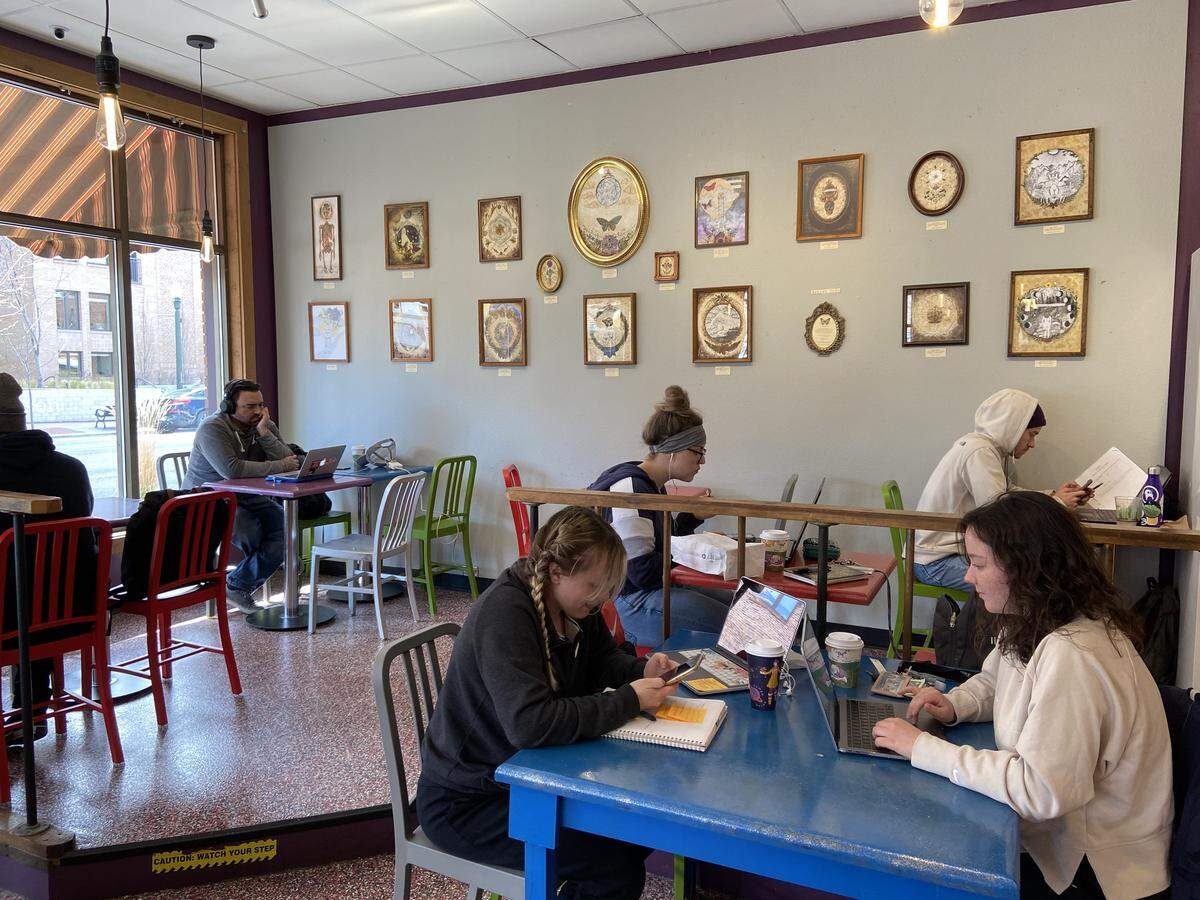
Colton and Weber are realizing they don’t have another flashbulb event to compare the coronavirus pandemic to — another moment in their lives where the nation coalesced together behind a united cause.
“If people lived through 9/11, they can remember that,” said Weber, who was just 3 years old in 2001. “This is the only thing that this generation has ever really gone through together.”
Colton said that her older family members are hoping that, like 9/11, the social distancing and preventative efforts will fade away, and normal life will resume in a few days. But from everything Colton’s read, she’s convinced that daily life is going to slow down, not pick up.
Back at Camel’s Back Park, Gordon and McCormick’s group expanded again, from six to eight people.
Gordon thinks some of the calls to stay inside and social distance may be an over-reaction.
“I don’t think this is going to be the thing that ends the world,” she said. “But my mom makes it seem like that.”
This story was originally published March 24, 2020 at 4:00 AM.