How can Boise deepen its rich ties to India? The consul general shares some ideas
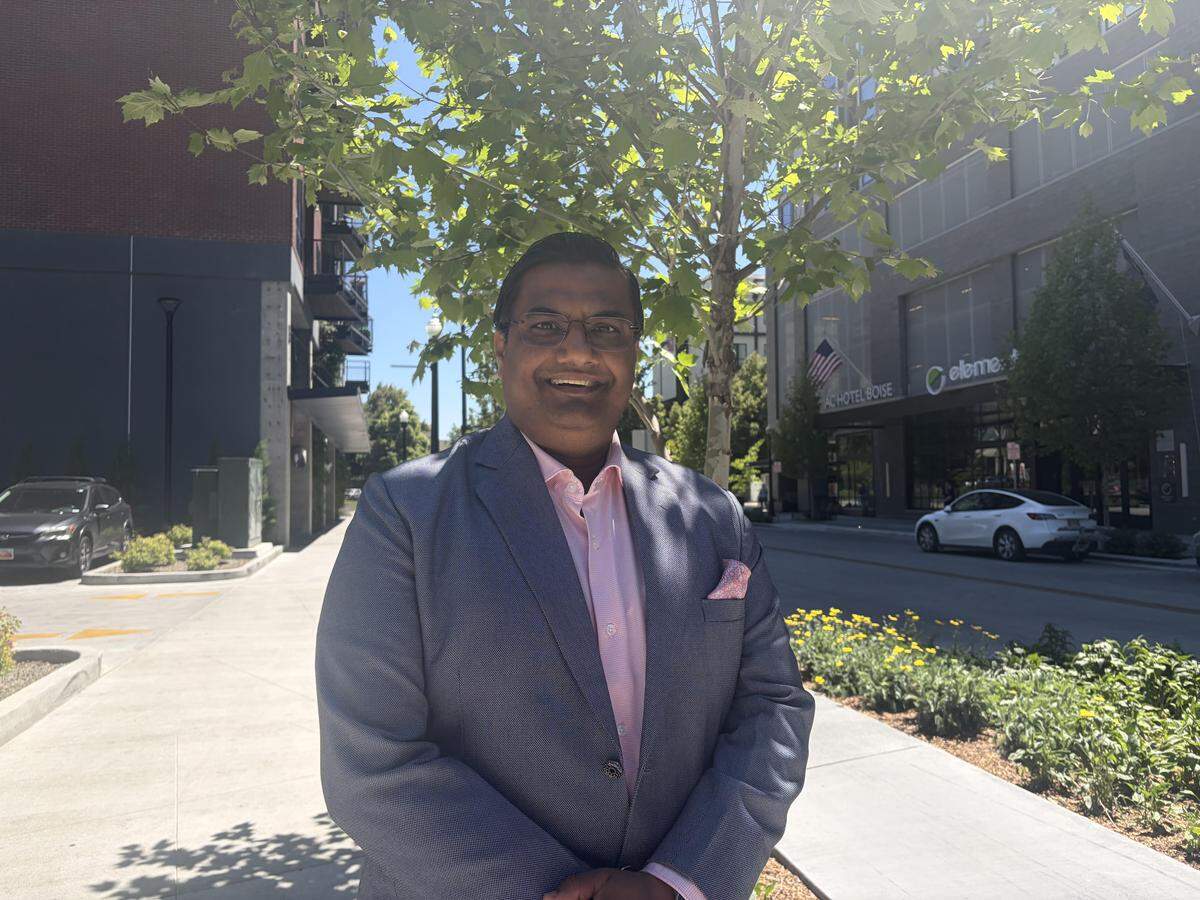
Idaho’s Capitol could soon host a Diwali celebration, and a statue of Mahatma Gandhi could be coming to Boise — two proposals put forward in May by Prakash Gupta, consul general of India, during his second visit to the city.
Gupta oversees the Indian Consulate in Seattle, which opened in 2023 and serves eight states, including Idaho. At least six Idaho-based companies, including Micron Technology, J.R. Simplot Co., Albertsons Cos., Clearwater Analytics, In Time Tec and Cradlepoint, now have operations in India.
“The mayor had (a) wonderful meeting with Consul General of India and appreciated his ask,” Emilee Ayers, press secretary for McLean’s office, said of the potential of a statue coming to Boise. “City staff are still thinking through this ask and contemplating next steps.”
The governor’s office did not respond to a question about the possibility of a Diwali celebration.
Below is a transcript of the Idaho Statesman’s conversation with Gupta on May 22, which has been lightly edited for brevity and clarity.
You met with Gov. Brad Little, Mayor Lauren McLean and other Idaho leaders about a year and a half ago the last time you were in Boise. What has your visit been like this time?
This is my second visit to Boise. I would say it’s been a very productive and substantive visit this time. Even though I got to spend less than 24 hours here, we were able to deepen India’s connections with the state of Idaho again. We had a wonderful reception hosted … by Mr. Skip Oppenheimer and his wife at their residence, where we were able to engage with most of the leadership of the state. Gov. Brad Little and the first lady were there. We had a very good conversation at the reception with the governor on initiatives that we would like to take on with the state. We requested the honorable governor to consider hosting a celebration of India’s festival of lights, we call it Diwali, perhaps in the month of October or early November at the State Capitol in Boise, and he was kind enough to appreciate our proposal and welcome it in principle. We will now work with the governor’s office to get Indian American community leaders and all those who have a deep investment in the India-Idaho relationship to join us for that special Diwali celebration.
The other meeting I had (that day) was with Mayor McLean. Whenever India opens a new consulate, like we’ve opened in Seattle in the last two years, we have this practice of gifting a statue of Mahatma Gandhi, who is the world’s greatest ambassador of non-violence and peace, to a city in our area. We offered to propose that statue for hosting in Boise. We discussed some options, and we are hoping to actualize that unveiling of the statue in Boise as well.
The third visit I had was with Boise State University, where we have some good Indian faculty and Indian students studying. We had a very good discussion on how to deepen exchanges and cooperation in the higher education space with India, because there are some very good counterpart centers of excellence in India where we would like to do more faculty exchange, student exchange and joint research projects.
We also had a good discussion with the leadership of Micron (the previous day). Micron (has a facility in) Gujarat, where they are doing a fab plant. A large portion of their workforce also comes from the Indian community. So, we had a good discussion with them on how to further deepen the India-Micron partnership in Gujarat.
What did those conversations look like with Micron?
Micron is a very important stakeholder for us, as one of the primary investors in Gujarat on the fab facility. India is also kind of pursuing its AI journey. Presently, we recently hosted a very big AI impact summit in New Delhi, where we had Micron’s presence, and wherein we got most countries of the global south to come and join the conversation on AI. We don’t want a divide to come in the AI story between the developed and the developing world. So we came up with a very forward, ambitious-looking outcome document wherein we are kind of giving a resource pool to all countries of the global south. So that’s a very important piece, and I’m very happy that Micron is a key stakeholder in that key conversation.
How have your relationships with Idaho’s leaders evolved? Has anything changed or progressed in those relationships that brings you back to Boise now?
Between then and now, a lot has evolved. It’s been one and a half years since I met them. I would say we have had a trade increase between the two sides. There is a trade potential for agricultural trade from Idaho to India. This year, we brought great Indian mangoes to Idaho, the Kesar mango varieties. I presented a box of mangoes to the first lady. We presented some to the city leadership … and some to the community. We hope to introduce some more Indian items, like Indian coffee, Indian whiskeys, Indian alcohol things, which I would say are welcomed by Idahoans as a taste of India. Those are the items that I would like to bring, and again, in the last one and a half years, these trades have grown further.
How large would you say the Indian community in Idaho is, and what does your office do to support the Indian community here?
As a consulate, our primary responsibility is to make sure that the interests of the Indian community, their consular needs, their passports, visas and documentation requirements are taken care of. There is a very nice Hindu temple here in Boise, which I had the opportunity to visit. I got to know from them that there are at least 1,000 to 1,500 Indian families who call Boise their home. There is a lot of the workforce in Micron, which is also of Indian origin. So, between them, we are easily looking at 1,500 families living here, contributing locally and contributing to the economic growth of Boise.
You mentioned India’s growing relationship with AI. Are there any other areas of potential you would be interested in seeing Idaho and India explore?
It’s not just the AI piece that connects us to Idaho. There are things beyond AI, as I said, higher education is a very key vertical. Ag tech, ag tech trade is a very important component. Beyond AI, there is quantum and photonics, that’s also a very key component. Aerospace is a very key component. So we are looking at a basket of verticals where we think there is potential between India and Idaho, and gradually get small working groups going on each of these to make sure that the overall relationship looks fine. The governor was very kind enough to appreciate that India is also the world’s largest democracy.
Where do you see the India-Idaho relationship 10 years from now?
I look at a very big potential of at least doubling, tripling bilateral trade, because the potential in trade is seamless across the board, things coming from India to Idaho and Idaho to India, that would certainly see an upsurge. I also see a greater mobility of high-end technologies, technologies in AI, quantum computing and aerospace scaling up. I see Boise making more connections with cities like Bangalore, Hyderabad, in India. I also see a large element of cultural exchange taking place between the state of Idaho and these counterpart states in India. I’m very confident that Diwali will also be a very big celebration 10 years down the line.
What would you say is the most rewarding aspect of your role?
Diplomacy at the end of the day is not just connecting nations, it’s about connecting people at a more people-to-people level. The more we are able to bridge differences, get people going together, working for the shared good of humanity — that’s what inspires us to keep going. And I think in the United States, the Indian American community is very important in all of that relationship, where they’ve played a very defining role in getting this going. So I would say connecting people, making sure that people prosper, relationships prosper and our countries connect at a more people-to-people level is what keeps us going.