Idaho Power found responsible for Valley Fire in Boise Foothills. Here’s why
The Idaho Department of Lands found that Boise-based Idaho Power was responsible for the nearly 10,000-acre Valley Fire, the result of a downed pole sparking a fire in the dry grassland of the Boise Foothills, according to a news release from Idaho Power.
The fire threatened homes in Southeast Boise’s Barber Valley but did not reach them. The fire is still burning but is nearly 80% contained.
The report found that a cross arm — the segment near the top of a power pole that forms the T-shape — broke, which allowed an energized wire to touch the ground, sparking the Oct. 4 blaze.
“The report found no evidence of rot or bug infestation and no visible alterations to the cross arm other than those necessary to support the line,” according to the release. “Idaho Power inspected this line three times this year, including the cross arm that appears to have broken, and no issues were noted in either ground or helicopter inspections.”
The Department of Lands said in its release that the power line started multiple small fires that grew into each other on the north side of Highland Valley Road, and was first reported at about 3:30 a.m. on Oct. 4. There were at least 14 areas of origin for the fire, the department’s report said.
The power line, which was installed in 2000, created an arc that struck the ground, mimicked a lightning bolt, and fused sand and rock into a fulgurite — a natural tube or crust of glass, at temperatures of at least 3,174 degrees Fahrenheit, according to the report.
“The only competent heat source of this capacity in or near the (area of origin) would be the downed energized electrical transmission line,” the report said.
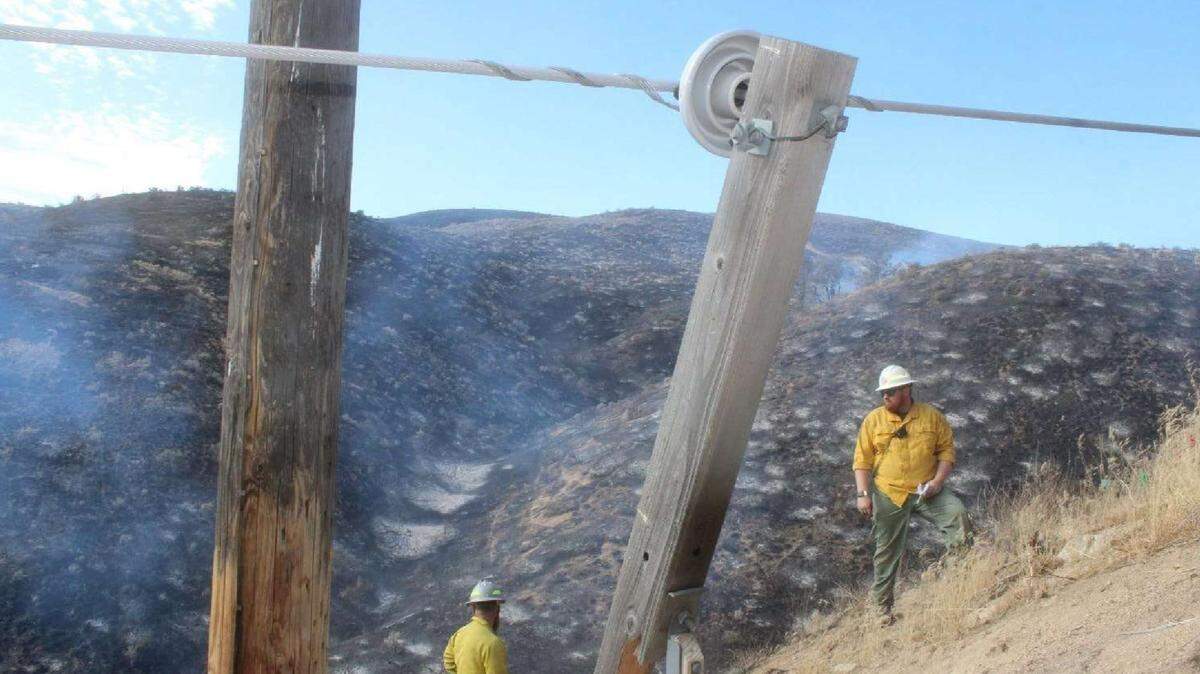
When the crossbeam snapped, the pole fell toward the ground but remained supported by poles to the east and west, according to the report. When the line then dropped close to the ground, it created that arc that could ignite the dry grass and brush.
The Department of Lands found no evidence that the fire was started by lightning, campfires, smoking, debris burning or other human activity.
It’s unclear whether Idaho Power will face any financial repercussions as a result of the fire. Sven Berg, a spokesperson for the utility, said he couldn’t comment on anything outside of the news release.
Sharla Arledge, a spokesperson for the Department of Lands, told the Idaho Statesman that investigators are still analyzing evidence from the scene, which will help them determine next steps.
Fire crews had containment at 79% as of Monday morning, according to the Department of Lands. Efforts were suspended Sunday briefly after a private drone was flown in the area.
“Flying drones in the fire area is not allowed,” according to a Monday morning press release. “Drones pose a safety risk for firefighting aircraft and medical rescues that require an airlift.”
Crews have made progress in the north and northeast segments of the fire nearest Robie Creek, and are monitoring the southern and western portions nearest Boise, according to the release. Robie Creek is still in Stage 1 evacuation status, meaning nearby residents should be ready in case the fire grows. Stage 1 is the lowest alert level.
All trails and roads are closed in the Boise Front segment of the Boise River Wildlife Management Area west of Idaho 21 and north of Warm Springs Avenue, in addition to closures in the Boise National Forest.
“Fuels, such as grasses and timber, are back to critically dry conditions in the Great Basin, with record-level dry conditions in many cases,” according to the release. “Dry conditions continue with highs averaging 70 degrees in the Valley Fire area and light winds.”
Robbie Johnson, a public information officer for the Department of Lands, previously told the Statesman that there are concerns about flooding and erosion in the area once Southwest Idaho gets rain again.
This story was originally published October 14, 2024 at 4:54 PM.