Stinker Stores’ owner and Boise native dies at 72. He was ‘the greatest stinker of all’
Stinker Stores’ owner and former CEO Charley Jones died from brain cancer Wednesday morning, Stinker’s CEO said. He was 72.
Jones and his business partner Shawn Davis purchased the iconic Idaho convenience-store chain from the family of founder Farris Lind in 2002. A decade later, Jones bought out Davis to become the sole owner of the brand with his wife, Nancy.
Stinker Stores was started in 1936 with a single gasoline station in Twin Falls. Lind was tagged by big oil companies in the 1940s as a “stinker” because he undercut their prices, the Idaho Statesman previously reported. The epithet led the company to assume a skunk wearing red boxing gloves as its logo.
The Boise-based chain now has 106 stores with gas pumps and employs more than 1,000 people across Idaho, Wyoming and Colorado.
Nate Brazier, the president and CEO of Stinker Stores, said in a news release that Jones’ business savvy and generous spirit made him the “hero” of the company over the last 22 years.
“Charley was absolutely one in a million,” Brazier said. “He is and always will be the greatest stinker of all.”
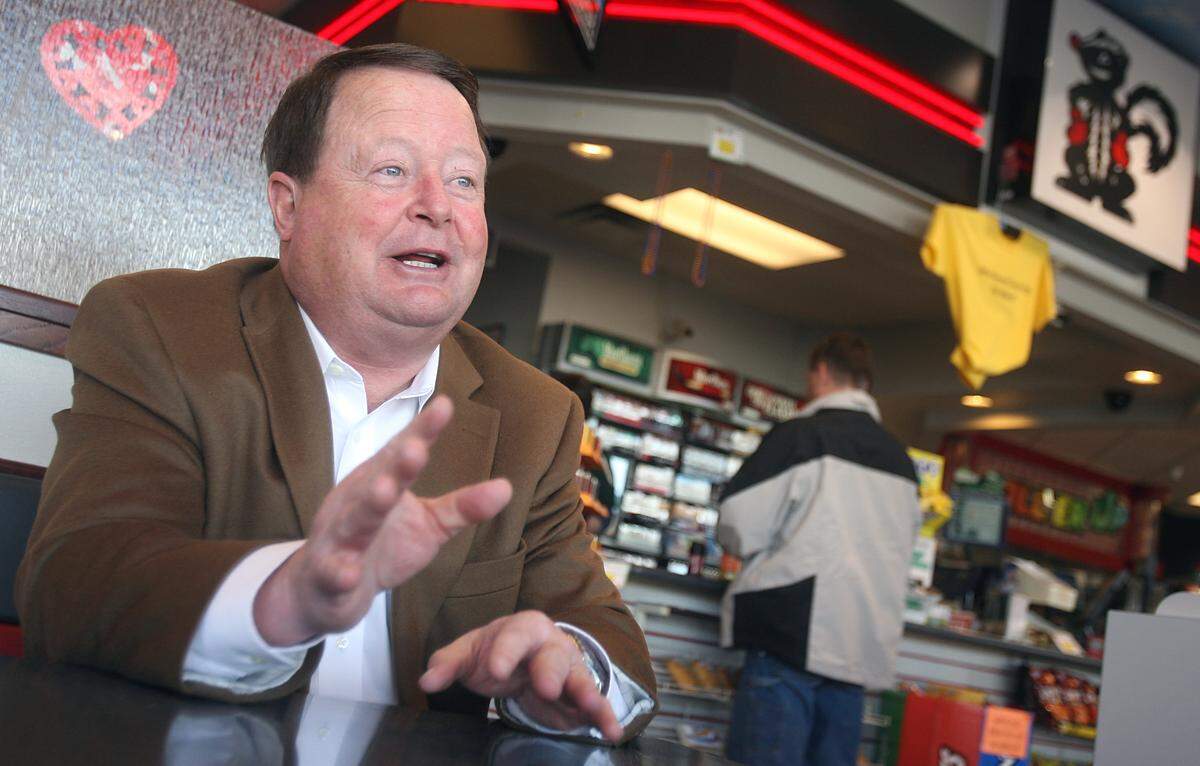
Jones attended Borah High School in Boise and later graduated from the University of Idaho, which he attended partly on an ROTC scholarship as the Vietnam War dragged on. “It wasn’t motivated by patriotism as much as a low draft number,” Jones told the Idaho Business Review in 2013.
He joined the U.S. Army Reserve Finance Corps and earned the rank of captain before becoming a certified public accountant and beginning a career in public accounting. He held various leadership roles in the Treasure Valley in the construction, high-tech manufacturing and wholesale distribution industries.
Before buying Stinker Stores, he was president of Stein Distributing, an Anheuser-Busch beer distributor in Boise.
When Jones and Davis took over Stinker, it was struggling and its staff demoralized, Jones told the Idaho Business Review. “The worst store we had was in Garrity Boulevard” in Nampa, he said. “... It was not much more than a shack. In front of the cash register was a hole in the floor ...
“You’ll go to a convenience store because it’s convenient,” he said then. “It’s not a destination shop. People get into routines, and we build our marketing around the relationships created by those routines. When you come into one of our stores, you’ll be quickly served. You’ll be greeted. It’ll be a quick, pleasant experience.”
He said he admired Stinker’s competitors, Jacksons Food Stores and Maverik.
“Sometimes they outdo me,” he told the Idaho Business Review. “Sometimes, many times, they have a better location than we do with a higher traffic count, easier access and a more modern store.”
Stinker is known in part for its yellow road signs that were scattered across southern Idaho in the 1940s and ‘50s, which advertised the Stinker Station empire on one side and offered witty humor on the other, according to the Idaho Farm Bureau Federation. One famous sign positioned near a field of lava rock on U.S. Highway 30 said: “Petrified watermelon. Take one home to your mother-in-law.”
The signs were Lind’s creation.
“Those roadside signs spoke to his sense of humor,” Jones previously told the Statesman. “People enjoyed his smile, and he was quirky enough to put those smiles out there on those advertising signs.”
Boise author Rick Just, who wrote a book titled “Fearless: Farris Lind, The Man Behind the Skunk,” previously said the signs were planted on federal property in the days before the interstate highway system. The first of the signs appeared between Boise and Mountain Home.
“It took eight hours to get from here to Idaho Falls across the desert, and it wasn’t much fun,” Just said. “And so you see a sign that says ‘Ain’t this monotonous?’ and you say, yeah, no kidding.”
Jones, like Lind, also had a sense a humor, according to Brazier. At meetings, he told stories that “would always make you laugh.” But nearly each one had an important lesson, he said.
Brazier said not much will change at the company in the wake of Jones’ death. He said they “knew the time would come eventually,” and that plans had already been made.
“Charley always said, ‘Carry on,’” Brazier said by phone. “And that’s exactly what we’ll do.”
In the last 24 hours, Stinker Stores’ employees have shared a flood of memories and things that they’ll miss about Jones, he said.
“He always took great interest in people and was very giving of his time,” Brazier said. “And probably the thing I loved most about Charley was that he was always direct, fair and honest in everything he did. I think that’s why people just wanted to be around the guy.”
Jones is survived by his wife, Nancy, who lives in Boise; his two sons, Nick and Duncan; and a granddaughter, Natalie.
This story was originally published August 21, 2024 at 6:35 PM.