Apartment rents keep rising in Boise. Prices nearly rival those in Dallas and Phoenix
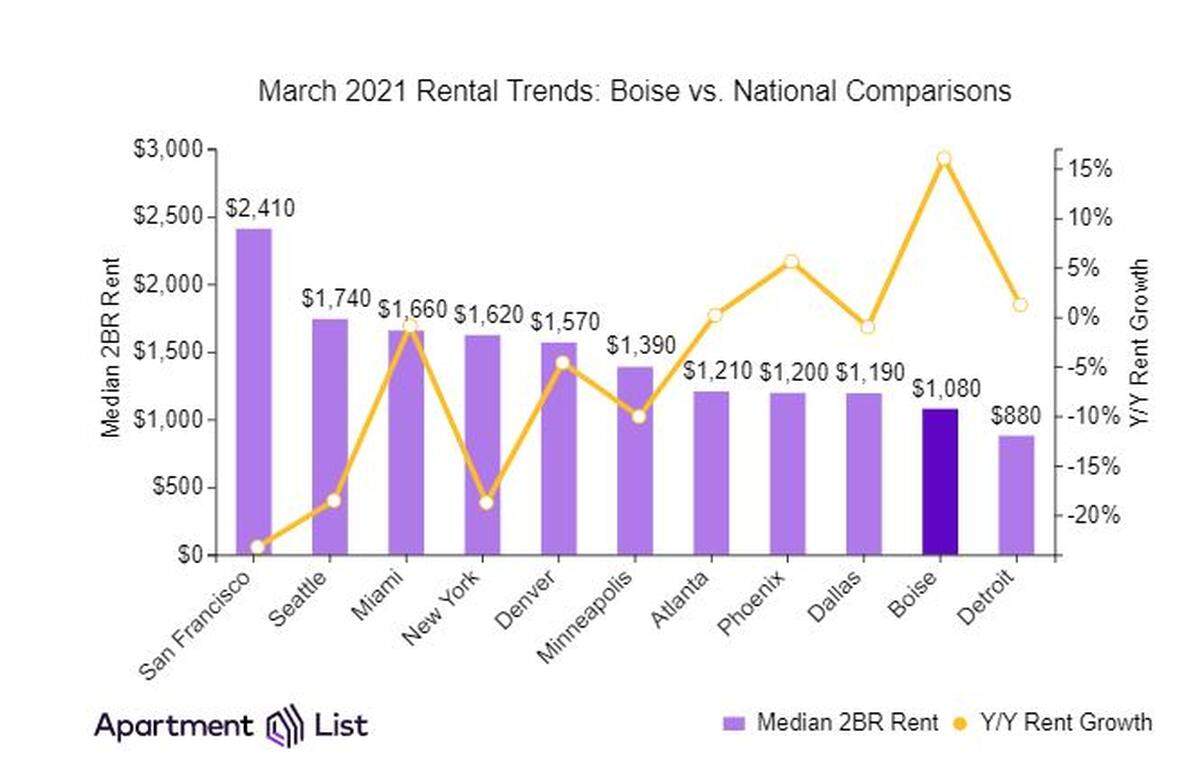
Amid a global pandemic, apartment rents in Boise jumped by 16.1% in the past year, the highest percentage increase among the nation’s 100 largest cities, according to an online rental agency.
The median rent for a one-bedroom apartment in Boise is now $909 a month, and it’s $1,080 for a two-bedroom apartment, according to ApartmentList.com. In the past month, apartment rents increased 3.4%.
The nine other cities in the top 10 for largest rent increases had jumps in the past year ranging from 8% (Reno and Toledo, Ohio) to 12% (Fresno, California), according to the data.
The median price for a two-bedroom unit in Boise is still slightly lower than the national average, which is $1,114. But rents in Idaho’s capital city are closing in on the prices people pay in substantially larger cities.
“As rents have increased sharply in Boise, other large cities nationwide have seen rents grow more modestly, or in some cases, even decline,” ApartmentList.com said in its March report. “Boise is still more affordable than most large cities across the country.”
But that’s of little value to many tenants, who find themselves frustrated by skyrocketing rents.
Boise resident Julie Bouchard’s mother, Jacqueline, has lived in an apartment in Boise’s Highlands neighborhood for more than eight years. Jacqueline Bouchard is in her 90s, and the pandemic has left her isolated and worried.
Both were shocked to receive word in late January that the rent at Jacqueline’s apartment was set to increase from $990 a month to $1,320 at the start of March — a hike of 33%.
“It’s appalling,” Julie Bouchard told the Statesman earlier this month.
ApartmentList.com uses U.S. Census Bureau data along with current rental transactions and historical data from specific rental units to pinpoint its numbers.
A two-bedroom apartment rents for a median of $1,190 in Dallas, $1,200 in Phoenix, $1,210 in Atlanta and $1,390 in Minneapolis. At the top of the list is San Francisco at $2,410. Seattle comes in at $1,740.
The increase in Boise could be misleading, developer Clay Carley said.
“We’ve seen this huge amount of new product come online,” Carley said by phone. “All that new product is new construction with higher costs, and the owners must ask much higher rents than the old product that was the baseline for the marketplace.”
Rents at Carley’s 76 apartments went up only 1% to 2% during the past year, he said. But that might be the exception.
Higher costs for land, labor, materials and added amenities have all contributed to higher apartment rental prices, according to Carley.
“In the old days, projects were built without a washer and dryer in each unit,” Carley said. “Today, that’s just not done. Everybody has a washer and dryer, so that’s a lot of money right there.”
The many new apartment complexes that opened in the past few years have driven up rents at existing sites, he said. “But the real driver for that rent increase statistic is all the new product that’s been built,” Carley said.
Demand has outstripped supply in Boise the past few years. In 2020, the vacancy rate for multifamily units in Ada County was 2.6% out of 18,600 units total, according to a report from TOK Commercial Real Estate. The percentage was even lower — 0.69% — for the 2,771 Ada County rental units managed by members of the Southwest Idaho chapter of the National Association of Residential Property Managers. That figure was for the fourth quarter of 2020.
Carley is involved in developing two apartment complexes under construction in downtown Boise. The Thomas Logan apartments will have 60 apartments on seven stories at 116 S. 6th St., with 45 of the units going to people making between 30% to 60% of Ada County’s median income. That median figure is $51,562 for a single person and $73,600 for a family of four.
Rents in the low-income, subsidized apartments will go for $343 to $730 for a studio, $507 to $783 for a one-bedroom, and $606 to $937 for a two-bedroom.
The second project, The Lucy, will have 114 apartments on six stories at 512 W. Grove St. The developers plan to rent 50 of the units at “workforce” rates — marketed to those earning close to the area median income. Rents will go for around $1,300 a month for a one-bedroom apartment.
Both projects are expected to be completed this winter.
Another 645 apartments are scheduled to open this year in downtown Boise, led by the 236-unit Park Place Apartments at 749 E. Park Blvd. The others are Jules on Third (173 units) at 3rd and Myrtle streets; The Cartee (161 units) at 4th and Broad streets; and The Vanguard (75 units) at 600 Front St.
It’s unclear whether there will be further demand for new apartments downtown when those projects are completed.
“Gosh, it’s so hard to say,” Carley said. “And part of that answer is Covid-related because the office occupancy downtown likely is going to decrease. And if people that work downtown don’t have to go to work and can work remotely, their desire to live downtown might be reduced.”
He said he’s going to sit back and watch where the market goes.
“When I see that there might be some other projects that come up, then I’ll say, ‘Let’s go,’” Carley said.