COVID-19 made a hip downtown Boise coworking place lonelier. Now it fights to survive
Taking your laptop to Trailhead Boise to work used to be trendy.
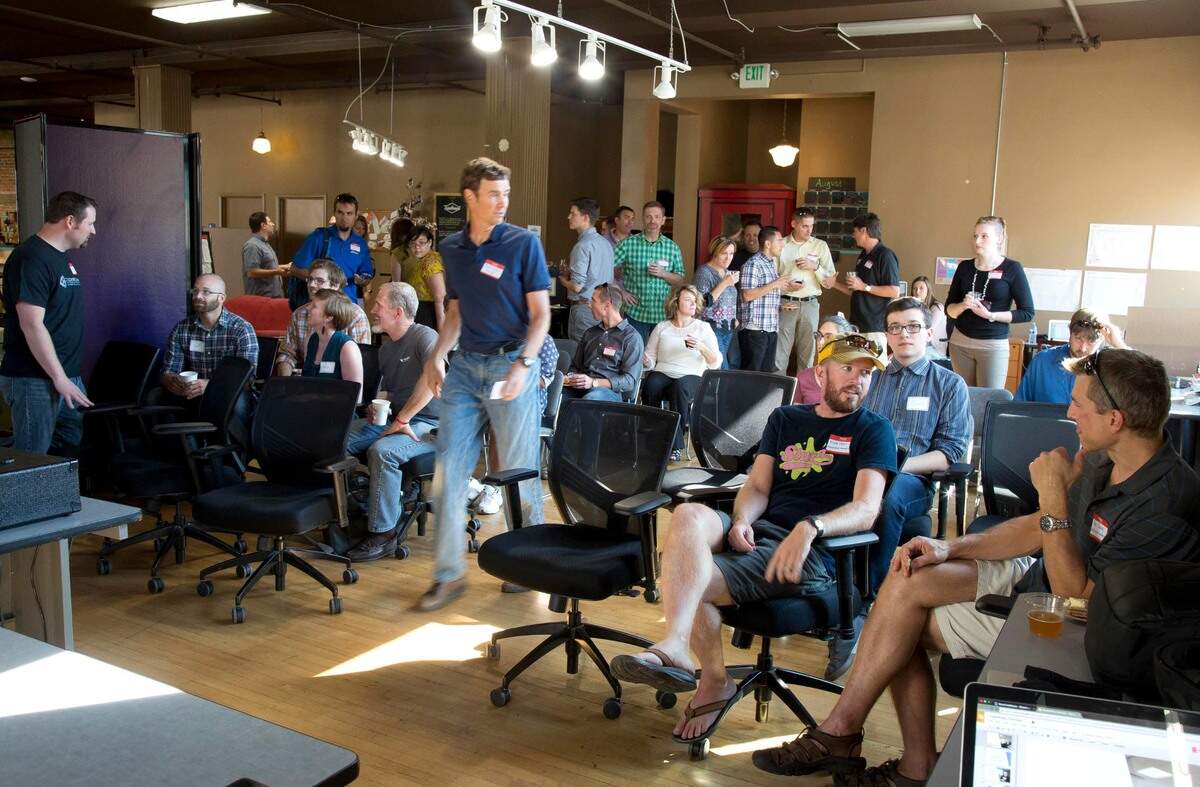
You didn’t even have to be a techie or a startup founder to go. Anyone could walk into Trailhead’s big open room, pick a table or a soft chair (by a window if you wanted), connect to the internet and get to work. Conversations offered possibilities for collegiality, new connections, friendly mentors to solve problems. On-site seminars offered the promise of fresh insights. Hot coffee was always at the ready.
COVID-19 changed all that. Working in close proximity to other people suddenly became risky. Home became the new, socially distant place to work.
Trailhead visits and memberships plummeted. The big room became a quieter, lonelier place. Five years of work on this carefully planned effort to incubate Boise’s startup culture — and create high-paying jobs — threatened to grind to a halt.
“We had to make some tough decisions,” Executive Director Tiam Rastegar said.
Now Rastegar is scrambling to keep the nonprofit alive. He’s optimistic. He’s getting help. But the pandemic persists.
Fast growth, followed by a fall, then recovery
It’s only 5 years old, but Trailhead has faced serious trouble before.
A small group of investors and business leaders, with support from then-Mayor David Bieter, founded Trailhead in 2015 with corporate and city money. They rented an old building on the southeast corner 8th and Myrtle streets, and invited anyone to join, but especially Idahoans just starting businesses or striving to make new ones thrive. For $35 a month (now $50), you could hang out, use the WiFi, drink the coffee. You could work. Network. Learn.
Things went great at first. At age 2, Trailhead expanded. It rented a space on the second floor of an office building three blocks north on 8th Street. Trailhead North offered key-lock access and dedicated desks where members could leave their laptops and belongings safely. It offered five offices for rent, too.

Revenue grew. In 2017, Trailhead reported $699,000, including $429,000 in contributions and grants, and $268,000 in money from programs and services it offered.
Then came 2018. Contributions and grants plummeted to $265,000, program revenue to $206,000. Trailhead’s board sought to turn things around.
That fall, the board hired Rastegar, a native Iranian who was 18 months old when his parents fled the country in 1983 to escape persecution after the Iranian Revolution. He came armed with an Executive MBA from Boise State University and experience at two Boise-area businesses.
He focused on tailoring programs to early-stage startups whose founders needed talent, mentorship and access to capital. Membership climbed. Revenue began to rebound. Trailhead reported more than $760,000 in the year that ended Sept. 30.
The pandemic reached Idaho in March. Trailhead ceased operating during Idaho Gov. Brad Little’s stay-home order and closure of nonessential businesses. It reopened in May with social distancing, sanitizing, masks and all-virtual programming, but most former users stayed away.
Along with health concerns, some members grew skittish about the pandemic’s impact on the revenue of their own struggling startups. “They don’t want any expenses that they can forgo, even a month-to-month temporary rent at Trailhead,” Rastegar told the commission that oversees Boise’s urban renewal agency, the Capital City Development Corp.
Slightly more than half of Trailhead’s members are small-business owners with fewer than five employees, Rastegar said. The rest are mostly what he calls “side hustlers” — entrepreneurs who have not yet given up their day jobs — and telecommuters in any field. Fifty-eight percent are men.
Rastegar laid off one of Trailhead’s three employees. He scrambled to secure government and corporate money to keep the nonprofit functioning.
He told the commission on Monday, Nov. 9, that he has succeeded in raising enough to keep the doors open. Rastegar said Trailhead will be ready when entrepreneurs and employees finally return after the pandemic wanes.
That’s when, not if.
.jpg "Tiam Rastegar 2 at Trailhead Boise 12-28-18 IMG_2884 adjusted (2).jpg")
“We really believe that when the health crisis subsides, there is going to be renewed activity around early-stage startups and entrepreneurship,” he said. “We want to maintain readiness so that when our members come back, we can hit the ground running.”
Why would he tell this to the urban renewal agency? Because it is one of Trailhead’s biggest funders.
The agency, which uses property-tax revenue generated in urban-renewal districts to foster redevelopment and economic development, spent $132,720 on Trailhead in the year that ended Sept. 30. That’s 17% of Trailhead’s revenue.
The original Trailhead site, now called Basecamp, has what office-space managers call hot desks. They’re unreserved, first-come, first-served work spaces available to anyone who buys a monthly membership. Trailhead’s Basecamp had 246 people with hot-desk memberships before the pandemic. Now it has 111. At $50 per member, that’s a loss of $6,750 a month.
The second site, Trailhead North, serves businesses that have grown beyond hot desks. Its reserved desks cost $150 a month. “You start at Basecamp. You scale at North,” Rastegar told the Idaho Statesman for a 2019 story.
Since the pandemic began, Rastegar has obtained a donation from Trailhead’s board members and secured a federal pandemic paycheck-protection payment and an Idaho National Laboratory contract. He won a commitment from Micron Technology Inc., one of Trailhead’s founding donors and its biggest corporate patron, to continue donating $50,000 per year for the next three years. He competed for, and secured, $50,000 from the U.S. Department of Energy and $40,000 from the U.S. Small Business Administration.
With Trailhead in its sixth year of city subsidies, the urban-renewal commission has pushed it to reduce its dependency on tax money and become self-sufficient. The tax money pays for Trailhead’s rent in the Basecamp site at 8th and Myrtle, and it formerly paid for utilities. In May, after its initial five-year commitment expired, CCDC ended the utility payments but agreed to extend the subsidy for at least three more years.
Commission member Ryan Woodings, himself a founder of a Boise tech startup, Metageek, asked last December whether it was time to pull the subsidy plug. Eleven months later, he’s convinced that Trailhead still needs the help.
“We need to support new entrepreneurs pursuing opportunities that might not have existed last year,” Woodings said by email. “I’m happy with the innovations that Trailhead has done in order to provide that support during COVID-19.”
Once businesses succeed in scaling up at Trailhead North, they graduate. They rent their own places to do business. The urban renewal commissioners hope they do that in downtown Boise. (Some do, some don’t. See the list of companies below.)
At the Nov. 9 meeting, commissioners asked Rastegar to prepare a report showing the return on investment the city has received on the money it has spent so far. They wanted to know how much benefit the city is getting for its six-figure bucks.
But they were impressed with the progress Rastegar made before the pandemic, and with the mostly one-time cash payments he has lined up since March to offset losses from membership attrition.
“Tiam, I think you’ve done exceptionally well,” said Bieter, who appointed himself to the commission while mayor and kept his seat after Lauren McLean defeated him in last December’s runoff election. “I’m just so pleased to see what you’ve accomplished in a short time.”
McLean, who also appointed herself to the commission upon taking office this year, agrees with Rastegar’s view that Trailhead’s troubles are temporary. Thanks to the money he has raised, “This too could, should, pass,” she said.
Trailhead’s latest lineup of businesses
Trailhead says its present and past member startups created 23 full-time jobs in the year that ended Sept. 30, raised $20 million in investments and generated $20 million in revenue. Those numbers are higher than in any previous year, Rastegar said.
He cites these companies and their progress. (For a primer on the startup-investment rounds in this list, see below).
▪ Lovevery, which makes educational toys. Lovevery graduated last year from Trailhead with 19 employees and now has 133, Rastegar said. Its new headquarters is in the former Macy’s/Bon Marche store at 918 W. Idaho St., which it shares with Athlos Academies.
▪ Lumineye, a five-person company that makes wall-penetrating radar devices to help first responders identify people and threats. It, too, has graduated from Trailhead and now rents office and production space across Capitol Boulevard from City Hall.
▪ Retrolux, a Trailhead alumnus now based at 1775 W. State St. Retrolux landed a partnership with a venture-backed fund and is working on its energy-saving lights for retrofitted buildings.
▪ Natural Intelligence Systems, which graduated from Trailhead, now does business at 855 W. Broad St. downtown. The company aims to use artificial intelligence to improve upon machine learning in solving problems in space, medicine and other fields.
▪ Fitted, a new startup that moved to Boise from San Francisco last year, uses artificial intelligence to help brick-and-mortar running-shoe stores build their e-commerce businesses. Fitted recently closed an A round of funding and is hiring.
▪ Killer Creamery, formerly Killer Whey, is based at the Village at Meridian. Killer, which makes sugar-free ice cream available at Albertsons supermarkets, closed an A round of financing, and has made distribution deals with Kroger and other smaller retailers.
▪ Washie, based in Pocatello, has added sanitizing products to its product offerings. Washie’s smart toilet seat, designed by a former Bannock County clerk, was the 2019 winner of the $20,000 first prize in Trailhead’s pitch competition during Boise Startup Week.
▪ Orchestra Provisions, of Salmon, sells Boise native Kate Stoddard’s protein-rich seasoning made from crickets. The company is increasing the seasoning’s distribution at Albertsons supermarkets throughout the Intermountain West.
▪ Terroir AI, a Menlo Park, California, startup, secured seed funding after finishing as a runner-up in Trailhead’s Boise Pitch Night competition. The company makes an app for vineyards whose sensing technology uses artificial intelligence to optimize crop yields and help grow better grapes.
▪ Joule Case, of Seattle, secured C-round funding for its clean-energy stackable battery, a quiet alternative to noisy portable gas generators.
—
What to know: The ABCs of startup investment
Most successful startups need more money than their founders have. So the startups may raise investment money several times to operate and to grow.
Don’t know the difference between an A round and a C round? Here’s a glossary, summarized from Investopedia:
Seed funding: Angel investors — wealthy individuals — or family, friends, incubators, or venture-capital firms invest in a startup either by themselves or as part of an investment group. Firms obtaining seed funding typically are valued up to $6 million.
Some companies do not need to solicit investments beyond seed funding. Those who may follow this pattern:
Series A: A startup seeks Series A funding after it develops a track record of users, revenue or some other performance indicator, and if it needs money to boost its customer base or improve its products. Such firms are typically valued up to $23 million. Venture-capital firms are common Series A investors.
Series B: A startup seeks Series B funding when it moves past the development stage and seeks to expand markets. Firms seeking this are typically valued up to $60 million. Venture capitalists experienced in later-stage investing are common Series B investors.
Series C: A business seeks this when it wants to expand even further or acquire other companies, such as competitors. Firms seeking this have an average value of $118 million. Hedge funds, investment banks and private-equity firms are common Series C investors.
After Series C, some companies go through series D and E rounds. Many move on to initial public offerings of stock.
This story was originally published November 13, 2020 at 4:00 AM.