Boise, developer want to move Bench’s tank farm and build this mini-city there instead
For the last year, Randy Johnson has heard rumors that the city has been looking to relocate the 60-year-old fuel tank farm located in Boise’s central Bench.
He’s eager for the fuel terminal to find a new home — one that’s a bit further away from his.
“It adds nothing to our neighborhood,” said Johnson, who has lived on the Bench for 10 years. Between Hartman and Phillippi streets, a block north of Franklin Road, the tank farm stores jet and auto fuel fed by a pipeline from Salt Lake City. From there, it’s trucked throughout the Treasure Valley.
When it was built in the 1950s, all that surrounded the industrial tanks was farmland. But the area quickly grew dense with housing and employment centers, like the nearby St. Alphonsus Regional Medical Center.
The neighborhood could soon evolve again. A Florida-based fuel consultant, John Armbrust, is partnering with Meridian-based developer Ball Ventures Ahlquist, or BVA, on an ambitious project that would relocate the tank farm to the Boise Airport and transform the neighborhood into a high-density, mixed use commercial hub.
“It would be a major transformative project for the Bench,” Ahlquist said in a phone interview with the Statesman.
That is, if it happens. Armbrust must overcome several major hurdles before the project comes under construction.
How the project began
Boise originally hired Armbrust as a consultant in 2017 to create a long-term plan for how the city would meet future fuel-supply demands as the city continued to grow.
Armbrust reported his findings to the City Council, but the council was more interested in something else: Could the city move the tank farm from the Bench?
For 15 years, the city had tried to find a new location for the tanks, Mayor David Bieter told Armbrust.
The airport seemed like a natural site. The fuel pipeline from Salt Lake City also crossed city-owned industrial land near the airport. Plus, airlines were already sending out trucks to pick up fuel at the Bench tank farm only to truck it back to the airport. The location also offered easy access to Interstate 84 without having to cut through residential area.
Armbrust made a proposal to the city that he buy the tank farm sites from the three oil companies that currently own them — Marathon Energy, Sinclair Oil and Franklin United Oil — and build them a new tank farm on city-owned land near the airport. The new tank farm would cost upward of $100 million, according to Ambrust. He would need someone to pay for all of this.
“The outstanding question that has yet to be explored is how is that initial investment going to be repaid,” said Rebecca Hupp, director of the Boise Airport, who has been at the table in negotiations.
In a report last year, Armbrust suggested that public debt could finance the project. The borrower, likely the city or its urban renewal agency, could pay back its loan by assessing a fee of one penny for every gallon of fuel that moves through the new terminal. This fee would generate more than $10 million a year.
Now Armbrust has a different suggestion: He himself would charge the oil companies a fee to use the site for storage — about 2 cents per gallon, which would likely be passed onto the consumer.
But one obvious problem exists: Why would the three oil companies give up land they’d hung onto for years and willingly go from owners to renters?
“The key component is that the oil companies would need to agree to that,” Hupp said in a phone interview. “It’s not clear to me that they would agree.”
Armbrust argues that the companies would have greater access to the freeway. By moving the tank site, they would reduce congestion in the city and free up the space on the Bench for redevelopment.
Asking one gas company to move is difficult enough — try three. Armbrust would have to get Marathon, Sinclair and Franklin United to all agree to move, or the project won’t work.
“The oil companies would like for us to leave them the heck alone, but they understand why we’re invested,” Armbrust said in a phone interview.
Armbrust and the city had begun talks with the oil companies, but negotiations stalled for six months this summer as Marathon completed its acquisition of Andeavor, which previously owned some of the tank farm land.
After the acquisition, the city and Armbrust had to negotiate with a new team and form new relationships. Armbrust said those talks have recently begun.
If he can close a deal to buy the old tank farm site, then he would also need to come to an agreement with Boise on a long-term lease for the site of the new tank farm.
“These are very complicated deals,” Armbrust said.
Redeveloping the tank farm
If he can buy the tank farm land, another long to-do list awaits Ambrust. He would have to clean up the nearly 50-acre site to prepare it for development. Oil spills can contaminate soil and groundwater with toxic chemicals.
Several years ago, Sinclair spilled fuel there, but cleaned it up and installed a new liner to make sure future spills wouldn’t leak into the soil, the Statesman previously reported.
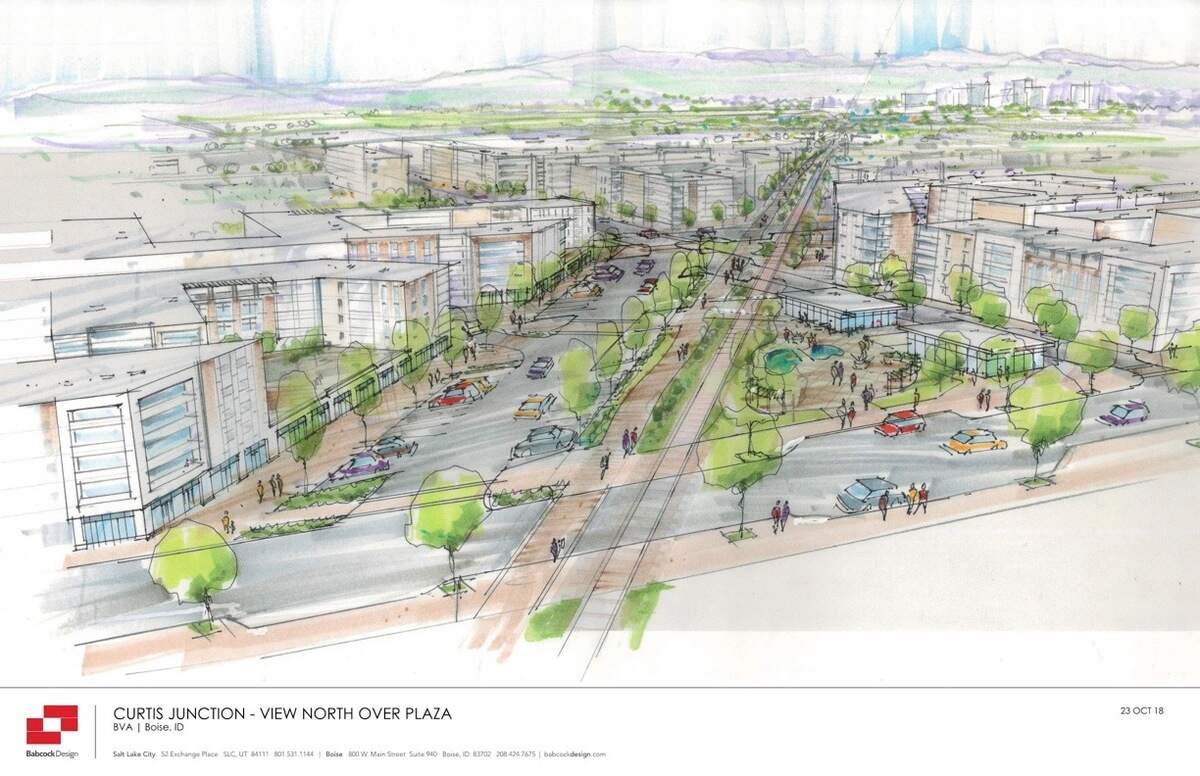
Already, Ambrust has brought on Tommy Ahlquist of BVA to envision what a future community would look like. BVA’s initial drawings imagine a development called Curtis Junction — two new city blocks with apartments and ground floor retail, all coalescing around a central pathway, an extension of the Greenbelt.
The project would also feature a central plaza, with indoor and outdoor public spaces.
“There’s already employment opportunities, there’s already parks,” Ahlquist said. “This really could be a great livable community.”
The project would be at a much denser scale than some of BVA’s recent projects, which include the Ten Mile office park and Eagle View Landing business development in Meridian.
“We do a lot of development in the area, but projects like this that are truly transformative for the community are really rare,” he said.
Ahlquist is also working to raise additional funds for the project after a private equity he had been working with backed out of the project earlier this year.
Despite the hurdles they need to clear and money they have yet to raise, Ahlquist and Armbrust are optimistic.
“There’s so much potential for that property,” Armbrust said. “It’s such a vital part of the city.”
This story was originally published October 5, 2019 at 5:00 AM.