
Inside MotivePower, Idaho’s only heavy-industrial transportation manufacturer
This story was first published April 4, 2012, in the Idaho Statesman’s Business Insider magazine, under the headline “MotivePower expands internationally.”
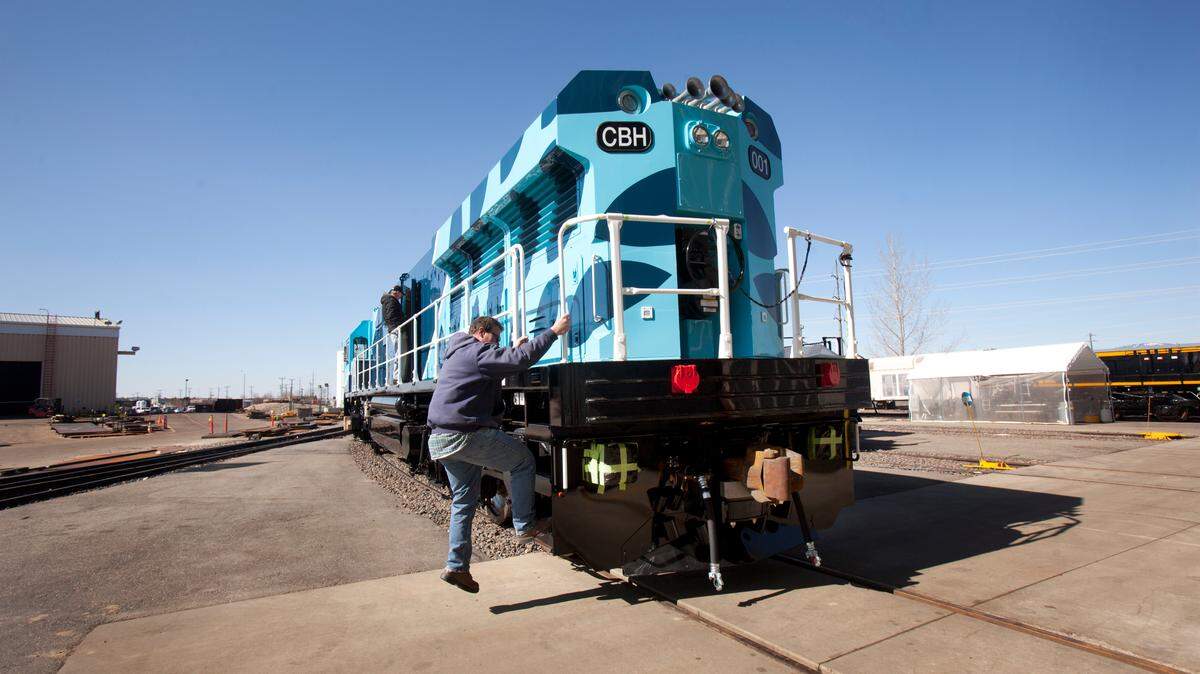
On a blustery, cold and sunny day in early March, workers at MotivePower in Southeast Boise prepare to ship the first of 22 new locomotives to Perth, Australia.
For its first international contract, MotivePower won the job of building the locomotives for CBH Group, a grain handler and transporter in western Australia.
The 40-year-old Boise company created a new design to meet Australian standards — including rails that are closer together than U.S. rails — and to be among the most fuel-efficient and environmentally friendly models in that country.
That deal led to another with an eastern Australia leasing company for one locomotive, and a potential order for nine more.
“It’s the economy,” says Mark Warner, vice president and general manager of MotivePower. “In Australia, they are in a significant growth mode.”
He says MotivePower hopes these agreements signal the beginning of the company’s expansion in Australia and to a number of countries, including South Africa and Peru, which require locomotives of similar weight, clearance and capacity for hauling different tonnage on various grades. The company also sees opportunities in China and India, two large railroad markets.
“We expect to set a record in sales” this year, Warner says. “We would like to see [international sales] be a permanent growth solution.”
Chugging forward
MotivePower stands alone in Idaho as a heavy industrial transportation manufacturer, though there are a couple of recreational vehicle makers in the Magic Valley and companies producing airplanes or agricultural equipment elsewhere in the state, according to the Idaho Department of Commerce.
John Brunelle, director of economic development for the city of Boise, says the company is unique in that it provides a variety of job opportunities from manufacturing to technology.
“They’ve been a great local employer and very responsible when they do have cyclical changes,” Brunelle says. “Though recently, it’s been good news because of their aggressive sales and marketing efforts. Their workforce has stabilized.”
The city is working with the Boise Valley Railroad Co. to condition a section of city track that MotivePower could use to test locomotives, possibly by this summer, Brunelle says. “We see that as a way we can help them with their competitive stance,” he says.
MotivePower says it is the No. 1 supplier of commuter locomotives in North America, providing or refurbishing about half the locomotives in daily commuter service.
The company’s challenge has been managing small orders of one to a couple of dozen engines for customers with varying needs in good and bad economies, Warner says.
“We’ve survived several downturns,” he says. “It’s the people. It’s the work ethic.”
The company culture was mostly responsible for MotivePower landing the Australian contract, Warner says.
“They toured three plants in the U.S.,” he says. “They said they saw a team they could relate to, one they could have a long-term relationship and partnership with.”
Colin Tutt, general manager of CBH operations, says CBH wanted a partner with a good reputation that made high-quality products and could handle innovation. CBH was seeking a partner for the next half century, Tutt says.
“I was over in Boise as the first loco was move out of the factory with engines started,” Tutt wrote in an email. “It was a fantastic moment. The quality is first class, and the engineering and dedication of the MTI team is outstanding. They have great product.”
New locomotives cost about $3 million to $5 million each. Their lifespan is about 25 years, or a million miles. Remanufacturing a train engine costs about 75 percent of the price of a new one and adds about another 25 years of life. Both commuter railroad agencies and freight railroads buy remanufactured locomotives, Warner says.
A Central Florida commuter rail system has ordered remanufactured, modernized locomotives, he says. And MotivePower is supplying operator cab/electrical locker modules to CSX, an international freight carrier that is remanufacturing its own fleet of locomotives.
MotivePower completes one new locomotive about every five or six days, and with changes to its assembly line, the company plans to cut that to three days, Warner says.
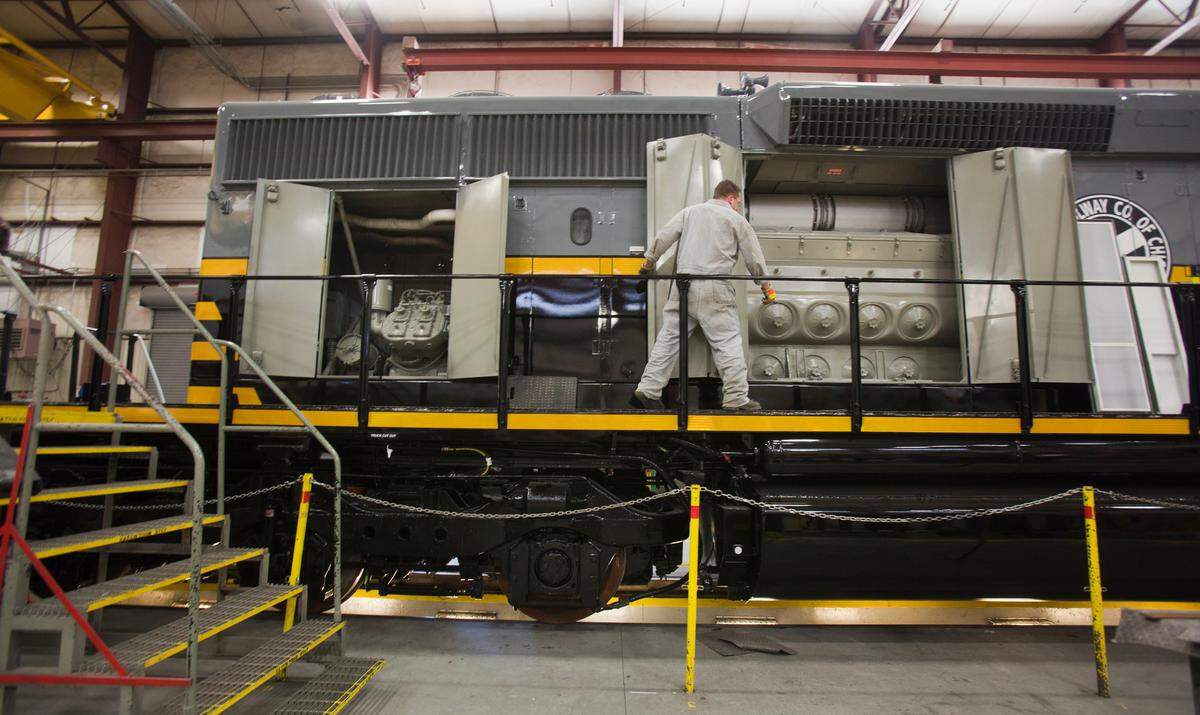
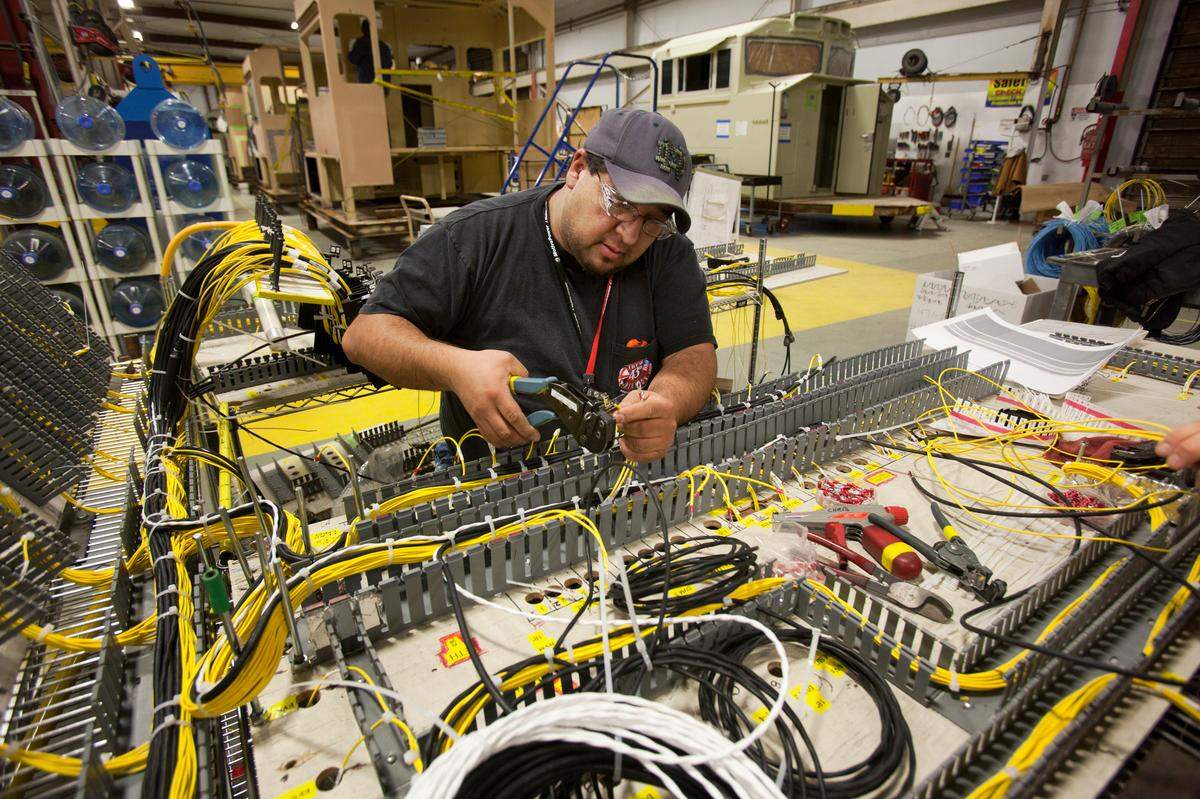
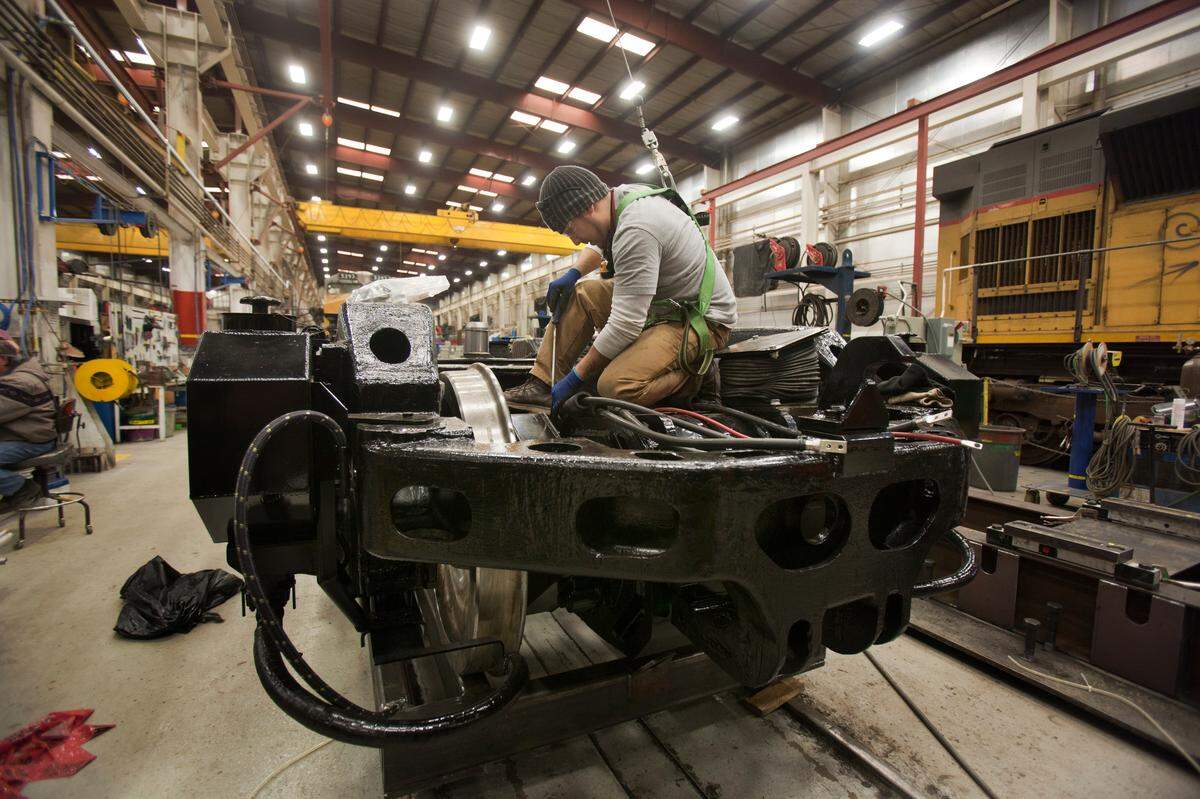
MotivePower designs and manufactures all of the steel-fabrication components of a locomotive, including the underframe, operator’s cab, car body, roof hatches and electrical locker structures, Warner says. It also designs and builds electrical and plumbing components. It buys engines, wheels, axles and some other equipment. Sister companies provide electronic air brake systems, radiators and a few other components.
MotivePower has delivered more than 2,500 locomotives since 1972, when it was founded by Boise-based Morrison-Knudsen Co., an engineering and construction company that’s now part of URS Corp. MK wanted to build rail cars and repair locomotives. Its executives also saw big potential in the growth of commuter rail. In 1994, MotivePower, then called MK Rail, was spun off as a wholly owned subsidiary with publicly traded stock, and built its first locomotive.
In 1999, MotivePower became a subsidiary of Wabtec Corp., a Pennsylvania-based group of companies that provide services and products to the rail industry. Wabtec doesn’t break out sales and income for its more than 40 divisions, but MotivePower’s contributions appear to make up about 10 percent of sales. Wabtec sales rose to nearly $2 billion in 2011 from $1.5 billion the previous year, while its net income increased by about $47 million to $170 million in 2011. Most recently, MotivePower has been producing between 30 and 50 engines a year.
The recession took a toll. The number of MotivePower employees has declined to about 550, not counting temporary workers and contractors, from a 2007 high of 750. But the company filled 65 new positions in 2011, mostly design engineers, and plans to add about 20 in 2012, Warner says.
“The markets look very strong, and we feel very confident about having stable employment,” Warner says.
Picking up speed
MotivePower faces competition in the U.S. and abroad, varying by product.
For the CBH contract, MotivePower competed against General Electric, General Motors’ Electro-Motive Division (EMD) and the National Railway Equipment Co. (NREC), all U.S. companies. For commuter locomotives, MotivePower competes with U.S.-based Brookville, Vossloh of Germany, EMD and GE. For locomotive overhauls, it competes with NREC, Progress Rail Services, Metro East Industries Inc., all in the U.S.; and CAD Railway Industries Ltd. of Montreal. For cab modules, it competes with SuperSteel of Wisconsin.
The railroad industry in the United States is showing signs of recovery, Warner says.
Rail freight worldwide dropped 8.4 percent in 2009 from the previous year, according to SCI Verkehr, Germany, a consulting company for the transportation industry. But it surpassed 2008 levels last year and is expected to continue to climb through 2020, thanks to rising demand and population growth, Verkehr reports.
About 5,000 freight engines were parked in 2009 and 2010 when demand for service fell, Warner says. “They started coming back last year; most of those are in service,” he says.
Commuter and freight railroad companies are beginning to replace old stock or refurbish it, Warner says. Rising fuel prices have helped railroads compete with the trucking industry on shorter hauls.
The outlook on the passenger locomotives also is strong, he says. The American Public Transportation Association reports increases in passenger trips on heavy, light and commuter rails ranging from 3 to 5 percent, and Verkehr anticipates passenger traffic rising at a higher rate than rail freight.
“Amtrak has plans to replace their entire fleet,” Warner says.
This story was originally published September 19, 2019 at 2:49 PM.