At drive-thru coronavirus testing sites, Idaho nurses are on the ‘front line’ of pandemic
During the first week of drive-thru coronavirus testing at St. Luke’s Meridian Medical Center, the nursing staff conducted as many as 311 tests in a single day.
For nurses like Ashley Layton, that equates to swabbing nearly 40 sick patients per hour to obtain the epithelial tissue needed to test for COVID-19.
“I won’t lie. There are days, especially in the beginning, when we were out here four or five days at a time,” Layton said. “By the end of the week, I would go home and be like, ‘Oh my gosh, I’m going to get this.’ ”
Layton and her colleagues are on the front line of a global pandemic. Using CDC guidelines, they must decide who qualifies for a test and who doesn’t. Although they are equipped with hospital-issued scrubs, disposable paper gowns, goggles, face shields, masks and gloves, they are still at risk of contracting the virus. Through Sunday, 203 health care workers in Idaho had confirmed cases of COVID-19, according to the Idaho Department of Health and Welfare.
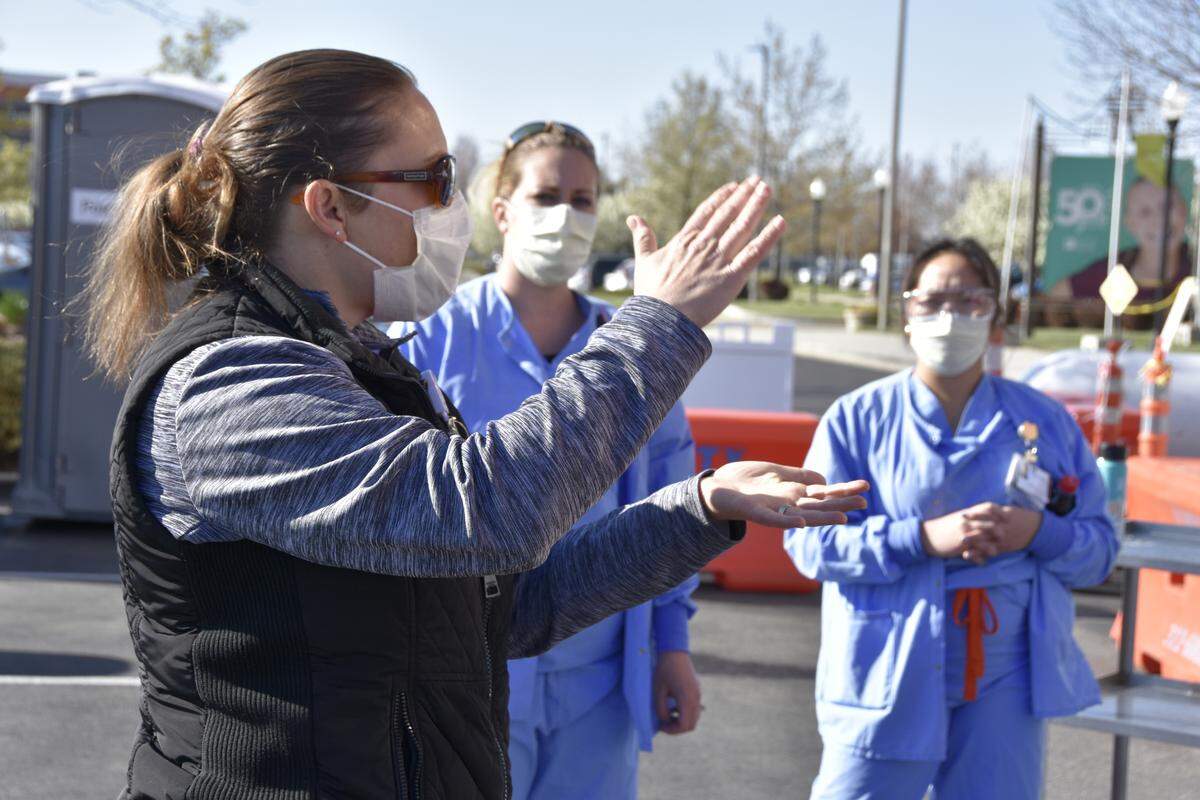
That’s why every shift starts with a “safety huddle.” While the nurses have put on personal protective equipment (PPE) thousands of times throughout their careers, procedural vigilance can be the difference between staying well and getting sick.
On Friday morning at St. Luke’s Meridian, Heather Knapp, who usually serves as a pediatric trauma educator, gathered the nurses to go over best practices for “donning” — or putting on — their PPE and “doffing” — or taking it off.
“Be careful and cognizant of what you are doing,” Knapp said. “Always assume you are contaminated.”
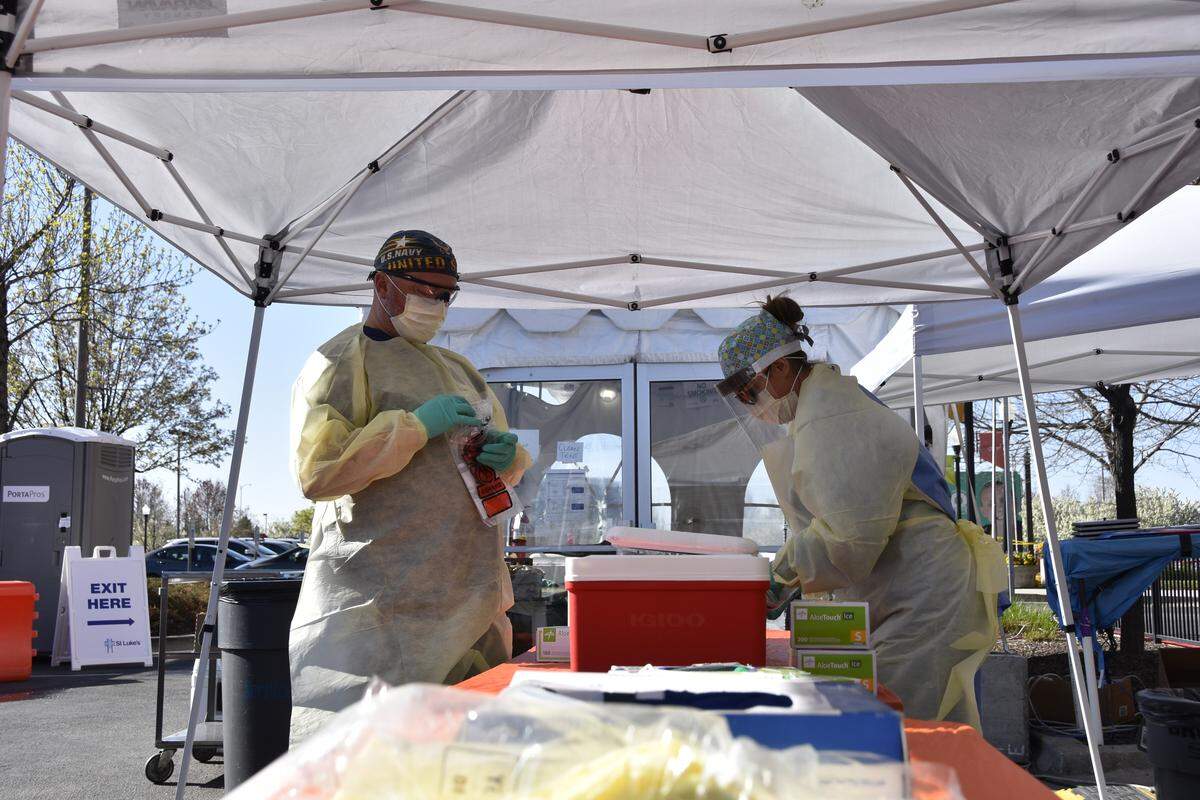
The patients who come to the drive-thru testing sites never leave their cars. But nurses still must have close interaction with each patient to assess the symptoms. If a patient qualifies for a test, a St. Luke’s staff member comes with a laptop to obtain demographic information. Then a nurse swabs the patient’s pharynx through the mouth or nose. That can cause people to gag, cough or sneeze, expelling respiratory droplets potentially containing the coronavirus into the air.
“Especially for the swab team, I feel like we are at the highest risk of exposure,” Layton said. “There have been times where I’ll swab someone, and I’ll walk away and whoever I’m working with that day will look at me and go, ‘Whoa, you’ve got some splatter on your screen there.’ It’s good to have that support to be able to know when you need to change your (PPE) and be clean.”
Nurses have a donning and doffing buddy who watches to make sure they don’t inadvertently expose themselves to contamination at any point during the shift. St. Luke’s even has a nurse assigned to each drive-thru site whose only job is to make sure the nurses follow proper procedure and stay safe.
“St. Luke’s is doing everything they can to make sure that we’re safe out here on the front line,” said Chris Colburn, a licensed practical nurse (LPN) at St. Luke’s. “They’ve been really great. We have all the gear we need. We have all the protection that we need and all the support that we need. … I can’t say that I’m any prouder to be a part of what we’ve implemented so quickly.”
Even when their shift is over, nurses can’t immediately let their guard down or they could risk exposing their families to the virus, which might be lurking in their clothes, hair, skin or shoes.
“I take off everything as soon as I get into the garage, and leave it in the garage,” Layton said. “Then I go straight to the shower and wash. I don’t even reuse my towel.”
The nurses who man the drive-thru testing sites show tireless compassion for the sick and sometimes scared patients they meet day after day. They do their jobs despite rain, wind and, sometimes, even earthquakes. They set aside exhaustion and anxiety for the sake of their patients. Their sacrifice hasn’t gone unnoticed.
“We’re really thankful to the community for how great they’ve been and how giving and patient they’ve been through all of this,” Layton said. “I’ve been really amazed by the outpouring of support. … People will drive by and honk and wave and say, ‘Thank you so much.’ I mean, it’s just really nice. It’s appreciated.”
This story was originally published April 20, 2020 at 4:00 AM.