Forest Service sprays chemicals on Idaho private properties, spurs distrust
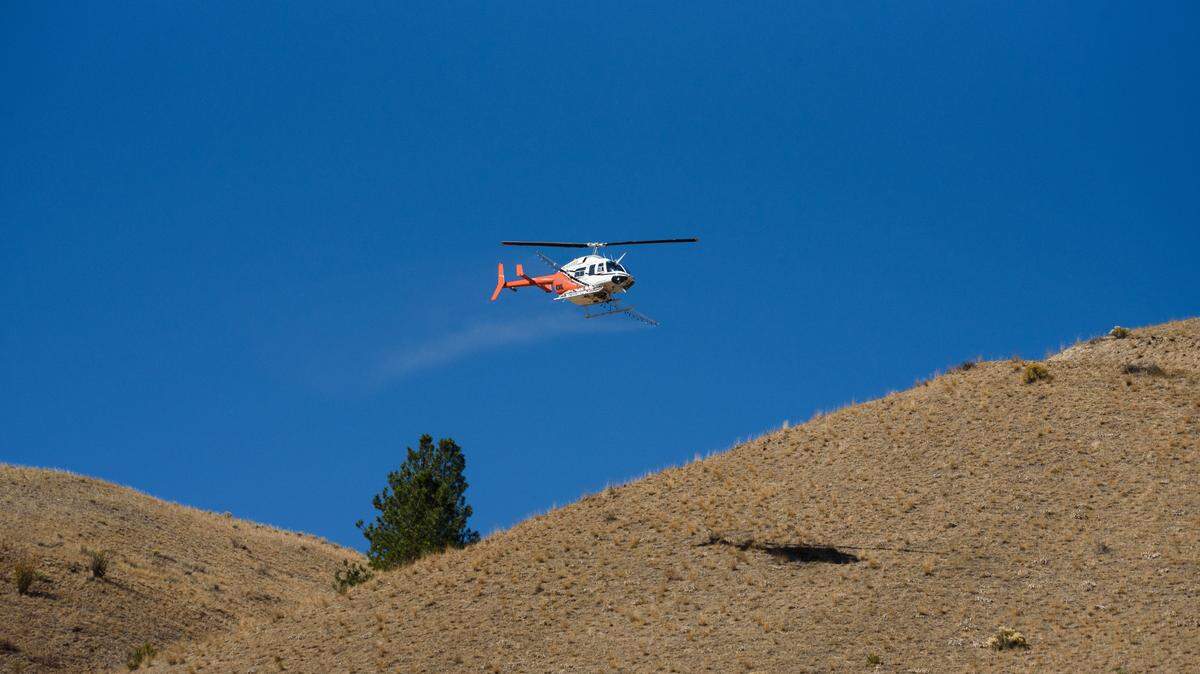
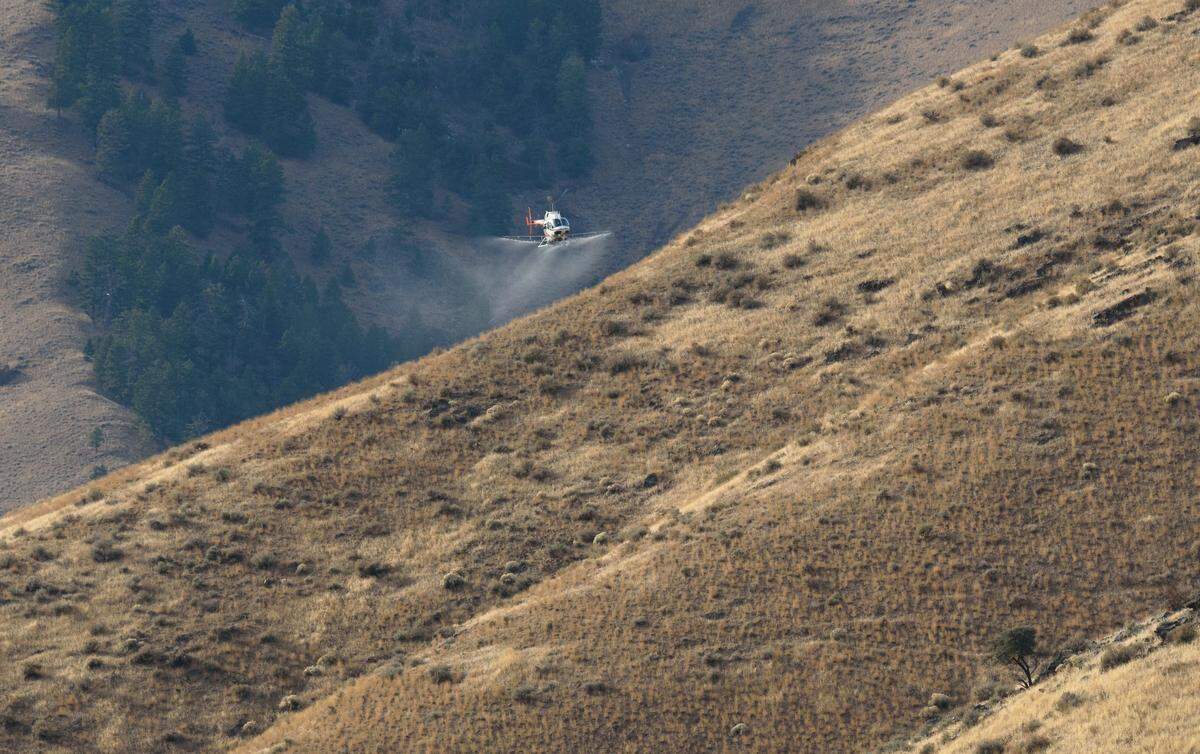
Dan Schuler was in his hay field moving irrigation pipes last fall when he first noticed the helicopter. It was perched on top of a truck near the home on his neighbor’s 20-acre property in Central Idaho refueling, before the pilot took off and resumed spraying a fine mist onto the surrounding hills.
As Schuler continued his work, the helicopter buzzed back and forth overhead. A chemical scent started to hang in the air over Fourth of July Creek, a small drainage in the rural town of North Fork near Salmon.
“I’m out there physically exerting myself,” Schuler told the Idaho Statesman. “As I’m huffing and puffing and I’m breathing this stuff in, I’m smelling it. I know it’s not good for me.”
The Forest Service was spraying herbicides meant to kill cheatgrass and other invasive plants, part of a multi-year effort to cut back on noxious weeds in the Salmon-Challis National Forest. The spray ended up on Schuler’s and other residents’ properties, an Idaho State Department of Agriculture investigation confirmed, despite promises of a buffer zone.
Complaints also alleged the spraying violated state law by ignoring labeling guidelines.
Experts told the Statesman that the herbicides are safe. But residents said they no longer trust the Forest Service after the agency broke its promises and left them in the dark about its project. Later, when officials tried to assure residents that the herbicides aren’t harmful to humans, many of the neighbors wondered if that was untrue, too — especially military veterans who’d previously been exposed to pollutants like Agent Orange.
Schuler said residents never received an apology from the Forest Service. Now the agency plans to spray another nearby drainage this fall, which Schuler said feels “like a slap in the face to us.”
Spraying raised concerns early on
The Forest Service began planning for its aerial cheatgrass spraying project in 2015. The project aims to eliminate several invasive weeds, reducing the risk of wildfire in the national forest and restoring native plants to the area.
After completing an environmental impact study, officials opted to use Milestone and Plateau, two herbicides that kill broadleaf plants — like invasive grasses — without harming many other plant types. Both herbicides are categorized by the Environmental Protection Agency as Category IV, or Very Low Toxicity, which is the lowest toxicity classification.
The Forest Service began spraying the herbicides in the Salmon-Challis National Forest in fall 2018 and has applied it in new areas each year since. In early October of last year, the project moved to the Fourth of July Creek area. The national forest and local Fish and Game office posted about the project on social media and flyers, and ran ads in local news outlets. But several residents told the Statesman the only direct notice they were given was a small sheet of paper posted on a sandwich board at the end of the road that leads into the drainage.
“There was no knock on the doors, no phone calls, nothing,” said Bill Hager, another Fourth of July Creek resident, in an interview with the Statesman.
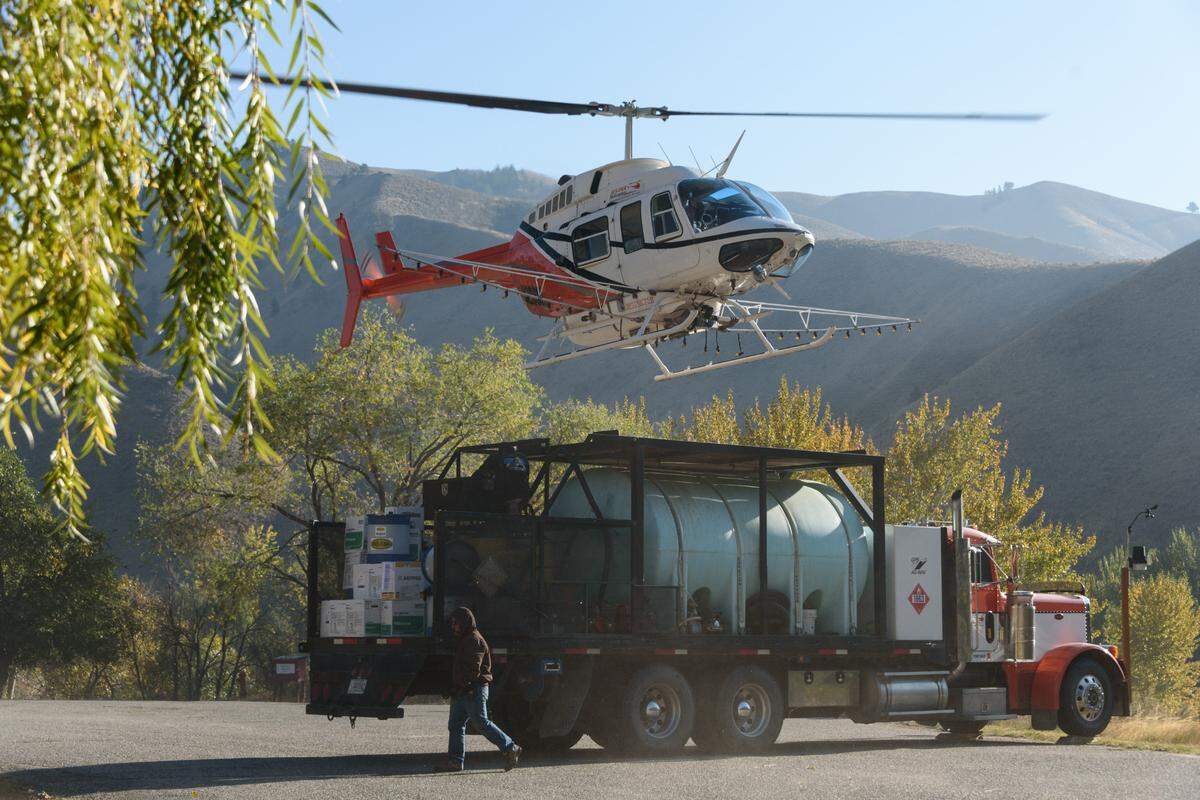
Several residents said they mistook the notice for a real estate sign or wildfire information and were unaware of the project until the helicopter began spraying. Sometimes the aircraft appeared to spray directly over their properties, which were supposed to be given a 300-foot buffer.
Hager, a former Army helicopter instructor pilot, said he first heard about the project in 2020 and immediately had concerns about aerial application on his property boundary with the Forest Service. He said the helicopter could cause the herbicides to drift beyond where the pilot initially sprayed it.
“(The boundary) is not a straight line and it’s in a canyon that’s got steep cliffs,” Hager told the Statesman. “How you would spray that and not have it drift was my initial concern.”
Hager said he was told he could have a buffer of 200 feet from his property line — 100 feet less than the minimum laid out in the Forest Service’s planning documents. He said he spoke with a Forest Service employee about helicopter application and his concerns with the buffer.
“She wouldn’t listen to anything I had to say about aerodynamics and how this was going to drift, and then she hung up on me,” Hager said.
A day after Schuler first saw the helicopter, he visited his dad, Dave, who also lives in Fourth of July Creek about 2 miles away. While at his father’s house, Schuler said, Forest Service employees arrived to ask if Dave would like a larger buffer than the required 300-foot minimum between his private property and the neighboring public land.
“I said, ‘I would’ve appreciated a visit to my house before you started spraying,’” Dan Schuler told the Statesman. “They said they didn’t know anybody lived back there.”
Schuler said he was also told that “resource constraints,” such as understaffing, prevented the agency from contacting all residents.
The next day, Schuler said, he saw the helicopter fly over the northeast corner of his property, and it appeared to be spraying. He said he watched the herbicides fall to the ground on his property and was taken aback that the pilot would be so close to his land when he’d asked for a larger buffer just a day before.
Schuler voiced his concerns to Salmon-Challis Forest Supervisor Chuck Mark in an email, and asked why no one had visited him in person. Other residents had complained to officials and commented on the agency’s Facebook post about the project saying they’d had no communication either. The Forest Service said it would start “a fact-finding effort” and later posted a Q&A on Facebook. The same document was sent to Schuler in response to his questions.
“After hearing concerns, we paused and took a hard look at our operations,” Deputy Forest Supervisor Heather DeGeest told Schuler in an email. “Specifically you’ll see lessons learned around private landowner outreach. We learned from this and will do better in the future.”
In its Q&A, the Forest Service said its pilot mistakenly landed on private property — where Schuler saw it refueling — due to a miscommunication. The agency said it apologized to the landowner for trespassing, but Schuler and others say that’s the only apology anyone has received over the situation.
“That would’ve made a difference,” Schuler said. “I understand mistakes are made.”
In the Q&A, officials also doubled down on assertions that the helicopter did not spray private land — a claim that was proven wrong several months later when the Idaho Department of Agriculture concluded its investigation.
“It can be difficult to see whether (or not) the helicopter is spraying at times — being able to see the herbicide as it is sprayed depends on time of day, lighting, and direction the helicopter is flying,” the Q&A document said. “People can think the helicopter is spraying if they can see the spray equipment. However, the helicopter could be flying to or from a unit and not actively be spraying.”
Schuler said he felt like his concerns were brushed off, even as GPS tracks from the helicopter appeared to show active spraying on the corner where he watched the aircraft fly over his property.
The Forest Service uses GPS technology to show where an aerial application aircraft has turned on its sprayer. Records from the Fourth of July Creek area showed small areas of overlap onto private property, as well as the absence of a buffer along some private property. Those GPS tracks also appeared to show that herbicides were sprayed less than 300 feet from a pond on Schuler’s property and a nearby spring. Water sources were supposed to have a 300-foot application buffer, according to the project planning documents.
Schuler is a Marine Corps veteran who was exposed to airborne hazards while serving in Afghanistan. He said he tries to be careful of exposure to potential pollutants.
“I spent years in Afghanistan inhaling burning medical waste and trash,” he said. “I shouldn’t be breathing pesticides or smoke or anything like that.”
Pesticides prompt health concerns despite safety
Alan Kolok, an ecotoxicology professor at the University of Idaho, recently published research showing a relationship between a pesticide called metam — which is considered a probable carcinogen — and cancer in humans. In a video interview, Kolok told the Statesman after reviewing Milestone and Plateau labels, he’s confident they don’t carry the same risks as the chemical in his previous research.
“(The two herbicides) are not going to kill anyone,” Kolok said. “They’re not going to give anyone cancer. They’re not going to create reproductive problems in a woman carrying a fetus, that kind of thing. They’re relatively benign, they’re relatively safe.”
That doesn’t mean people shouldn’t use “sensible” precautions around the herbicides, Kolok added. That includes avoiding areas that have recently been sprayed — something residents say the Forest Service didn’t warn them of — and contact with skin and eyes. Kolok said that’s likely to avoid temporary irritation to skin, eyes or respiratory systems from the still-wet chemicals.
Schuler lost much of his sense of smell and taste after being exposed to burn pits in Afghanistan — large garbage pits where U.S. troops would burn everything from plastic to medical waste, a practice that has since been linked to illness. For Schuler, sensible precautions around herbicides likely would’ve included avoiding the spray area altogether. While moving his irrigation equipment, he should’ve worn personal protective equipment if there was a chance he’d be exposed to the spray, according to the herbicide labels.
Schuler’s neighbor, Vietnam veteran Richard Harrison, left his home for the day when he heard about the spraying plans. Harrison, a cancer survivor who now uses an oxygen tank, was exposed to Agent Orange and other pollutants during the war. He said he has scar tissue in his throat from “running back into a burning helicopter” and has developed chronic obstructive pulmonary disease, an amalgamation of lung diseases that cause difficulty breathing.
“So I have a lot of issues with them spraying. I don’t want them spraying now because I don’t know if it will affect my breathing,” Harrison told the Statesman in a phone interview.
Despite assurances from the Forest Service on the safety of the herbicides, Fourth of July Creek residents said they still worry about longterm effects of the products. Many eat food grown on their own properties and threw away their produce last fall out of an abundance of caution.
“I’m fearful of anything they spray on us,” Harrison said. “If it’s man-made it’s going to kill us.”
Kolok said the public’s trust was broken after early herbicides and pesticides, like DDT and Agent Orange, were found to be toxic after previous statements to the contrary. These days, Kolok said, chemicals are much more targeted to specific pest or plant species, and they remain in the environment for far less time and don’t pose the same risk to humans. But many people, like Fourth of July Creek resident Richard Isley and his neighbors, have yet to be convinced that Milestone and Plateau are benign.
“That’s what they said about asbestos and Roundup,” Isley said in a phone interview. “Sometimes you don’t find these things out until years later.”
Schuler agreed.
“I’m a little skeptical because I’ve seen it firsthand,” he said. “For probably 10 years, I would receive emails from (Veterans Affairs) saying, ‘Our top scientists looked at these burn pit issues and there’s nothing to worry about.’”
Kolok said scientists and agencies like the Forest Service have to work hard to rebuild that trust.
“There are modern tools, including these second- and third-generation pesticides, and they’re valueless if people don’t trust you,” he said.
Kolok said other than irritation, the only other major concern with the herbicides is with Milestone’s ability to kill plants even after traveling through animal digestive systems. If, for example, a cow were to graze on grasses treated with Milestone, the herbicide would pass through the cow without harming the animal, but its manure would contain the active herbicide. Anyone using the manure to compost would likely end up killing their crops rather than fertilizing them.
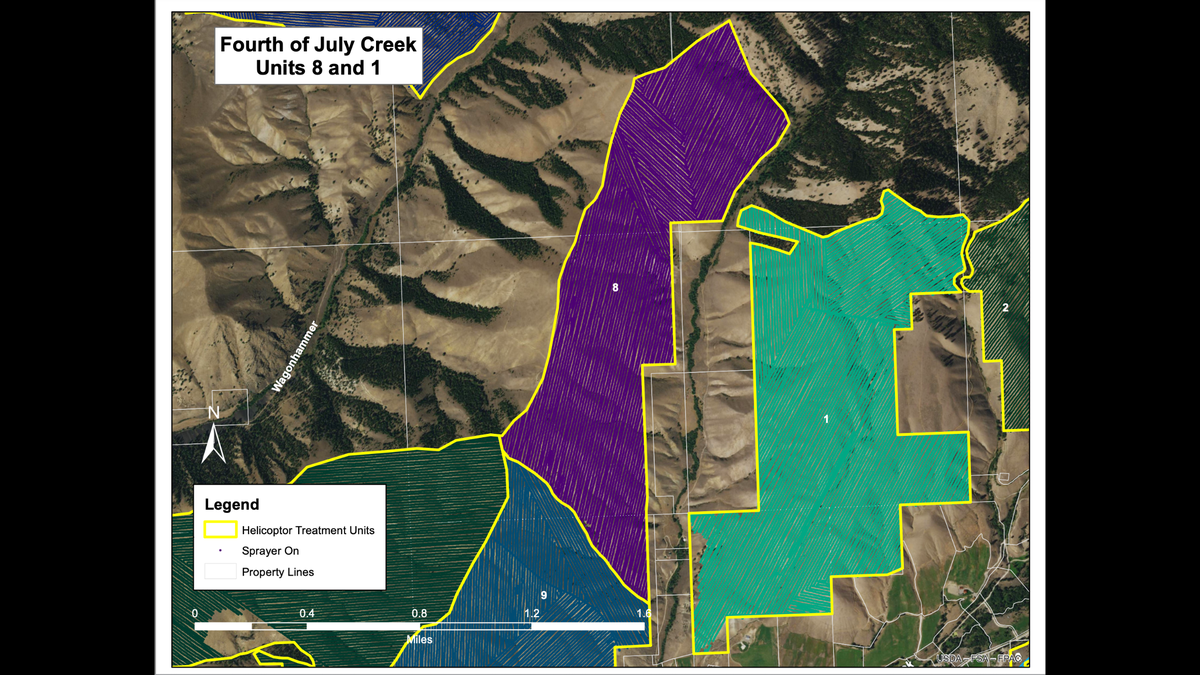
The Idaho State Department of Agriculture opened an investigation in October 2021 after receiving complaints from five residents — including Schuler and Hager — about spraying onto private property. Spraying pesticides or herbicides in a way that’s inconsistent with their labeling is a violation of Idaho state law. Labeling specifies the spraying should remain in a target treatment area and reduce the potential for drift.
The agency visited Fourth of July Creek, met with the residents and took samples of plant matter from each of the complainants’ properties. The samples were then tested for the presence of the Forest Service herbicides.
In March, the Department of Agriculture issued a warning to Andy Orr, the contractor helicopter pilot who sprayed the Fourth of July Creek area. The agency told him to “take corrective action” to avoid spraying herbicides in a manner that lets them drift outside of the target area. Orr did not respond to a request for comment.
The warning also included the lab results for the samples: Milestone and Plateau were detected on three private properties, including Hager’s. One of the properties was 1,300 feet from the targeted spray area and shares no borders with public land. Plateau was detected on one of two sample sites on Schuler’s property. Another private property owner’s jacket showed an “anomalous” amount of Milestone, far higher than even the concentration of herbicides on the targeted public land.
The Department of Agriculture concluded that “due to the anomalous and inconsistent results, the ISDA could not definitely state that human exposure occurred.”
The Statesman asked the Department of Agriculture how common its investigations are and how it decides which consequences to issue for pesticide violations. The agency didn’t respond.
Schuler said the results were bittersweet. He felt validated to have confirmation of the spraying he witnessed. But he was also disappointed to learn he’d been right.
“I didn’t want my property to have been sprayed,” he said. “I would’ve been perfectly glad and actually preferred the results come back negative.”
Spraying project to continue ‘for many years to come’
This summer, the Salmon-Challis National Forest put out notifications about its plans to spray herbicides near another drainage, called Tower Creek, just south of Fourth of July Creek Road. Another swath of privately owned parcels follows the road into the canyon, with Forest Service land around its edges. The agency also plans to spray near Kriley Gulch and North Fork.
Forest Service officials said they learned their lesson. This year, the agency held several in-person and virtual public meetings about the upcoming spraying. It sent out mailers and tried to ensure Tower Creek residents were aware that the spraying would take place between Sept. 26 and Nov. 4 as weather allows. Officials said during a virtual public meeting last week that drift cards — slips of paper placed before spraying to show where chemicals may have drifted outside their target area — showed very little drift, even last year.
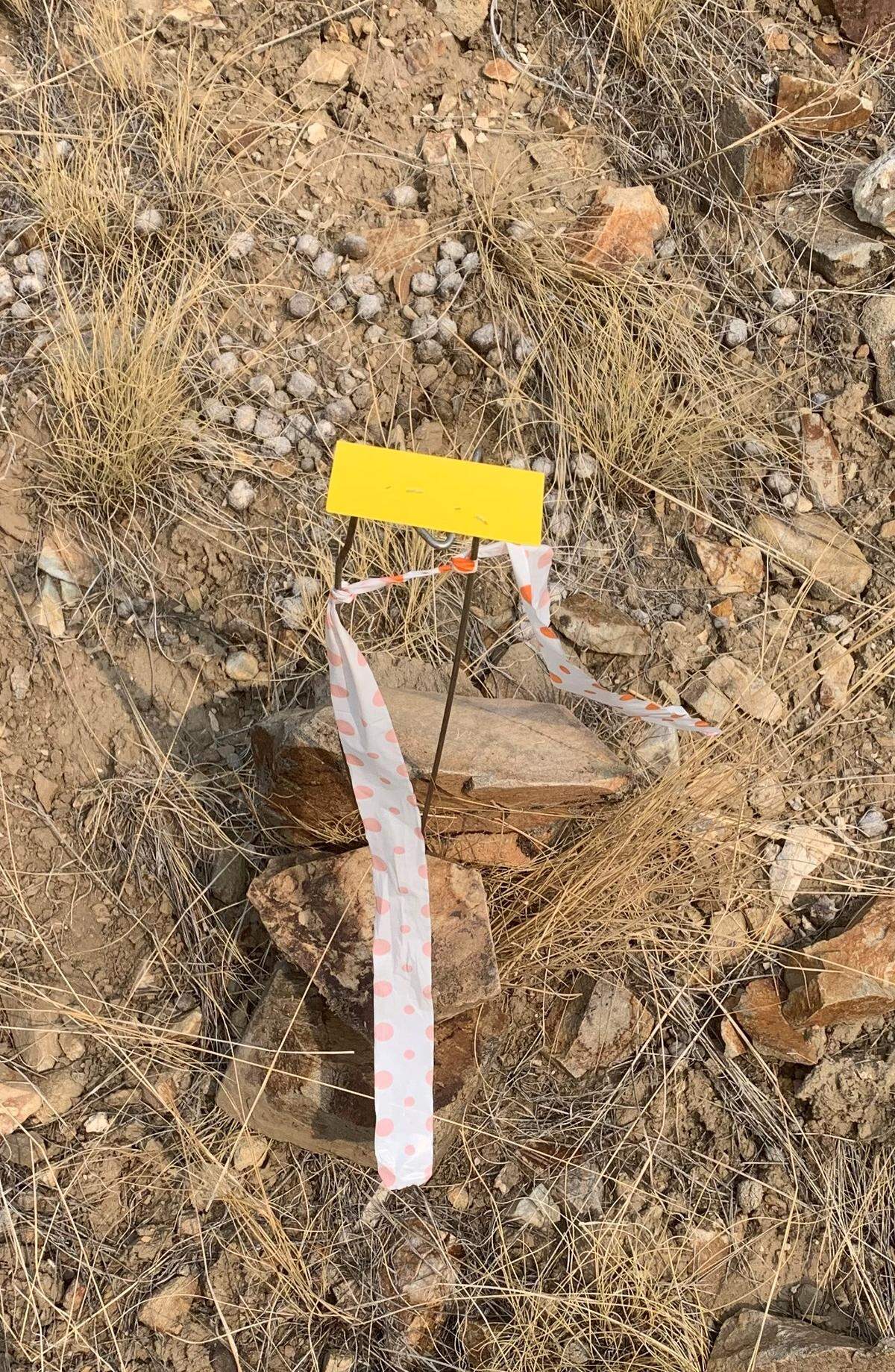
“There’s a lot of moving parts on these kinds of projects, and last year we had a couple minor mistakes,” said forest biologist Katie Baumann during the meeting. “We are working really hard to fix all of those.”
Baumann said the agency understands that residents are “skeptical of the unknown” when it comes to chemicals being sprayed near their properties. She said the Forest Service has tried to be transparent and reassure residents that the herbicides aren’t dangerous.
“There’s people in Fourth of July Creek that are making these complaints ... but they don’t engage with us,” Baumann said.
Not all of the residents in Fourth of July Creek are opposed to the spraying project. Patti Prugh and Don Bellamy both asked the Forest Service to eliminate any buffer along their properties so they’d see a reduction in invasive weeds, too. Bellamy said he’s noticing a real difference in the amount of noxious weeds on his land — something the Forest Service said it has seen on previously sprayed areas, too.
Even Schuler said he understands the need to use herbicides to tackle the invasive grasses, but he thinks the Forest Service needs to revisit its plans. DeGeest, the deputy forest supervisor, told the Statesman in an email that the project is expected to continue “for many years to come” as the Forest Service tries to exhaust the seed bank in the forest soil.
Schuler, Hager and other Fourth of July Creek residents are worried. Both men said they don’t see how the agency’s changes will prevent it from making the same mistakes again.
A year later, they feel like the Forest Service hasn’t even admitted it did anything wrong.
“My concern is they haven’t changed anything about the safety buffer,” Hager said. “They’re doing the exact thing over again. They don’t seem to care.”
This story was originally published October 6, 2022 at 4:00 AM with the headline "Forest Service sprays chemicals on Idaho private properties, spurs distrust."