Boise makes yet another Top 25 list, but don’t breathe easy: This is not a good one
Boise has cracked another Top 25 list.
This time, though, it’s not a list we want to be on.
Boise made the list of cities having the worst daily spikes in air pollution, according to the American Lung Association’s latest “State of the Air” report.
Most of our negative score comes from wildfires.
The report, released Thursday, compiles data reported to the U.S. Environmental Protection Agency for two main pollutants, ozone and fine particulate matter, over a three-year period. This year’s report looked at 2018-20.
The Lung Association then takes the data and calculates values reflecting the air pollution problem, assigning grades in three categories: daily spikes in particulate matter air pollution, long-term average particle pollution and daily measures of ozone.
The list that Boise joined is for daily spikes in particulate matter — a measurement, essentially, of the number of days that we’re in the “orange” or “red” category — or worse — for air quality.
Boise joined Salinas, San Luis Obispo and San Diego in California, as well as Bellingham, Washington, as newcomers to the list.
They replaced Missoula, Montana; El Centro and Santa Barbara, California; Lancaster, Pennsylvania; and Las Vegas, which all moved off the list of worst 25 cities for spikes in particulate matter.
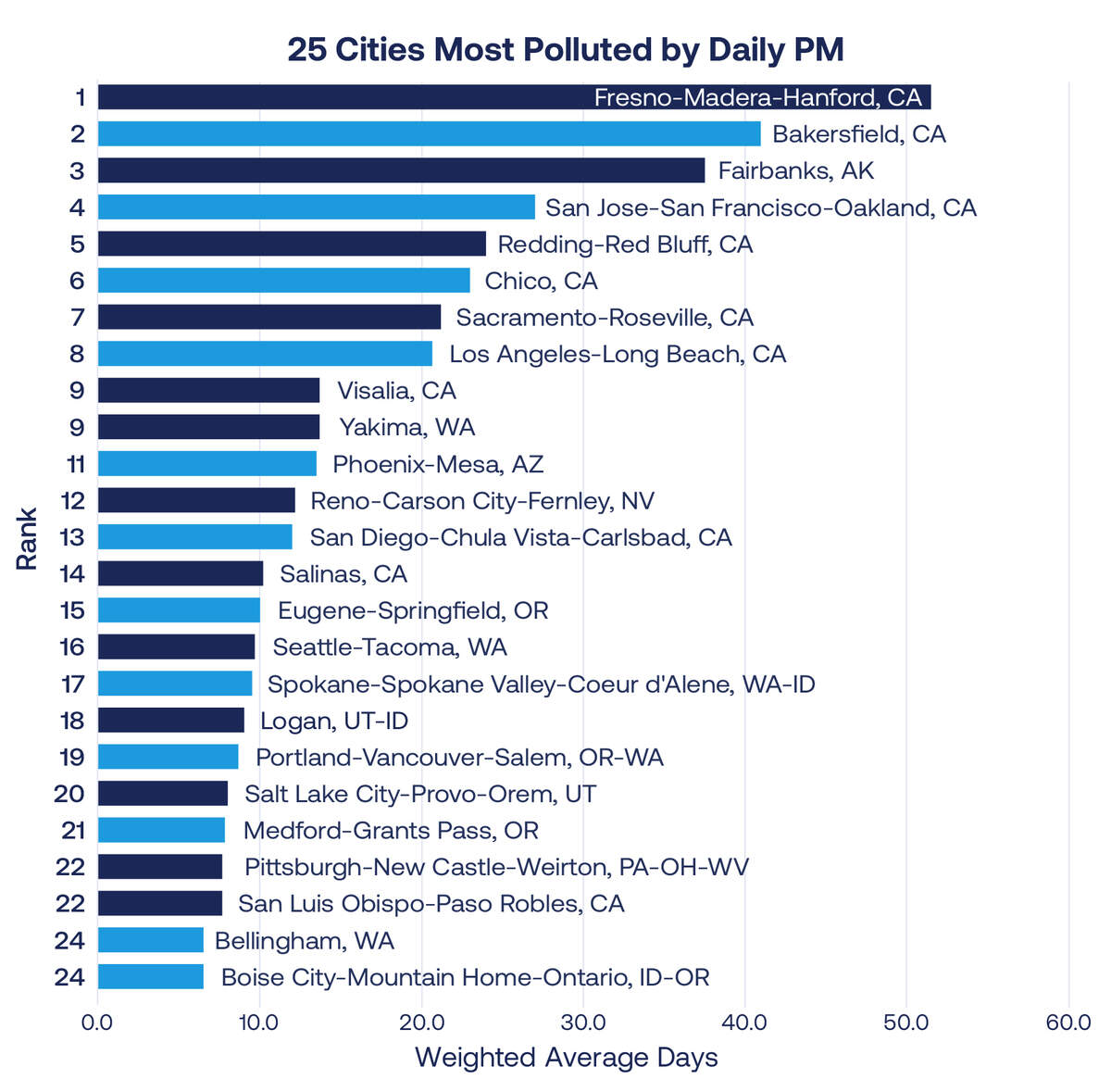
The report shows that the air pollution problem is moving west. On that list of 25 worst cities for short-term particle pollution, Pittsburgh is the only one not in the West.
Of the remaining 24 cities, 11 are in California, nine in the Pacific Northwest and four in the Southwest.
“This continues a shifting geographic trend driven in large part by the increasing number and size of wildfires resulting from climate change-induced heat and drought,” according to the report.
Wildfire smoke
Boise didn’t make the other two lists, for ozone and long-term particulate matter pollution, which makes sense.
Boise gets hit during wildfire season, when smoke from Idaho and other states settles in the Treasure Valley, hence the poor grades in daily spikes, not overall average pollution.
“If we exceed the standard for (fine particulate matter) in the summer, for the past 10 years or so I’ve been doing this, it’s always been due to wildfire smoke,” David Luft, air quality manager for the Idaho Department of Environmental Quality, said in a phone interview. “And the majority of wildfire smoke we’ve been getting in the Treasure Valley for the last few years has been smoke that’s come in from out of state.”
Luft points out that aside from wildfire smoke, Idaho is in good shape when it comes to its air quality.
“The Treasure Valley right now is in compliance with all those national ambient air quality standards,” Luft said. “So based on how the EPA mandates that, we calculated we’re complying with all the health-based standards.”
In fact, he said, pollution levels have been on the decline.
The State of the Air report backs that up.
Boise had fewer unhealthy days of high ozone in the 2022 report, giving us a “B” for ozone pollution. From the 2021 report to this year’s report, Boise improved from 53 most polluted city for ozone pollution to 117 in the 2022 report.
“The pollutants that they’re looking at in this report, fine particulate matter and ozone are the pollutants of concern for the Treasure Valley, and those have been trending down over the years,” Luft said. “When we don’t have wildfire smoke, our air is usually pretty darn good.”
Health effects
That’s not to say that wildfire smoke can be dismissed.
Of course, the American Lung Association has an interest in this, as air pollution, particularly the fine particulate matter, has negative health effects — for vulnerable individuals, including children; senior citizens; people who are pregnant; and people who have a history of asthma, chronic pulmonary obstruction disease, lung cancer or cardiovascular disease.
“Short-term spikes in particle pollution that last from a few hours to a few days can kill,” according to the report. “Premature deaths from breathing these particles can occur on the very day that particle levels are high, or up to a month or two afterward.”
The report estimates that fine particulate matter pollution is responsible for nearly 48,000 premature deaths in the United States every year.
“One of the things that I hope that people always take from this report is to care about your air, to understand your air, to make sure that during the wildfire season, you’re tracking the air quality,” said Carrie Nyssen, vice president of advocacy and air quality for the American Lung Association, said in a phone interview. “Just so people can do what’s best for their lungs, and for the lungs of their family.”
Staying indoors during bad air days, canceling outdoor sporting events, getting a non-ozone indoor air purifier, setting up community clean-air spaces, such as in the library, and looking out for vulnerable friends and family are important steps, Nyssen said.
Nationwide, the 2022 report found that more than 40% of Americans — over 137 million people — are living in places with failing grades for unhealthy levels of particle pollution or of ozone. This is 2.1 million more people breathing unhealthy air compared to last year’s report.
The report notes that since the State of the Air report first began in 2000, emissions from transportation, power plants and manufacturing have been reduced due to the federal Clean Air Act.
“In recent years, however, the findings of the report have added to the evidence that a changing climate is making it harder to protect human health,” according to the report. “The three years covered by (the 2022 report) ranked among the seven hottest years on record globally. Spikes in particle pollution and high ozone days related to wildfires and extreme heat are putting millions more people at risk and adding challenges to the work that states and cities are doing across the nation to clean up air pollution.”
This story was originally published April 21, 2022 at 4:00 AM with the headline "Boise makes yet another Top 25 list, but don’t breathe easy: This is not a good one."