
Olympic gold medalist Kaitlyn Farrington focuses on what's next after unexpected retirement
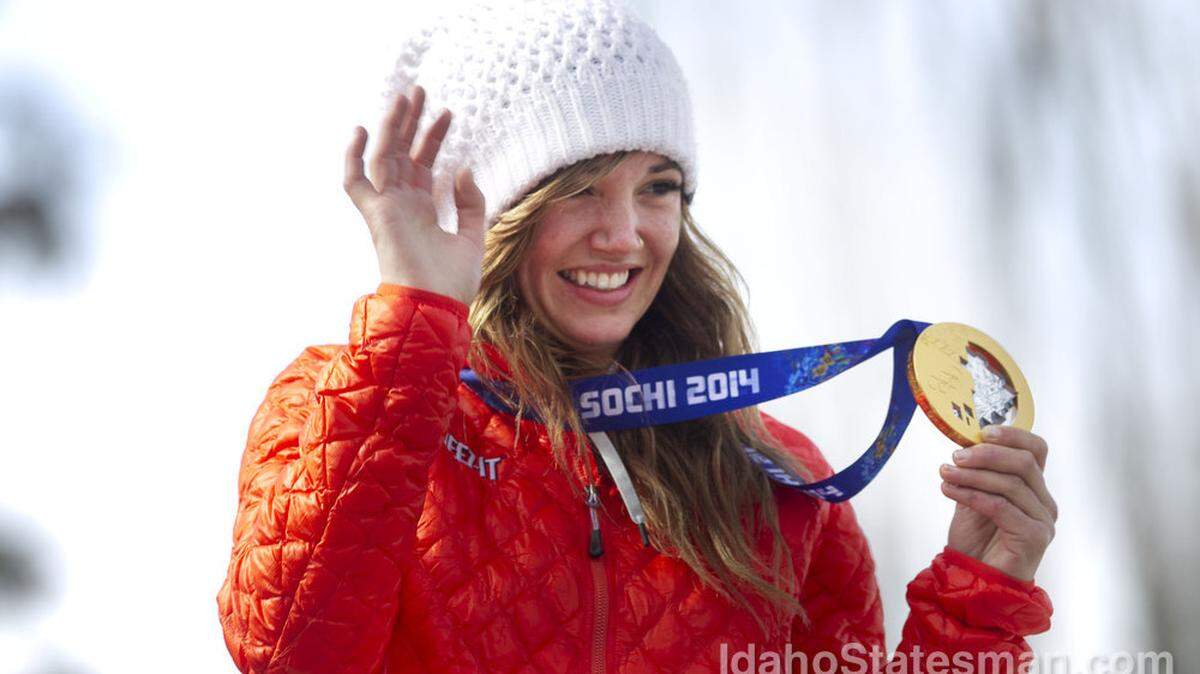
Olympic gold medalist Kaitlyn Farrington has accepted her forced retirement from the snowboard halfpipe, announced last week. Now she's dealing with the second part of the unexpected news.
"The hardest part is just figuring out what's next," Farrington told the Statesman on Monday.
Farrington hopes to remain part of the snowboarding industry. She can't perform any aerial tricks, which rules out competing in events such as the halfpipe or slopestyle. She could race but isn't interested in that type of snowboarding.
For now, she plans to do some "adventure snowboarding" and try some non-competitive roles at snowboard events. She'll hand out medals at the X Games on Saturday and do some announcing or interviewing later this winter.
Farrington, 25, was diagnosed with congenital cervical stenosis (narrowing of the spine) in November - nine months after she won gold in Sochi. She grew up in Bellevue and lives in Salt Lake City.
The diagnosis was confirmed by three more doctors before she made the public announcement Thursday. It's a condition she's had since birth without her knowledge.
"The last few days have been crazy, but it's been really nice because I'd been holding this in for so long," Farrington said. "It's finally out there. I've gotten a lot of love and a lot of positive vibes. It's been really nice to know there's a lot of support still out there for me, and I know a lot of people are still behind me, whatever I do next."
Here are some other highlights from our conversation with Farrington, who will be in Sun Valley next week for a Rainforest Action Network event.
Q: Will it be difficult to watch the X Games this week?
A: I think it's going to be a really emotional X Games, going to see all of my friends I've competed with for so many years. It will be crazy not competing and knowing I'll never compete again.
Q: How tight was the group you talked to about your condition?
A: I kept it pretty close. I only told basically my parents when I first found out. ... It was something totally unexpected. I didn't really know what to expect because I didn't really know anything about stenosis. It was just too hard. It was too hard to explain to people what I had.
Q: What was your reaction to the diagnosis?
A: The first doctor I went and saw told me the worst possible news ever. I sent him away, out of the office, bawling. I pretty much told him to (take off). I never went and saw him again. I wasn't ready to hear what he told me at that time. I've talked to him since and said: 'Sorry. I wasn't ready.'
Q: When did the diagnosis click for you?
A: (U.S. Snowboard team physician Tom Hackett) is a doctor I worked with for years. I know him really well. I thought, 'Wow, he wouldn't be lying to me.' He put screws through my wrist (in the past), made everything possible for me to be on the mountain. I knew when he said it, it was a more serious thing. I was getting a lot of requests for this January, before X Games. It was time to just tell people because I was lying to everybody for the past two months. It was getting hard because it was making me believe I was going to be back competing again.
Q: Had you ever had an MRI on your back or neck before?
A: I never had X-rays or an MRI on my back or neck, so nobody would have seen this before.
Q: What do you think the future holds for you?
A: I think my future will be in powder, riding - adventure snowboarding, I call it. A lot more touring, just trying to ride some powder. Doctors say I can't put myself in a position where I could tomahawk down a mountain 20 times. I'm just figuring out how far my limit is. No jumps or cliffs in the backcountry, but I can still make turns - that's what's important. ... All of my sponsors have been so supportive. It wasn't like somebody just dropped me because of the condition I have. They're waiting to see what I can do.
Q: It seems like TV work would be a natural for you.
A: Yeah, that's what I'm kind of going for. I'd love to get involved in TV. I don't want to leave this sport. That's why I'm still trying to figure out how far I can take snowboarding. That would be something to keep me around my friends. I've got a pretty bubbly personality. I think TV could be a good thing for me.
Q: How is your health?
A: In a couple months I go get another MRI on my neck to make sure things are healing OK because there was talk of a surgery maybe. I don't have any pain. I've just been snowboarding. I text my doctors: 'Can I go bungee-jumping? Can I skydive? Can I go rock climbing or bouldering?' Those are questions that are important for me to ask. ... I get a little bit sore after a couple days of riding and my back gets tight. I have no pain, no problems. That's the hardest part, I think - I don't feel anything different but I know I have to be careful.
Q: You went snowboarding the day after the accident in Austria?
A: Yes. I woke up the next day and it was a powder day. I thought, 'Wow, I'm not that sore.' I thought I wasn't going to be able to get out of bed.
Q: The lack of feeling in your shoulders is from the crash in Austria?
A: Yes. From losing all feeling throughout my body. It's a sign of stenosis. When I got up, I had this really, really gnarly burning sensation in my shoulders - both of them. ... My shoulders feel like my hand does. I've had so many surgeries on my wrist that I just have this weird numbness.
Q: Will your shoulders improve?
A: They hope it will go away. It's been months now. ... I'm used to it.
Q: Given what has happened since, how much does that gold medal mean to you?
A: It's just one of those things - 'Well, Kaitlyn, at least you went out on top.' It's just crazy. It's something I dreamed of my whole life - every child's dream, go to the Olympics and win an Olympic gold medal. Mine became reality. And all in one year I had it stripped away from me, pretty much. Everything changed. I went from the beginning of the year becoming an Olympic gold medalist to the end of the year having to retire. It's been such a wild year. I'm just kind of baffled. I don't know what to think and I don't know what's going to come next because everything changed so fast.
Chadd Cripe: 377-6398, Twitter: @IDS_BroncoBeat
This story was originally published January 19, 2015 at 10:09 AM with the headline "Olympic gold medalist Kaitlyn Farrington focuses on what's next after unexpected retirement."